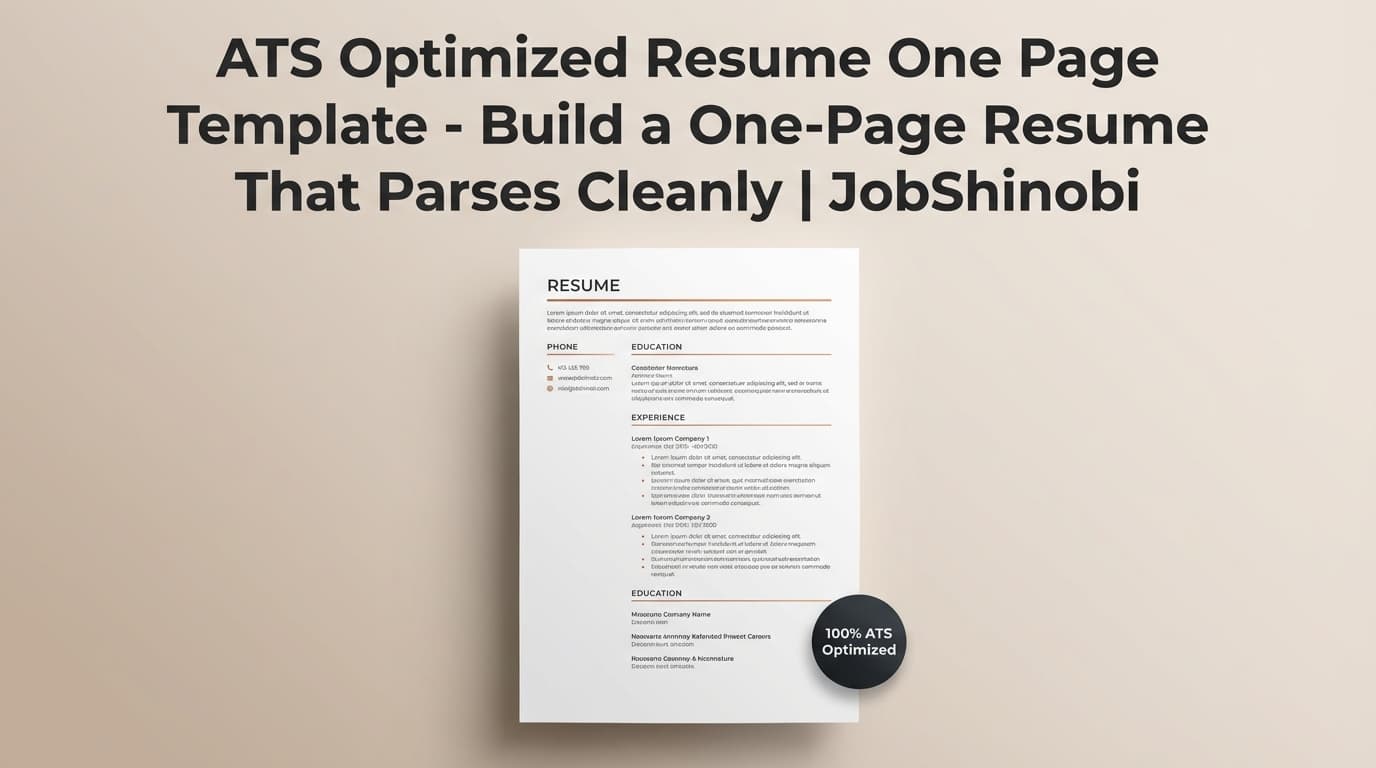
If you’re searching for an ats optimized resume one page template, you’re not just looking for a “nice layout.” You’re trying to solve three real problems at once:
- Stay one page (without shrinking everything into unreadable text)
- Keep the structure ATS-parseable (so your experience and skills don’t get scrambled)
- Match the job’s keywords (so you don’t get filtered out before a human sees you)
JobShinobi is built for exactly that workflow. Instead of downloading a static template and guessing, you can:
- Start from a LaTeX resume template
- Edit it in a LaTeX editor
- Generate a live PDF preview via compilation
- Run AI resume analysis that includes an ATS score plus keyword and formatting feedback
- Paste a job description (or job URL) and run resume-to-job matching to find missing keywords and tailoring recommendations
- Use a streaming AI Resume Agent to tighten, rewrite, and tailor—while keeping the resume compilable
- Save versions so you can keep separate one-page variants for different roles
Get started: /login
Why choose JobShinobi for an ATS optimized resume one page template?
Most “ATS one-page template” pages rank by offering downloads (Word, Google Docs, PDF) and broad advice. That’s helpful… until you realize ATS optimization is not a one-time formatting choice. It’s a loop:
Template → Tailor → Score → Improve → Export → Repeat (for the next job)
JobShinobi supports that loop with features that are specific and measurable inside the product—not generic resume advice.
LaTeX-first resume building (structure you can control)
JobShinobi resumes are stored with their LaTeX source (latex_source). That means your resume is based on explicit structure (sections, headings, bullet lists), not fragile drag-and-drop elements.
Why that matters for ATS + one-page constraints:
- You can keep a clean, consistent hierarchy (Experience, Skills, Education)
- You can tighten content without breaking layout unexpectedly
- You can avoid common ATS hazards that show up in “designed” templates (layout tricks, complicated elements, unpredictable text flow)
Live PDF preview via compilation (know it’s one page before you export)
A one-page resume is a hard constraint. JobShinobi compiles your LaTeX and shows the PDF output, so you can verify:
- The resume is actually one page
- Spacing, line breaks, and section lengths look right
- No “oops, the last bullet pushed Education to page 2” surprises
Resume analysis that includes ATS + keyword + formatting scores
Inside the editor, JobShinobi can generate a resume analysis report with an overall score and category scores including:
- ATS score
- Keyword score
- Formatting score
- Content score
- Completeness score
You also get structured feedback like strengths, weaknesses, ATS issues, and keyword analysis (present/missing/overused keywords, keyword density, and more—where available in the analysis output).
Resume-to-job matching (turn your template into a job-specific one-page resume)
A template alone doesn’t get you interviews. Relevance does.
JobShinobi supports job matching where you provide job data (from a job description or extracted job details), and the system generates:
- A match score
- Present keywords vs missing keywords
- Tailoring recommendations/suggestions you can implement
Streaming AI Resume Agent for fast edits (without breaking compilation)
JobShinobi includes a streaming AI editing workflow designed around resume editing tools (update sections, update resume content, compile checks). This is ideal for one-page resumes because you can repeatedly request:
- “Tighten these bullets to fit one page”
- “Rewrite this experience section to emphasize X”
- “Add missing keywords naturally (no stuffing)”
- “Improve impact and clarity without adding length”
…and then confirm your LaTeX still compiles into a clean one-page PDF.
What “ATS optimized” means for a one-page resume (and what usually breaks parsing)
The term “ATS optimized” is often oversimplified. Most ATS success comes from two big forces:
- Parsing reliability (can the system correctly extract your content?)
- Keyword relevance (does your resume contain what the employer filters for?)
A one-page resume can help—but only if you avoid the formatting traps that people use to cram content.
Parsing reliability: keep the structure linear and predictable
Common issues that can reduce parsing quality:
- Multi-column layouts (content can be read out of order)
- Tables/text boxes used as layout containers
- Icons replacing text labels (e.g., phone/email icons instead of “Phone:”)
- Non-standard headings that ATS may not recognize as sections
The safest structure is typically a clean, single-column layout with clear headings.
JobShinobi’s LaTeX workflow makes it easier to keep this structure intentional—because you’re working with explicit sectioning and consistent formatting rather than moving blocks around visually.
Keyword relevance: “ATS-friendly” is not “ATS-optimized”
Many pages sell “ATS-friendly templates.” But ATS-friendly formatting doesn’t guarantee you match the role.
True ATS optimization includes:
- Using the job’s exact skill/tool language where it’s truthful and relevant
- Aligning your experience bullets with the job’s responsibilities
- Including the role’s core keywords in the sections ATS typically parses (Skills + Experience)
JobShinobi supports resume-to-job matching so you can see what you’re missing and tailor quickly.
One page: compress by prioritizing, not by hiding
A one-page resume often fails because candidates compress by:
- Shrinking font size too far
- Reducing margins excessively
- Overloading a skills section with keyword lists
- Cramming multiple roles/projects into dense, unreadable blocks
Better compression is editorial:
- Remove low-signal bullets
- Rewrite for impact and brevity
- Focus on role-relevant projects/skills
- Replace vague bullets with tight, measurable outcomes
JobShinobi helps you do this with analysis signals and AI editing—then confirms the result via PDF preview.
How JobShinobi’s ATS optimized resume one page template workflow works
This section mirrors the real product flow: templates → editor → compile preview → analyze → match job → iterate.
Step 1: Start from a template (Resume Templates library)
Open JobShinobi’s resume area and choose Start from Template. This loads a LaTeX template from the template library and takes you into the editor.
- Templates are retrieved from JobShinobi’s template system
- Your resume begins as LaTeX content that you can edit and save
Go to templates: /dashboard/resume
Step 2: Edit your one-page resume in the LaTeX editor
In the resume editor, you can directly edit the LaTeX source.
This is where one-page success is actually built. The template gives you structure, but you’ll tailor:
- Section ordering
- Bullet length and density
- Skills list relevance
- Summary (if you use one) to be concise and keyword-aligned
Open the editor: /dashboard/resume/editor
Step 3: Compile to PDF and confirm it’s truly one page
Compile your resume to generate a PDF preview. Use the preview to check:
- Does it stay one page?
- Did a line break push content to page 2?
- Are headings clear and scannable?
- Does spacing look intentional (not cramped)?
Because compilation generates the same style consistently, you can iterate reliably.
Step 4: Run AI resume analysis (includes ATS score)
Run analysis and review:
- Overall score (/100)
- ATS score
- Keyword score
- Formatting score
- Content and completeness signals
- Strengths/weaknesses and recommendations
- Keyword findings (keywords found vs missing keywords, where included)
This turns “ATS optimization” from guesswork into a repeatable improvement process.
Step 5: Match your resume to a job description (or job URL)
To optimize your resume for a real role, add job information and run matching.
Job matching outputs include:
- A match score
- Missing keywords vs present keywords
- Tailoring recommendations and structured “tailored suggestions” (e.g., added/removed keywords and section ordering suggestions where provided)
This is the step that converts “a one-page template” into “a one-page submission for this job.”
Step 6: Tighten and tailor with the streaming AI Resume Agent
Use AI mode to request edits that are perfect for the one-page constraint:
- Shorten bullets while keeping the outcome
- Improve impact verbs and specificity
- Rebalance skills vs experience emphasis
- Reduce redundancy and filler phrases
- Add role keywords naturally (no keyword stuffing)
Because JobShinobi’s AI workflow is integrated with resume editing and compilation checking, it’s designed for iterative improvement—especially when you need to keep formatting stable.
Step 7: Save versions so you can tailor faster next time
When you have a strong one-page baseline, save it. When you tailor for a specific job, save again.
This creates a repeatable library of one-page variants, such as:
- “Data Analyst — One Page (General)”
- “Data Analyst — One Page (Healthcare)”
- “Backend Engineer — One Page (API/Scale)”
JobShinobi supports resume versioning so you can revert and keep a clean history as you iterate.
Key features for an ATS optimized resume one page template
| Feature | What it does in JobShinobi | Why it matters for one-page ATS optimization |
|---|---|---|
| Resume templates library | Lets you start from a template instead of a blank page | Faster setup + more consistent structure |
| LaTeX resume editor | Edit your resume as LaTeX source (latex_source) |
Precise structure control; easier to keep linear ATS-friendly formatting |
| PDF preview via compilation | Compiles LaTeX into a PDF preview | Verify it’s truly one page before exporting |
| Export options | Download PDF and .tex source | Professional output + portable source |
| AI resume analysis (ATS score included) | Produces scored analysis + structured feedback | Iterate based on signals (ATS/keywords/formatting), not opinions |
| Enhanced analysis mode (optional) | Supports deeper analysis outputs when enabled | More actionable, structured improvement paths (when present) |
| Resume-to-job matching | Match score + missing/present keywords + suggestions | Tailor fast to real postings |
| Streaming AI Resume Agent | Chat-based editing workflow for your resume | Tighten + tailor quickly while keeping the resume compilable |
| Resume version history | Persist changes over time | Revert safely; maintain multiple one-page variants |
The practical one-page ATS optimization checklist (that works across roles)
If you want a reliable way to build a one-page resume that is ATS-friendly and job-relevant, use this checklist inside JobShinobi.
1) Choose your target role (so you’re not optimizing in a vacuum)
Before you tailor, define:
- Target role title (e.g., “Backend Engineer”, “Data Analyst”, “Project Manager”)
- Seniority (junior/mid/senior)
- The 5–10 “must-have” keywords for that role (tools, skills, methods)
If you don’t choose a target, you’ll cram in everything you’ve ever done—and one page becomes impossible.
2) Keep a simple, ATS-friendly structure (even if you’re using a “modern” template)
For most job seekers, a one-page ATS-safe structure looks like:
- Header (Name + email + phone + location + LinkedIn/GitHub)
- Skills (relevant and structured; not a keyword dump)
- Experience (2–4 roles, role-dependent)
- Education
- Optional: Projects or Certifications (if they strengthen the target role)
Avoid “creative” headings that could confuse parsing.
3) Compress bullets the right way: “impact-first” + measurable outcomes
Instead of writing long responsibilities, use tight bullets:
- Start with a strong verb
- Include scope/tools where helpful
- End with outcome (ideally measurable)
Examples (generic examples you can adapt):
- “Reduced API latency by 35% by optimizing PostgreSQL queries and introducing caching.”
- “Automated monthly reporting in Python, cutting manual analysis time by 40%.”
If your bullets run long, JobShinobi’s AI editor can help rewrite them shorter while preserving meaning.
4) Run resume analysis and fix the biggest constraints first
Don’t try to perfect everything at once. Use a priority order:
- Formatting/ATS issues (parsing risk)
- Missing keywords (relevance)
- Weak bullets (impact)
- Completeness/sections (coverage)
- Fine-tuning style and readability
JobShinobi’s analysis outputs are designed to provide structured signals you can act on.
5) Match to the job description and tailor only what matters
When you paste a job description (or job URL → extracted job details), focus your one-page edits on:
- Skills section (align to the role’s toolchain)
- 2–4 bullets (rewrite to mirror the posting’s priorities)
- One line summary (optional) aligned to the target role
Then re-run analysis and re-check the PDF preview.
6) Save a “role family” one-page baseline
Once you have a strong baseline for a role family, keep it as your master. Tailoring becomes far faster because you’re starting close to the target instead of reinventing your resume each time.
ATS optimized resume one page template vs. common alternatives
You’ll see many options in search results. Here’s how they differ in what they actually help you do.
Downloadable Word/Google Docs templates
What they do well
- Quick to start
- Familiar editing experience
Where they fall short for “ATS optimized + one page”
- Many templates are not built for iterative tailoring (you still have to find missing keywords manually)
- You often don’t get a structured ATS/keyword score loop
- Editing can cause formatting drift (especially when trimming to one page)
Template libraries with generic ATS advice
What they do well
- Teach basics (avoid columns/tables, use standard headings)
Where they fall short
- Advice doesn’t tell you what to change in your resume for this job
- People still get stuck guessing which keywords matter most
JobShinobi (template + analysis + job matching + AI edits + PDF preview)
What JobShinobi does well
- Start from a template, then iterate
- Validate with ATS score + keyword and formatting feedback
- Tailor using resume-to-job match (missing/present keywords)
- Keep it one page by checking PDF preview
- Maintain separate one-page variants with versioning
Best fit
- Job seekers applying to multiple roles who need fast tailoring without losing structure control.
Why many “ATS one-page templates” still fail in real applications
Even if you choose a simple single-column template, a one-page resume can underperform for reasons that have nothing to do with the template itself:
Failure mode 1: Keyword mismatch (you’re not showing up in filters)
Your resume can be perfectly formatted and still miss the employer’s search terms. JobShinobi’s job matching is built to highlight missing keywords so you can address them.
Failure mode 2: Vague experience bullets (low signal for both ATS and humans)
ATS doesn’t “understand” your value the way a recruiter does; it indexes words and sections. Recruiters then skim quickly. Tight, specific bullets improve both.
JobShinobi’s analysis can surface weaknesses and recommendations so you can rewrite with purpose.
Failure mode 3: Overstuffed skills sections (keyword stuffing that reads poorly)
Adding every keyword you can think of can backfire with humans, and it can also dilute the signal of your true strengths.
A better approach:
- Keep skills structured (Languages, Frameworks, Tools, Methods)
- Prioritize what the job actually asks for
- Reinforce those keywords in experience bullets (where you prove them)
Failure mode 4: You tailor the wrong parts
Many people tailor by rewriting the summary repeatedly and barely touching experience bullets.
A high-impact tailoring approach usually changes:
- Skills section alignment
- 2–4 bullets that match the role’s priorities
- Project selection (if included)
Example: how to compress a two-page resume into one page (without wrecking ATS readability)
If you’re starting from a longer resume, here’s a clean compression strategy you can apply in JobShinobi.
Step A: Reduce low-signal bullets
Pick your top 2–4 bullets per role that show:
- Most relevant skills to the target role
- Strongest measurable outcomes
- Most recent/high-impact work
Remove “supporting” bullets that repeat the same theme.
Step B: Tighten bullet language
Common edits that shorten without losing meaning:
- Remove filler openings (“Responsible for…”, “Worked on…”)
- Replace long phrases with tighter equivalents (“utilized” → “used”)
- Remove redundant context already implied by the role title
- Combine “what + why” into one line
Step C: Shrink the “everything” section
Common “space leaks”:
- Overlong summaries
- Exhaustive coursework lists
- Too many projects (especially old ones)
- Skills lists that are long but not role-specific
A one-page resume is a prioritization document. Keep what helps you get this interview.
Step D: Re-check the PDF preview
Every compression change can shift layout. Preview is how you ensure you didn’t solve “one page” by accidentally making the layout cramped and hard to scan.
Where JobShinobi fits if you’re also applying at high volume
If you’re applying to many jobs, you’re not only editing your resume—you’re also managing process. JobShinobi includes a job application tracker where you can:
- Track job applications in a dashboard
- See realtime updates in the tracker
- Export job applications to Excel (.xlsx)
Job tracker: /dashboard/job-tracker
Note: JobShinobi also supports email-based job application ingestion and updates via forwarded emails, but inbound email processing is gated to Pro membership.
Pricing
JobShinobi offers paid subscriptions via Stripe:
- Monthly: $20.00
- Yearly: $199.99
If your main goal is building and tailoring a one-page ATS-optimized resume, the value comes from the repeatable workflow:
- Templates → editor → PDF preview
- Resume analysis (including ATS score + keyword/formatting feedback)
- Job description matching → missing keywords → targeted edits
- Versioning so you can tailor repeatedly without losing your best baseline
Frequently asked questions
Is a single-column one-page resume better for ATS?
Often, yes—because a single-column layout is simpler for parsing and easier for recruiters to scan. The bigger point is not “single column vs two column,” it’s parsing reliability and clear section structure.
JobShinobi helps you keep a clean structure (LaTeX-based resume format) and validate improvements through resume analysis (including ATS score) plus PDF preview.
Can ATS read columns, tables, or text boxes?
Many ATS systems can struggle with content that’s placed in tables, columns, or text boxes—especially if the layout causes reading order issues. If your goal is reliability, it’s typically safer to keep the structure linear and simple.
Does JobShinobi provide an ATS optimized resume one page template I can download?
JobShinobi provides a templates library you can start from, then edit and tailor inside the LaTeX editor. From there, you can export:
- PDF, and
- .tex (LaTeX source)
Rather than relying on a single static download, JobShinobi is built around an optimization loop: template → tailor → score → improve → export.
How does JobShinobi help me tailor my one-page resume to a job description?
JobShinobi supports resume-to-job matching. When you provide job details (from a job description or extracted job data), JobShinobi can generate:
- Match score
- Present vs missing keywords
- Tailoring recommendations
This is one of the fastest ways to adapt a one-page resume without guesswork.
What scores does JobShinobi provide in resume analysis?
JobShinobi’s resume analysis provides an overall score and category scores including:
- Content score
- Keyword score
- Formatting score
- Completeness score
- ATS score
It also returns structured feedback such as strengths, weaknesses, ATS issues, and keyword analysis (as included in the analysis output).
Can JobShinobi help me keep my resume to one page?
Yes—because you can:
- Edit the LaTeX source directly (tight control)
- Use AI editing to shorten and improve bullets
- Compile to PDF and verify it’s one page before exporting
JobShinobi doesn’t “magically” guarantee one page for every background, but it gives you the tools to reliably iterate toward that goal.
Is JobShinobi a Word/Google Docs resume template tool?
No. JobShinobi is LaTeX-based. You edit LaTeX, compile to PDF, and download the PDF and .tex source. If you want a structured, consistent workflow with PDF preview and optimization feedback, that’s what JobShinobi is designed for.
Get started with JobShinobi today
Stop guessing whether your one-page resume is “ATS optimized.” Start from a template, tailor to the job, validate with ATS + keyword scoring, and export a clean one-page PDF.
- Sign in: /login
- Start from a template: /dashboard/resume
- Open the editor: /dashboard/resume/editor