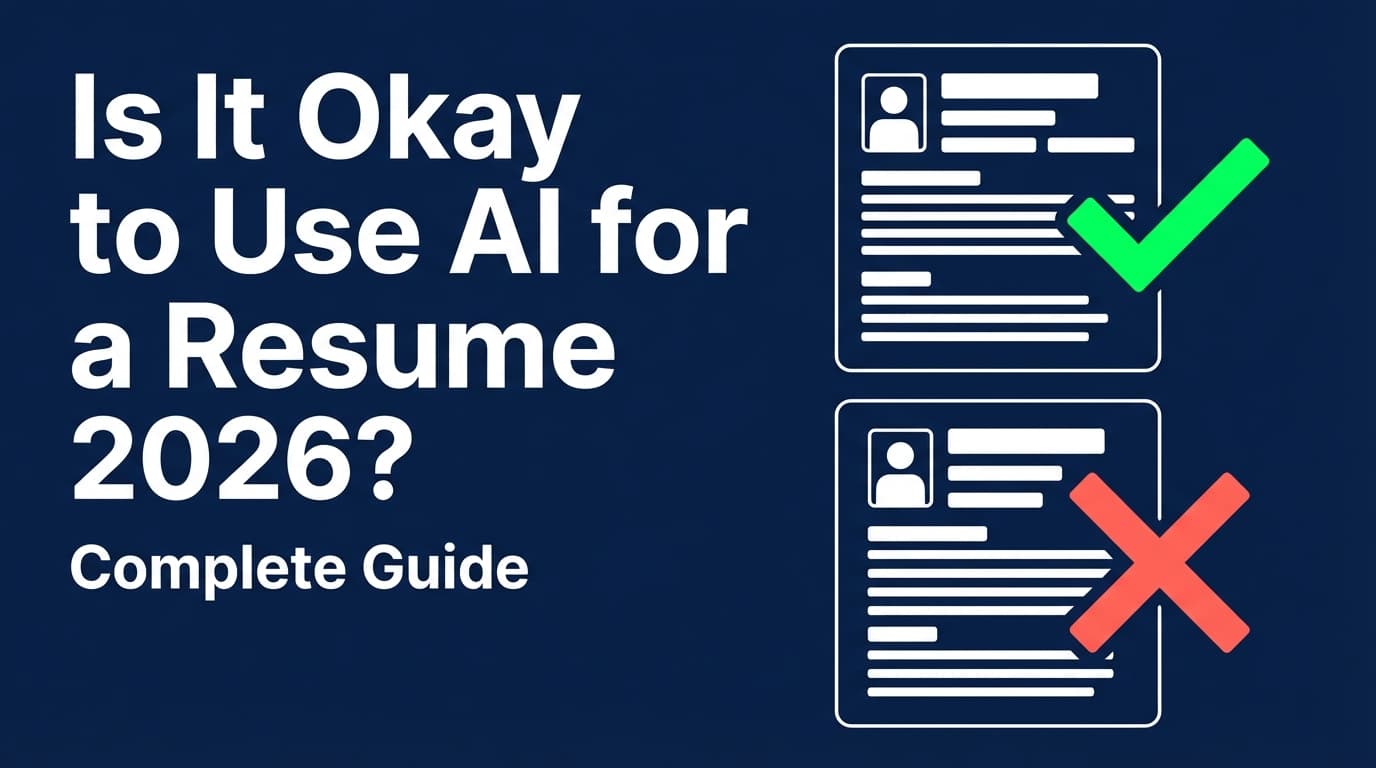
In 2026, it’s not whether AI is involved in hiring—it’s where and how much. The bigger question for job seekers is: is it okay to use AI for a resume in 2026 without getting rejected for sounding generic or “too AI”?
One reason this question keeps coming up: AI usage is now mainstream on both sides of the market.
- 45% of job seekers said they’ve used generative AI to build, update, or improve their resumes (Canva survey of 5,000 people). (Source: Canva newsroom) (Confidence: High — primary source)
https://www.canva.com/newsroom/news/new-job-canva/ - Around 88% of companies already use AI for initial candidate screening, according to the World Economic Forum. (Source: WEF) (Confidence: Medium–High — credible org, widely cited)
https://www.weforum.org/stories/2025/03/ai-hiring-human-touch-recruitment/
So yes—it’s generally okay to use AI on your resume in 2026. But there are clear “right ways” and “wrong ways” to do it.
In this guide, you’ll learn:
- When AI help is ethical vs. risky (and what crosses the line)
- A step-by-step workflow to use AI without sounding generic
- ATS-friendly formatting rules (so your resume parses correctly)
- The biggest mistakes that trigger recruiter skepticism
- Prompts + examples you can copy/paste
- Tools that help (including when a dedicated resume tool beats a generic chatbot)
What does “using AI for a resume” actually mean?
“Using AI for a resume” can describe very different behaviors:
AI use that’s usually fine (and common)
- Rewriting bullets you already wrote to be clearer and more impact-focused
- Turning messy notes into structured bullet points
- Finding missing keywords from a job description
- Fixing grammar, tone, and repetition
- Formatting guidance for ATS readability
AI use that’s risky (and can backfire)
- Letting AI invent accomplishments, metrics, job titles, or tools
- Submitting a resume that reads like a template (“results-driven professional…” everywhere)
- Keyword stuffing or “white font” tricks to game ATS
- Copy/pasting without review (errors, contradictions, wrong dates)
A useful standard: AI can help you communicate what you did—AI can’t decide what you did.
Why this matters more in 2026 (not less)
1) Hiring teams are flooded with polished, similar-looking resumes
AI makes it easy for many candidates to produce “clean” language. That raises the bar: to stand out, your resume needs evidence, specificity, and relevance—not just fluent writing.
2) Some hiring managers are skeptical of AI-generated applications
One widely cited data point:
- A resume.io study reports 49% of hiring managers automatically dismiss AI-generated resumes (survey of 3,000 hiring managers). (Confidence: Medium–High — primary source, but from a resume company)
https://resume.io/blog/resume-rejections
This doesn’t mean “don’t use AI.” It means: don’t submit something that looks mass-produced.
3) AI governance and disclosure expectations are increasing
Even if you’re not in the EU, global norms influence hiring practices.
- The European Commission’s AI Act page notes that transparency rules of the AI Act come into effect in August 2026. (Confidence: High — official source)
https://digital-strategy.ec.europa.eu/en/policies/regulatory-framework-ai
Separately, in the U.S., some jurisdictions regulate automated employment decision tools (AEDTs). For example:
- NYC’s Automated Employment Decision Tools page covers Local Law 144 requirements (notice + bias audits). (Confidence: High — official source)
https://www.nyc.gov/site/dca/about/automated-employment-decision-tools.page
Bottom line: 2026 is a year where “AI + hiring” is normal—but also more scrutinized.
Is it ethical to use AI for a resume in 2026?
In most cases, yes—if you use it like an editor and strategist, not a ghostwriter who fabricates evidence.
A practical ethics checklist:
Ethical (green light)
- You can defend every bullet in an interview
- Every number is real (or clearly approximated based on your records)
- The resume reflects your actual scope, tools, and level
- You reviewed and edited output for accuracy, tone, and relevance
Unethical (red flag)
- AI created achievements you didn’t do
- AI inflated your impact (“increased revenue by 200%”) without proof
- You copied content from others (plagiarism)
- You used hidden keywords or deception techniques
If a bullet would make you nervous to explain live, rewrite it.
Can employers tell if you used AI?
Sometimes they can suspect it—but detection is rarely the real issue.
Hiring teams typically notice:
- Repetitive phrasing across bullets (“leveraged,” “utilized,” “delved,” “pivotal”)
- Overly broad claims with no context (“improved efficiency” — how?)
- Generic summaries that don’t match the role
- Skills lists that feel copy/pasted from the job description
What matters isn’t “AI vs. no AI.” It’s signal quality:
- Is your resume specific?
- Is it consistent?
- Is it credible?
- Does it match the job?
How to use AI for your resume in 2026 (step-by-step workflow)
This workflow is designed to keep your resume accurate, ATS-readable, and human-sounding.
Step 1: Build a “truth file” first (before you prompt anything)
Create a plain-text document with:
- Your roles, companies, dates
- Projects and responsibilities
- Tools/tech/processes you actually used
- 8–15 concrete outcomes (with numbers where possible)
Examples of acceptable proof sources:
- Performance reviews
- Dashboards/KPIs
- Project trackers
- Sales/CS metrics
- Postmortems
- GitHub/Jira/Asana summaries (sanitized)
Pro tip: If you don’t have numbers, use scope metrics:
- volume (“supported 120+ users/week”)
- time (“cut turnaround from 5 days to 2”)
- scale (“migrated 30 reports”)
- quality (“reduced error rate by X%”)
Step 2: Extract the job’s keyword + responsibility map
Take the job description and ask AI to extract:
- hard skills (tools, languages, platforms)
- soft skills (stakeholder mgmt, communication)
- responsibilities (what you’ll do weekly)
- success metrics (what “good” looks like)
Prompt (copy/paste):
Read this job description and output:
- Top 12 hard-skill keywords
- Top 8 responsibility phrases (verbatim if possible)
- 5 measurable outcomes this role likely cares about
Then ask me 10 questions to fill gaps in my experience.
Step 3: Rewrite bullets using an evidence-first formula
Use one of these formats (they read human and “real”):
- Action + Tool + Outcome + Proof
- Problem + Action + Result + Scale
- What you owned + What changed + Why it mattered
Prompt:
Rewrite these resume bullets to be more specific and outcomes-driven.
Constraints:
- Do NOT add skills/tools I didn’t mention
- Do NOT invent numbers
- Keep each bullet 1–2 lines
- Use strong action verbs
- Make them easy for an ATS to parse
Here are my raw bullets: [paste]
Here is the job description: [paste]
Step 4: Run an ATS sanity check (format + keywords)
This is where many AI resumes fail: formatting and parsing.
ATS-friendly guidance commonly recommends avoiding complex layouts like tables/text boxes/graphics. For example, MIT CAPD explicitly advises safeguarding how you use AI and also provides ATS-friendly guidance in related resources (and many career offices warn against tables/graphics for parsing reliability). (Confidence: Medium–High — career center guidance is consistent across universities)
MIT CAPD AI + resume guidance: https://capd.mit.edu/resources/ai-uses-for-resume-writing/
Quick ATS sanity checks you can do yourself:
- Paste your resume into a plain-text editor
- Does it stay in the correct order?
- Do headings stay clear?
- Ensure standard headings: Experience, Education, Skills, Projects
- Avoid icons for contact info (use text labels)
- Keep dates consistent (e.g.,
Jan 2023 – May 2025) - Use a single-column layout if possible
Step 5: Make it sound like you (de-robotify pass)
Add small human signals:
- Replace vague verbs (“utilized”) with concrete ones (“built,” “shipped,” “audited,” “debugged”)
- Add 1–2 domain nouns per bullet (the real “stuff” you worked on)
- Remove filler adjectives (“dynamic,” “results-driven”)
Prompt:
Edit this resume to sound natural and specific.
Remove clichés, buzzwords, and generic phrasing.
Keep it professional and ATS-friendly.
Flag any bullet that sounds exaggerated or unverifiable.
Step 6: Do a “defend it in an interview” test
For each bullet, write a one-line explanation:
- What was the situation?
- What exactly did you do?
- What tool/process did you use?
- What changed because of it?
If you can’t answer quickly, the bullet is too vague—or not true enough.
12 best practices for using AI on your resume (without getting rejected)
- Use AI as a collaborator, not an author. Start with your own notes and outcomes.
- Force “no hallucinations” constraints in your prompts. Tell it not to add tools/numbers.
- Prefer specificity over sophistication. Simple language beats fancy language in resumes.
- Tailor the top third. Summary + most recent role should mirror the job’s priorities.
- Match keywords naturally. Use the same phrasing as the job post where truthful.
- Avoid keyword stuffing. It reads fake to humans and can create weird, repetitive text.
- Keep formatting boring. ATS-safe formatting is a feature, not a bug.
- Use fewer, better bullets. 4 strong bullets beat 9 generic ones.
- Quantify carefully. Only include metrics you can explain.
- Keep tense consistent. Present tense for current role; past tense for previous roles.
- Proofread like it’s a legal document. One wrong date can destroy credibility.
- Treat your resume as sensitive data. Don’t paste full personal details into random tools.
Common mistakes to avoid (the ones that scream “AI resume”)
Mistake 1: Generic summaries and copy/paste templates
Bad:
- “Results-driven professional with a proven track record…”
Better:
- “Data analyst (5 years) focused on churn reduction and lifecycle reporting in B2C subscription products.”
Mistake 2: Invented metrics or inflated scope
If you’re guessing, label it as scope:
- “Supported reporting for ~12 stakeholders” (if true)
- Avoid: “Increased revenue 200%” unless documented
Mistake 3: Keyword stuffing
If the “Skills” section looks like a job description pasted into your resume, it’s a red flag.
Mistake 4: ATS-hostile layout
Two columns can look great to humans and still parse poorly in some systems. Minimize the risk:
- single-column
- standard headings
- no text boxes
- minimal styling
Mistake 5: Uploading sensitive info into tools without thinking
MIT CAPD explicitly calls out data protection considerations when uploading resume content into AI tools. (Confidence: High — direct career office guidance)
https://capd.mit.edu/resources/ai-uses-for-resume-writing/
Prompts + examples (so you don’t start from scratch)
Prompt 1: Turn notes into bullets (without inventing)
Convert these notes into 4 resume bullets.
Rules: Do not invent tools, employers, titles, or numbers. If a metric is missing, ask me for it.
Notes: [paste]
Prompt 2: Tailor bullets to a job description safely
Here is my current bullet: [paste]
Here is the job description excerpt: [paste]
Rewrite the bullet to align with the job description using ONLY truthful details.
Keep it under 200 characters if possible.
Prompt 3: ATS plain-text test
Here is my resume text (plain). Identify any parts that might break ATS parsing (tables, columns, headers/footers, unusual symbols). Suggest a simpler structure.
Before/after example (generic → evidence)
Before (AI-generic):
- “Responsible for improving operational efficiency and collaborating cross-functionally.”
After (evidence-based):
- “Automated weekly ops reporting in Google Sheets + SQL exports, cutting manual updates from ~2 hours to ~20 minutes and standardizing metrics across 3 teams.”
Tools to help with AI resume writing in 2026 (honest recommendations)
When a dedicated resume tool helps more than a generic chatbot
Generic AI can rewrite text, but job seekers often struggle with:
- version control (“what changed between applications?”)
- job-specific match analysis
- keeping formatting consistent and ATS-safe
JobShinobi (AI resume + job matching + tracking)
If you want a workflow built around job searching (not just writing text), JobShinobi supports:
- LaTeX resume editing with PDF preview/compilation (useful for consistent, clean formatting)
- AI resume analysis with scoring + detailed feedback (ATS/keyword/formatting-oriented)
- Resume-to-job matching (paste a job description or URL, extract job details, and see match insights)
- An AI resume editing agent (chat-based) with version history so you can iterate safely over time
It also includes a job application tracker. A standout feature is email-forwarding job tracking (forward application emails to your unique JobShinobi address and it logs/update applications)—but note: email processing is Pro-gated.
Pricing (accurate): JobShinobi Pro is $20/month or $199.99/year. The pricing page/marketing mentions a 7-day free trial, but trial mechanics are not clearly verifiable in code—treat it as “mentioned,” not guaranteed. (Confidence: High on price; Medium on trial mention)
Internal: /subscription
Other tools (use-case based)
- Grammarly: grammar + tone polish (great for the final proofread pass)
- Teal / Huntr (job search tools): organizing applications + tailoring workflows (varies by plan/features)
- Plain text editor + PDF export: underrated for ATS sanity checks
A simple “ethical AI resume” policy you can follow (1-minute rule)
Before you submit, confirm:
- I wrote (or validated) the substance; AI only improved clarity/structure.
- Every claim is accurate and defensible in an interview.
- I didn’t add skills I can’t demonstrate.
- My formatting is ATS-safe enough to parse cleanly.
- I tailored the resume to the job (not just “sprinkled keywords”).
If you can’t say yes to all five, revise.
Key takeaways
- Yes, it’s okay to use AI for a resume in 2026—as long as you stay truthful and don’t submit generic output.
- AI is best used for editing, structuring, and tailoring—not inventing achievements.
- To avoid rejection, focus on evidence, specificity, and ATS-readable formatting.
- Use a workflow: truth file → keyword map → rewrite with constraints → ATS check → de-robotify → interview-defense test.
- Tools like JobShinobi can help when you need resume analysis, job matching, and a structured way to iterate versions.
FAQ
Is it legal to use AI to write a resume?
In general, yes—there’s no broad law that makes it illegal for a job seeker to use AI to draft or edit a resume. The legal risk typically comes from misrepresentation (lying about credentials, employment, or achievements), not from the use of AI itself.
Is it ethical to use ChatGPT (or AI) for a resume?
Usually yes—if the resume is truthful and AI is used as a writing assistant. It becomes unethical when AI invents experience, metrics, or skills you don’t have.
Can employers tell if you used AI on your resume?
They might suspect it if the resume sounds generic or buzzword-heavy. But most employers are reacting to low-quality, copy/paste AI output, not “AI use” itself. Your goal is: specific, credible, tailored.
Should I disclose that I used AI on my resume?
Most candidates do not disclose it, and most employers don’t ask. If an application explicitly asks, answer honestly. Otherwise, focus on making sure your resume is accurate and well-written.
Do employers reject AI-generated resumes?
Some do—especially when the resume feels generic. For example, resume.io reports 49% of hiring managers automatically dismiss AI-generated resumes (survey of 3,000). (Confidence: Medium–High)
https://resume.io/blog/resume-rejections
How do I use AI on my resume without sounding like AI?
Use AI to improve your bullets, but supply the real substance:
- your specific projects
- tools you actually used
- scope and outcomes
Then do a “de-robotify” pass: remove clichés, add concrete nouns, and tighten wording.
How do I make my resume ATS-friendly in 2026?
Keep it simple:
- standard headings (Experience, Education, Skills)
- consistent dates
- minimal graphics/icons
- ideally single-column
Then do a plain-text paste test to ensure the content order stays intact.
What’s the biggest AI resume mistake?
Letting AI create “perfect-sounding” bullets that aren’t real—or that you can’t explain in an interview. The second biggest: submitting a generic resume that looks like it could belong to anyone.