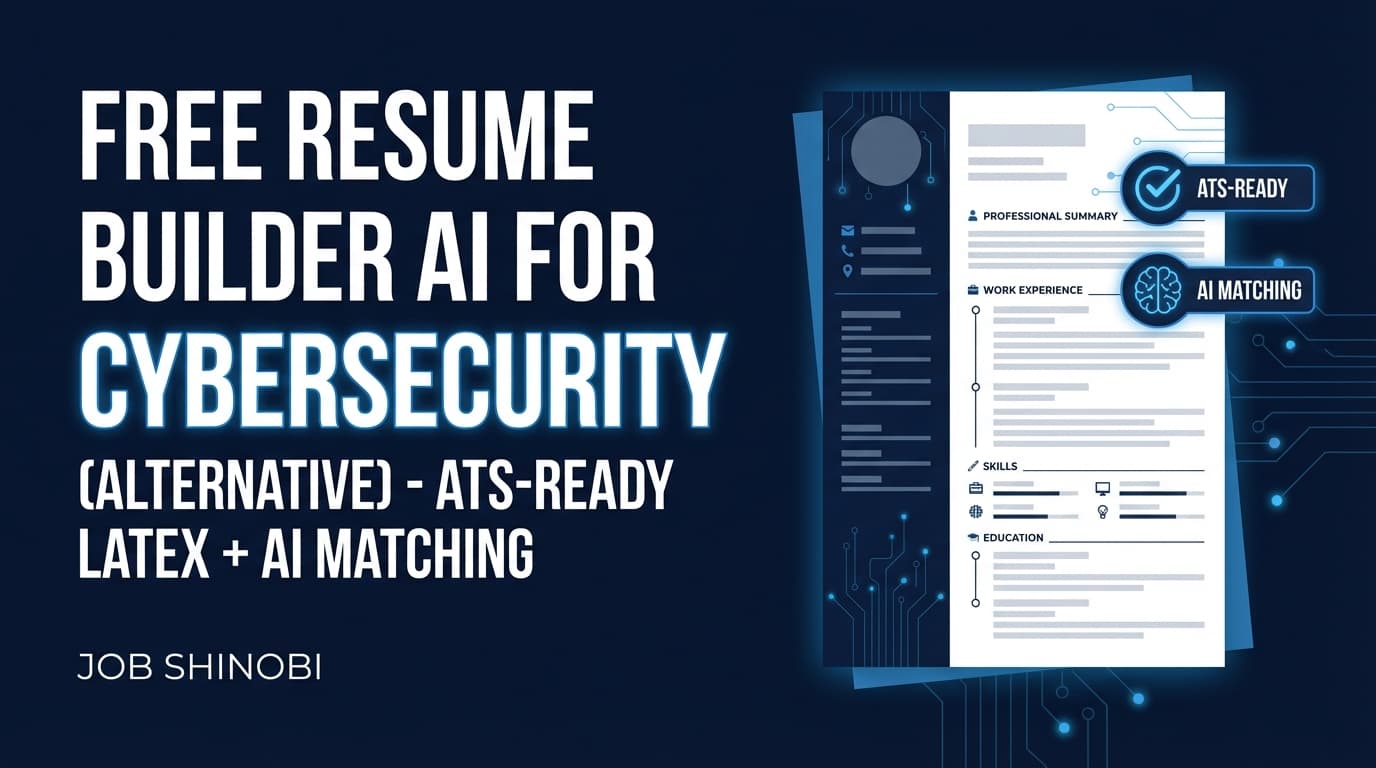
Searching “free resume builder ai for cybersecurity” usually means you’re trying to solve a very specific problem:
You don’t just need a resume that “looks good.” You need a resume that:
- Parses cleanly in ATS (no formatting traps)
- Matches the job description (keywords + skills + role language)
- Proves impact (incident response outcomes, detection improvements, risk reduction, automation, compliance wins)
- Can be tailored fast across many applications (SOC, GRC, cloud security, AppSec, IR, vuln mgmt)
JobShinobi is built for that workflow.
It’s a LaTeX-based resume builder with:
- A template library
- A LaTeX editor with PDF compilation + preview
- AI resume analysis (with cached results when your resume hasn’t changed)
- Job description extraction + resume-to-job matching
- A streaming AI resume editor that can update your LaTeX and verify it compiles
- Version history so you can maintain multiple cybersecurity variants
Pricing transparency: JobShinobi is a paid subscription product (Monthly $20.00, Yearly $199.99). This page targets “free” search intent by offering a more controlled, ATS-first alternative—without claiming a free tier or a verified free trial.
Get started: /login
Go straight to the Resume Builder: /dashboard/resume
Why Choose JobShinobi for Cybersecurity Resume Building?
Cybersecurity resumes have two audiences:
- ATS / automated filters (structure + keywords + parseability)
- Humans (clear scope, decision-making, and measurable outcomes)
Most “free AI resume builders” optimize for speed and generic writing. That can backfire in security because hiring teams look for specificity:
- Which tools did you actually use? (SIEM/EDR/IAM/cloud)
- What did you improve? (MTTR, false positives, vuln backlog, audit readiness)
- What was the environment? (endpoints, cloud accounts, log sources, control frameworks)
- What decisions did you drive? (containment actions, detection strategy, risk acceptance)
JobShinobi’s advantage is the workflow: build a stable ATS-friendly structure in LaTeX, then tailor with analysis + matching.
Benefit 1: LaTeX precision for ATS-friendly structure (with PDF preview)
JobShinobi resumes are stored as LaTeX source (latex_source). That matters because you get consistent structure and fewer “mystery formatting” issues at export time.
In the editor you can:
- Edit your resume as LaTeX
- Compile it into a PDF preview
- Download:
- .tex source
For cybersecurity, that means you can keep sections like Skills, Tools, Certifications, Projects clean and readable—without layout surprises.
Benefit 2: AI Resume Analysis with detailed feedback (and caching)
JobShinobi includes an AI analysis endpoint that can run in:
- Comprehensive analysis
- Enhanced analysis mode (via
enhancedModeflag)
It can also return cached results if your resume hasn’t changed since the last analysis—useful when you’re iterating on small edits across multiple roles.
You get structured outputs like:
- Overall and category scores (content/keyword/formatting/completeness/ATS)
- Strengths and weaknesses
- Keyword analysis (present/missing/overused + density signals where available)
- ATS issues and section-level insights (depending on analysis mode)
Benefit 3: Job description extraction + resume-to-job matching
Cybersecurity postings are keyword-heavy and inconsistent across companies. JobShinobi helps you move from “guessing” to “targeting”:
- Paste a job posting URL or the full job description text
- JobShinobi extracts structured job details and keywords
- Run resume-to-job match analysis that stores a match score and shows:
- Present keywords
- Missing keywords
- Recommendations you can apply
This is ideal when you’re switching between:
- SOC Analyst (alert triage, SIEM queries, runbooks, MITRE)
- Security Engineer (controls, cloud guardrails, detection engineering)
- GRC Analyst (policies, risk assessments, NIST/ISO mapping)
- Incident Response (containment, forensics, playbooks, stakeholder comms)
Benefit 4: Streaming AI resume editor that works with your LaTeX (and checks compilation)
JobShinobi’s AI editor is built around a tool-based workflow: it can read your current LaTeX, propose edits, update your resume, and run LaTeX compilation checks.
You also get resume version history, which is practical when you maintain multiple variants (e.g., “SOC-focused”, “GRC-focused”, “Cloud Security”).
How JobShinobi’s Cybersecurity Resume Builder Works
Step 1: Sign in and open the Resume Builder
- Go to /login and sign in.
- Open the Resume Builder: /dashboard/resume
You’ll see:
- Start from Template (template catalog)
- My Resumes (saved resumes you can open, duplicate, or delete)
Step 2: Start from a template (or duplicate an existing resume)
Cybersecurity job searching often requires multiple targeted versions. JobShinobi supports:
- Creating a new resume from a template
- Duplicating an existing resume (useful for role variants)
Example: Create three versions fast
- SOC Analyst (SIEM, triage, detections, incident handling)
- Cloud Security Engineer (IAM, guardrails, logging, platform controls)
- GRC Analyst (risk, compliance, policies, audits)
Step 3: Edit in the LaTeX editor and compile your PDF preview
Open the editor: /dashboard/resume/editor
In the editor you can:
- Edit LaTeX directly
- Compile and preview your PDF
- Download PDF / download
.tex - Save your resume (versions are stored so you can revert later)
Why this matters for cybersecurity:
- ATS failures often come from formatting choices. A stable, text-first structure helps.
- Security resumes need dense technical content, but still must scan quickly.
Step 4: Run AI Resume Analysis (comprehensive or enhanced)
Run analysis to get feedback on:
- Content clarity and completeness
- ATS-oriented structure signals
- Keyword alignment
Because analysis can be cached when unchanged, you can iterate efficiently:
- Update one section (e.g., “Skills” or “Experience bullets”)
- Re-run analysis when needed
- Avoid repeating scans when nothing changed
Step 5: Add a job description (URL or text) and run match analysis
Use the Job Description input:
- URL tab: paste a job posting link
- Text tab: paste the full job description
Then run match analysis to see:
- Match score
- Present vs missing keywords
- Recommendations you can implement
Step 6: Apply improvements with the AI editor (and keep version history)
Use the AI chat editor to request changes like:
- “Rewrite my SOC bullets to be more measurable”
- “Add context to my Splunk work without keyword stuffing”
- “Tailor my summary to this job description”
- “Make my incident response bullets more outcome-driven”
Each iteration can be saved as a version so you can compare and revert.
Key Features for “Free Resume Builder AI for Cybersecurity” Use Cases
| Feature | What It Does | Why It Matters |
|---|---|---|
| LaTeX resume builder | Creates and stores resumes as LaTeX source (latex_source) |
Stable ATS-friendly structure and predictable exports |
| Template library | Lets you start from a template catalog | Faster setup for a clean baseline cybersecurity resume |
| PDF compilation + preview | Compiles LaTeX to a PDF preview | Catch formatting issues before you submit |
Download PDF + .tex |
Export your final resume and keep the source | Submit a standard PDF while preserving full control |
| AI Resume Analysis (cached) | Scores and analyzes your resume; can return cached analysis if unchanged | Faster iteration while tailoring across many postings |
| Enhanced analysis mode | Optional deeper analysis output when enabled | More detail for senior/lead security roles and positioning |
| Job description extraction | Paste a job URL or text to extract structured job data | Turns long postings into actionable targets |
| Resume-to-job matching | Match score + missing/present keywords saved to analysis | Reduces guesswork and improves targeting |
| Streaming AI resume editor | Chat that can update LaTeX and verify compilation | Safer AI edits for a LaTeX-based resume |
| Resume version history | Stores versions from manual saves and AI workflows | Maintain multiple cybersecurity variants without losing work |
| Job tracker (optional) | Track applications and statuses in a dashboard | Helps manage high-volume applications |
| Excel export for job tracker | Export applications to .xlsx |
Keep your pipeline portable for reporting or backup |
| Job search analytics | Response rate, conversion insights, trend views | Improve your process, not just your resume |
Cybersecurity Resume Content That Actually Converts (What to Write, Not Just What to List)
A “free AI resume builder” often encourages generic phrasing. Cybersecurity hiring teams want evidence and scope.
Use this structure as a checklist.
1) Skills/Tools section: use grouped categories, not a wall of buzzwords
Instead of dumping tools, group them so ATS and humans can scan fast:
Example grouping
- SIEM / Detection: Splunk (SPL), Microsoft Sentinel (KQL), Sigma
- Endpoint / EDR: (only include what you used)
- Cloud Security: AWS/Azure/GCP security services (as applicable), IAM/RBAC
- Vulnerability: scanning + remediation workflow (tools if used)
- Frameworks: NIST CSF / 800-53, ISO 27001 (only if relevant)
- Scripting / Automation: Python, Bash, PowerShell (if used in security context)
JobShinobi’s job match view helps you identify which groups to emphasize for a specific posting.
2) Experience bullets: write “security outcomes,” not “security tasks”
Bad (generic):
- “Monitored SIEM alerts and investigated incidents.”
Better (credible):
- “Triaged ~X alerts/week in SIEM, validated true positives with SPL/KQL queries, and escalated incidents using documented runbooks to reduce time-to-triage.”
Bad:
- “Worked on vulnerability management.”
Better:
- “Coordinated vulnerability remediation across Y assets, tracked SLAs, validated fixes with re-scans, and reduced critical backlog from A → B.”
Bad:
- “Improved security posture.”
Better:
- “Implemented guardrails for IAM / logging / hardening (scope), resulting in measurable reduction (outcome) or improved audit readiness (result).”
Use JobShinobi’s AI editor to rewrite bullets while keeping them truthful and measurable—but you provide the facts (scope, tools, impact).
3) Projects section: cybersecurity labs count if they demonstrate applied skills
If you’re early-career, projects can carry real weight when written correctly:
Good project bullet patterns:
- What you built (detection rule, logging pipeline, hardening baseline)
- What data you used (log sources, telemetry)
- What you measured (false positive reduction, coverage, alert fidelity)
- What you documented (runbooks, playbooks, diagrams)
Create a “project-only” resume variant by duplicating a resume and tailoring it—JobShinobi’s version history makes this manageable.
4) Certifications: list clearly, avoid burying them
Common security certs can be valuable signals:
- Security+
- CySA+
- SSCP
- CISSP (if applicable)
- Vendor certs (cloud/security platforms)
Place them in a dedicated section so ATS can parse them easily.
“Free Resume Builder AI for Cybersecurity” vs. Common Alternatives
Alternative approach: “Just use a free template + ChatGPT”
This can work, but it introduces common failure points:
- Formatting drift after multiple edits
- Generic, repetitive phrasing that doesn’t show security scope
- No systematic keyword gap detection against a specific job posting
- No clean workflow for maintaining multiple tailored versions
JobShinobi is built around repeatable tailoring:
- Stable LaTeX structure
- Analysis + job matching against a posting
- AI editing that can update LaTeX and validate compilation
- Version history so you can branch and revert
Alternative approach: “Free resume builder” that’s free to create but limits exporting
Many “free” builders attract users with free creation, then restrict downloads or require upgrading at the end. If your goal is to iterate quickly and submit tailored versions, that friction slows you down.
JobShinobi is straightforward about pricing (below) and focuses on giving you a controlled workflow: build, analyze, match, edit, export.
Pricing
JobShinobi offers paid subscriptions via Stripe payment links:
- Monthly: $20.00
- Yearly: $199.99
You may also encounter a “Subscription Required” page at /subscription for gated access.
Frequently Asked Questions
Is JobShinobi a free resume builder AI for cybersecurity?
No. JobShinobi is a paid subscription product (Monthly $20.00 / Yearly $199.99). This page targets “free” search intent by offering an ATS-first alternative focused on LaTeX structure, AI analysis, job matching, and export control—without claiming a free tier.
Can JobShinobi help me tailor my cybersecurity resume to a job description?
Yes. JobShinobi supports job description extraction (URL or pasted text) and resume-to-job matching that identifies missing vs present keywords and provides recommendations you can apply in the editor.
Does JobShinobi export to PDF?
Yes. The LaTeX editor compiles your resume and supports PDF download, and you can also download the .tex source.
Does JobShinobi support DOCX export?
JobShinobi is LaTeX-based and supports PDF and .tex downloads. DOCX export is not listed as a supported feature.
Will JobShinobi auto-apply to cybersecurity jobs for me?
No. There are no supported job board integrations or “auto-apply” features. JobShinobi focuses on resume creation, ATS/keyword analysis, job matching, and job application tracking.
How do I manage multiple cybersecurity resume versions (SOC vs GRC vs Cloud Security)?
Use a combination of:
- Resume duplication (create a new variant from an existing resume)
- Version history (save checkpoints while tailoring)
- Job match analysis per role/posting to guide what to emphasize
Get Started with JobShinobi Today
If you’re searching for a free resume builder AI for cybersecurity, you’re already thinking the right way: ATS + keywords + tailoring.
JobShinobi gives you a workflow built for security job searches:
- Start from a template
- Edit in LaTeX
- Compile and preview a PDF
- Run AI resume analysis
- Match to a posting (URL or text)
- Use the AI editor to apply changes safely
- Keep version history so you can maintain multiple targeted variants
Start now: /login
Open the Resume Builder: /dashboard/resume