If you searched “free resume builder ai for customer success”, you’re probably trying to do two things:
- Build an ATS-friendly Customer Success resume that gets callbacks
- Tailor it fast for different CS job postings (CSM, Enterprise CSM, Onboarding, Implementation, Renewals, etc.)
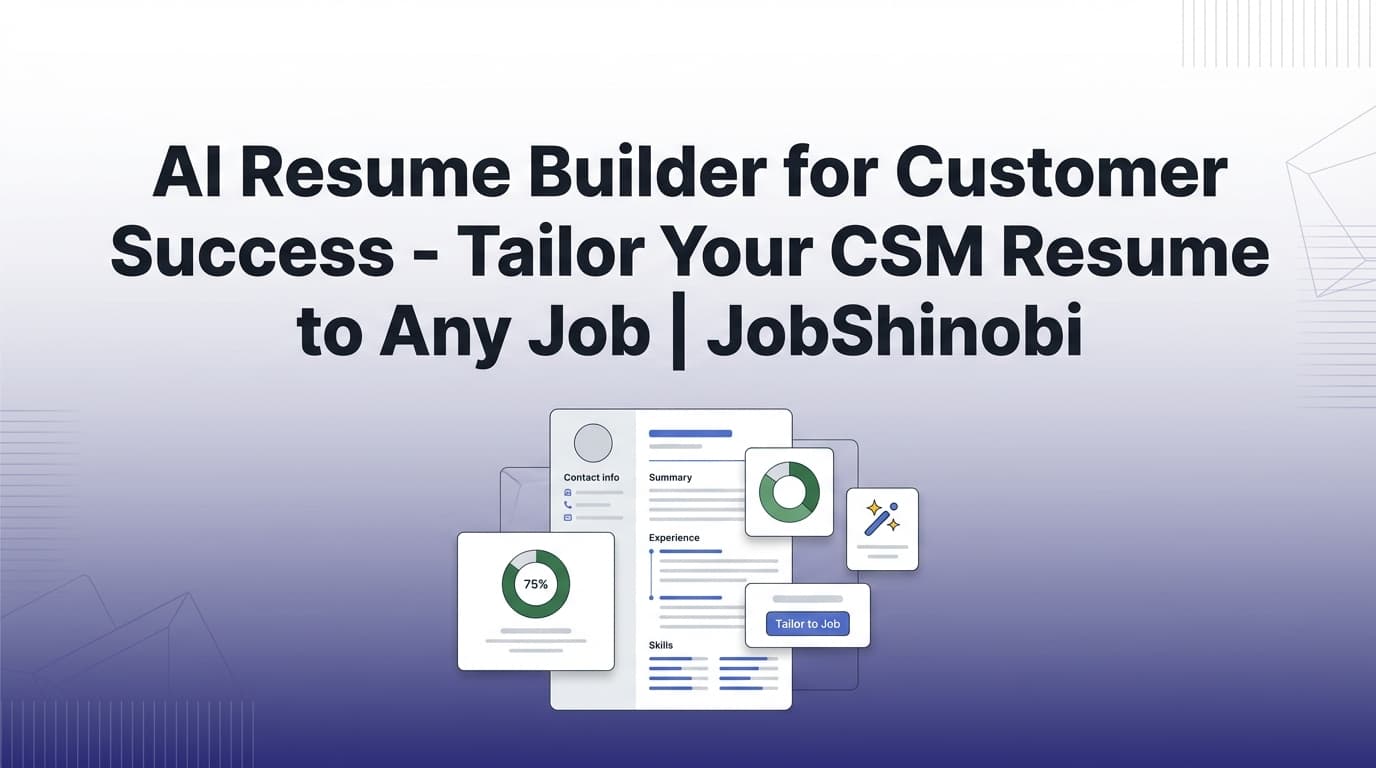
JobShinobi is built for exactly that workflow: LaTeX-based resume templates + AI resume analysis + job description extraction + resume-to-job matching + an AI resume editor with version history—so you can iterate quickly without breaking formatting or losing your “baseline” resume.
Important pricing note (no bait-and-switch): JobShinobi is a paid subscription (Monthly $20.00 or Yearly $199.99). We don’t claim a free tier for full functionality on this page. If you need something completely free, keep reading—we’ll also share a practical “free-first” checklist you can use with any tool.
Primary CTA: Build your Customer Success resume in JobShinobi → /login
Browse templates: /dashboard/resume
Why Customer Success Resumes Get Rejected (Even When You’re Qualified)
Customer Success is a metrics-and-motion role, and many resumes fail because they don’t clearly communicate:
- Your scope (portfolio size, ARR, segment, book of business)
- Your motion (high-touch vs tech-touch; onboarding vs renewals vs expansion)
- Your impact (NRR/GRR, churn reduction, adoption lift, time-to-value, CSAT/NPS)
- Your tools (CRM + CS platform + support stack—only the ones you actually used)
- Your ability to tailor to the job description without keyword stuffing
Most generic resume builders are designed for formatting, not for the job-specific iteration loop Customer Success candidates actually need.
JobShinobi is designed around that loop: build → analyze → match to job → revise → export → repeat.
Why Choose JobShinobi for Customer Success?
1) LaTeX resume templates built for consistency (and fast iteration)
JobShinobi resumes are stored as LaTeX source (latex_source) and compiled into a PDF preview. That gives you a structured foundation that stays consistent while you tailor content—especially helpful when you’re applying to multiple CS roles and don’t want formatting drifting between versions.
What you get:
- A template library (with categories)
- A LaTeX editor workflow
- PDF compilation preview
- Download as PDF and
.tex
2) AI Resume Analysis you can re-run without losing time
JobShinobi includes an AI-powered resume analysis endpoint with two modes:
- Comprehensive analysis
- Enhanced analysis (via an
enhancedModeflag)
It also supports cached results if your resume hasn’t changed since the last analysis—so you can open your resume again and not “pay the time cost” repeatedly for identical scans.
What the analysis returns (high-level):
- Score breakdown (overall + sub-scores)
- Strengths/weaknesses
- Missing sections
- Keyword-related feedback
- ATS-related issue list
- Structured deeper objects (section scores, bullet analysis, ATS analysis, length analysis, benchmarking, role alignment)
3) Job description extraction + resume-to-job matching (built for tailoring)
Customer Success postings vary wildly by company and segment. JobShinobi helps you tailor by letting you:
- Paste a job URL or job description text
- Extract structured job details
- Run a resume-to-job match
- See missing vs present keywords and recommendations
This is especially useful for CS roles that shift emphasis between:
- Onboarding / implementation / time-to-value
- Renewals / risk mitigation / forecasting
- Expansion / growth / value realization
- Support partnership / escalations / executive alignment
4) AI Resume Editor with streaming responses + version history
JobShinobi includes a streaming AI resume editor (chat-style) that can help you revise sections and improve bullets. The product supports resume versions (including chat-sourced versions), making it easier to keep:
- a strong baseline resume
- multiple tailored variants per job type or per company
Bonus (built-in): JobShinobi supports multiple AI model tiers via OpenRouter:
- Shinobi Swift
- Shinobi Turbo
- Shinobi Pro
(These are model options inside the product; availability depends on the app configuration.)
5) Job tracking + analytics (so your search improves over time)
JobShinobi also includes a job application tracker and analytics dashboard:
- Track applications (add/edit/delete)
- Realtime updates via Supabase Realtime
- Export to Excel (
.xlsx) - Analytics like response rate and trends
For high-volume applicants, this helps you run your job search like a funnel: apply, measure response rate, adjust targeting, and iterate.
How JobShinobi’s Customer Success Resume Workflow Works
Step 1: Sign in and start from a template
Go to:
- Sign in: /login
- Templates & saved resumes: /dashboard/resume
Choose a template and create a resume (or duplicate an existing resume to make a tailored variant).
Step 2: Edit your resume (manual + AI-assisted)
Open your resume in the editor:
You can:
- Edit the LaTeX content directly (great for precise formatting control)
- Use the AI chat editor to revise summaries, skills, and experience bullets
Step 3: Compile to PDF preview to confirm formatting stays clean
JobShinobi compiles LaTeX to a PDF preview so you can verify:
- spacing and readability
- section order and hierarchy
- whether bullets look dense or skim-friendly
- consistent dates/titles across roles
Then download:
- PDF output
.texsource
Step 4: Run AI Resume Analysis (and reuse cached results when unchanged)
From your resume analysis flow, run AI analysis to get feedback. If you re-open and your resume hasn’t changed since the last analysis, JobShinobi can return cached results.
Best practice for CS candidates: run analysis after you:
- rewrite your summary
- add metrics to the top 2–3 experience bullets
- tailor skills/tools to the job description
Step 5: Paste a job description (or URL) and run job matching
In the job matching flow:
- paste a job description or URL
- extract structured requirements
- run matching to identify:
- present keywords
- missing keywords
- match score and recommendations
Step 6: Save a tailored version per job (instead of overwriting your baseline)
For Customer Success applicants, versioning is not optional—it’s how you keep speed without losing quality.
A practical system:
- Baseline resume: “Customer Success Manager — Core”
- Variant A: “Enterprise CSM — Renewals + Exec Stakeholders”
- Variant B: “Onboarding / Implementation Specialist”
- Variant C: “Scaled / Tech-touch CSM”
Key Features for “Resume Builder AI for Customer Success”
| Feature | What It Does | Why It Matters for Customer Success |
|---|---|---|
| LaTeX Resume Templates | Start from structured resume templates stored in the template library | Stable formatting while you tailor across many job postings |
| LaTeX Editor + PDF Compilation Preview | Edit LaTeX and compile to a PDF preview | Prevent layout drift and keep a consistent, professional PDF |
| AI Resume Analysis (Comprehensive + Enhanced mode) | Generates structured feedback and scoring | Helps you quickly spot weak bullets, missing sections, and keyword gaps |
| Cached Analysis Results | Returns previous analysis if resume hasn’t changed | Faster iteration when you’re refining a CS resume daily |
| Job Description Extraction | Accepts job URL or text and extracts job details | CS postings vary; extraction reduces guesswork |
| Resume-to-Job Matching | Compares resume content to job requirements/keywords | Helps tailor without keyword stuffing |
| AI Resume Editor (Streaming) | Chat-style editor with tool-based workflow | Faster bullet rewrites and section upgrades |
| Resume Version History | Stores versions from manual edits and chat edits | Keep multiple tailored CSM variants organized |
| Job Tracker + Realtime Updates | Track applications and statuses; updates in realtime | Run a structured pipeline instead of a messy spreadsheet |
| Export Job Tracker to Excel | Export applications to .xlsx |
Share with mentors/coaches or analyze offline |
Customer Success Resume Blueprint (What to Write, Not Just How to Format)
Most “resume builder” pages focus on templates. For Customer Success, content quality is what gets interviews. Use this blueprint while building inside JobShinobi.
1) Your headline should declare your CS lane
Instead of a generic title like “Customer Success Manager,” aim for a headline that matches the job posting’s emphasis:
Examples you can adapt:
- Enterprise CSM (renewals + exec): “Enterprise Customer Success Manager | Renewals, Executive Alignment, Value Realization”
- Onboarding/Implementation: “Customer Onboarding Specialist | Time-to-Value, Enablement, Launch Management”
- Scaled CS / Tech-touch: “Scaled Customer Success | Lifecycle Programs, Adoption, Risk Signals”
2) Your summary should include scope + motion + proof
A Customer Success summary should answer in 5–7 seconds:
- What segment did you support? (SMB/MM/Enterprise)
- What motion did you run? (renewals, expansion, onboarding, adoption)
- What type of product? (SaaS, platform, developer tools, etc.)
- What kind of outcomes did you drive? (retention, churn, adoption, CSAT/NPS)
A strong format:
- Line 1: role + segment + product context
- Line 2: motion + cross-functional partners
- Line 3: proof metrics (if you have them)
- Line 4 (optional): tools (only if relevant and true)
3) Your experience bullets must be outcome-first
Many CS resumes read like job descriptions. You want achievement bullets.
A simple CS bullet formula:
- Action + Scope + Program/Motion + Result + Metric
Examples (write yours truthfully, using your real numbers):
- “Led onboarding for a portfolio of mid-market accounts, improving time-to-value and increasing adoption across key workflows.”
- “Proactively managed risk through stakeholder alignment and structured follow-ups, supporting renewal outcomes and reducing churn drivers.”
Metrics that usually land well in CS resumes
Only use metrics you can support and explain:
- renewal rate, churn reduction
- NRR / GRR (if your org used these)
- expansion influence (revenue or %)
- adoption lift (feature usage, active users, utilization)
- time-to-value reduction
- CSAT / NPS improvements
- number of accounts, ARR book size, stakeholder level
4) Add a “Tools” section—then prove tools in bullets
Customer Success hiring teams expect tool familiarity, but they don’t want a buzzword list with no proof.
Good pattern:
- Tools: Salesforce (CRM), Gainsight/Totango/ChurnZero (CS), Zendesk/Intercom (Support), Looker/Tableau (Analytics)
Then reinforce in bullets:
- “Maintained CRM hygiene in Salesforce to support renewal forecasting and stakeholder visibility.”
- “Monitored customer signals and engagement trends to prioritize outreach and mitigate risk.”
5) Tailor without keyword stuffing (JobShinobi helps here)
Keyword stuffing fails both ATS and human review. The better move:
- use exact terms from the job description where they naturally belong
- prioritize keywords in:
- role headline
- skills/tools section
- top 2–3 bullets of your most recent role
JobShinobi’s job matching helps you identify what’s missing, so you’re not guessing.
“Free Resume Builder AI for Customer Success” vs JobShinobi (Honest Comparison)
If your goal is zero cost, free tools can be enough to produce a decent resume—but they often break down when you need to tailor quickly across many applications.
What free tools usually do well
- Basic resume formatting
- Simple templates
- Sometimes: basic AI text suggestions
Where free tools usually struggle (especially for Customer Success)
- Keeping multiple tailored versions organized
- Matching resume content to job descriptions in a structured way
- Giving you analysis you can reuse without restarting
- Maintaining consistent formatting while you iterate quickly
Where JobShinobi fits
JobShinobi is positioned for candidates who want a repeatable system:
- structured LaTeX resume workflow + PDF compilation preview
- AI analysis (with cached results when unchanged)
- job extraction + resume matching
- AI editing + version history
- optional job tracking + analytics
Bonus: A Free-First Checklist (Use This Even If You Don’t Buy Anything)
If you’re committed to a free route, use this checklist to improve your Customer Success resume with any tool:
- Make the resume single-column and avoid complex layouts
- Add scope context in each role (segment, accounts, ARR if applicable)
- Ensure each role has at least 1–2 metric-driven bullets
- Mirror the job description’s language:
- renewals vs retention vs expansion
- onboarding vs implementation vs enablement
- QBRs, success plans, stakeholder management, escalations
- Keep tools honest and specific (CRM/CS/support stack)
- Create at least 2 tailored versions:
- renewals-focused CSM
- onboarding/implementation-focused CS role
- Export to PDF and proof it visually:
- consistent headings
- dates aligned
- readable spacing
JobShinobi simply gives you a product workflow to do this faster and with better iteration support.
Pricing
JobShinobi offers subscriptions via Stripe:
- Monthly: $20.00
- Yearly: $199.99
Manage your subscription and account from: /subscription and settings inside the app.
Frequently Asked Questions
Is JobShinobi a free resume builder AI for customer success?
No—JobShinobi is a paid subscription (Monthly $20 or Yearly $199.99). If you specifically need a completely free resume builder, you may prefer a free tool. If you want a structured workflow for tailoring Customer Success resumes (analysis + job matching + version history + PDF compilation), JobShinobi is built for that.
Can JobShinobi help me tailor my resume to each Customer Success job posting?
Yes. You can paste a job description or URL, extract key requirements, and run resume-to-job matching to find missing vs present keywords and get recommendations for tailoring.
Does JobShinobi export a Customer Success resume as a PDF?
Yes. JobShinobi compiles your LaTeX resume and lets you download the PDF output (and also download the .tex source).
Does JobShinobi include an ATS resume score?
JobShinobi provides AI resume analysis with structured feedback (including keyword-related feedback and ATS-related issue lists). Use it to identify gaps, then iterate and re-run analysis as you refine the resume.
Can employers detect AI-written resumes?
Some employers may suspect AI if language is overly generic, repetitive, or stuffed with buzzwords. A safer approach is to use AI to refine your real experience into clear, metrics-based bullets—then ensure the resume reads naturally. JobShinobi’s workflow supports iterative editing and versioning so you can refine tone and specificity over time.
Does JobShinobi track my job applications too?
Yes. JobShinobi includes a job tracker dashboard with realtime updates and Excel export. There is also an email-forwarding workflow that can automatically create/update job applications from forwarded emails (email processing is restricted to Pro members).
Get Started with JobShinobi Today
Build a Customer Success resume you can tailor quickly—without losing formatting or drowning in versions.
- Sign in: /login
- Start from a template: /dashboard/resume
- Open the editor: /dashboard/resume/editor
- Track applications: /dashboard/job-tracker
- View analytics: /dashboard/analytics
- Subscribe: /subscription