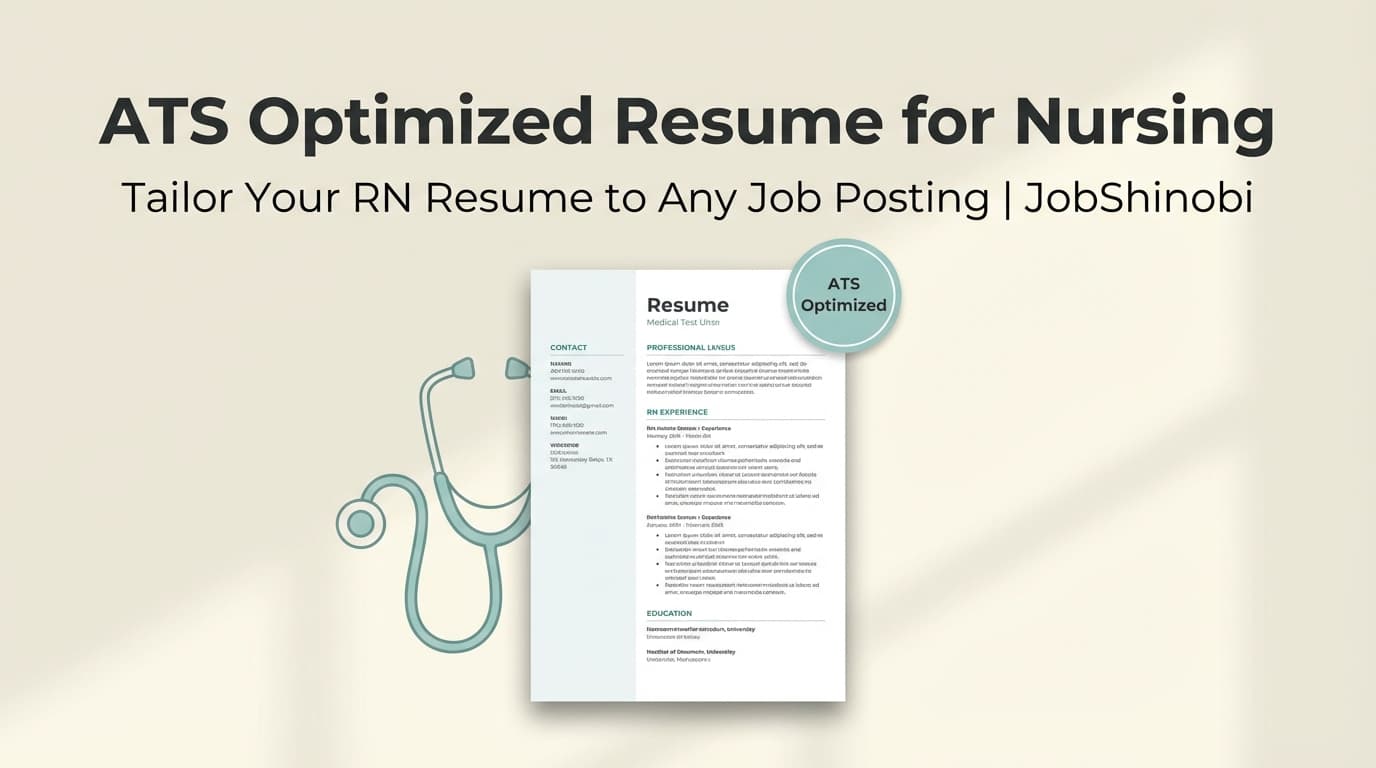
JobShinobi helps you create an ATS optimized resume for nursing by combining a LaTeX-based resume builder, AI resume analysis (including ATS issues + keyword feedback), and job-description matching—so you can tailor each RN resume version to the exact posting you’re applying for.
Hospitals, health systems, and staffing agencies often use ATS software to parse resumes and filter candidates. That doesn’t mean you need gimmicks—it means you need a resume that’s easy to parse, clearly communicates your scope, and includes role-relevant language (skills, certifications, unit keywords) in context.
With JobShinobi, you can:
- Start from a structured resume template (LaTeX)
- Preview your resume as a PDF (compile + preview)
- Run AI analysis to identify ATS/formatting issues and keyword gaps
- Paste a job description (or URL) to extract requirements and keywords
- Match your resume to the job and see missing vs present keywords
- Iterate quickly using the AI Resume Agent (streaming) and resume version history
- Track applications in a job tracker (and export to Excel)
CTA: Ready to tailor your nursing resume to a specific posting? Create your resume → /login
Why Choose JobShinobi for an ATS Optimized Nursing Resume?
Most nursing resume advice is correct—but it’s still manual. You read tips, guess keywords, tweak formatting, and hope you didn’t break parsing or omit something important (licensure, certifications, EHR, unit fit).
JobShinobi turns that into a repeatable workflow built for high-volume applications and frequent tailoring:
- LaTeX Resume Builder + Templates: Build clean, consistent structure across multiple tailored versions (ICU version vs ER version vs Med-Surg version).
- AI Resume Analysis (Comprehensive + Enhanced): Get structured scoring and feedback including keyword analysis and ATS issue detection.
- Job Description Extraction + Resume-to-Job Matching: Extract requirements/keywords from a posting and compare them to your resume to identify gaps.
- AI Resume Agent (Streaming) + LaTeX compile checks: Iterate quickly while keeping your document valid and previewable.
- Resume Version History: Save versions as you tailor so you can revert and keep “one resume per application” organized.
Note: No tool can guarantee how every employer’s ATS will rank you. JobShinobi helps you improve the things you can control: structure, clarity, and role-aligned language.
What “ATS Optimized Resume for Nursing” Actually Means (Checklist)
An ATS optimized nursing resume typically succeeds when it does three things well:
- Parses cleanly (simple structure, predictable headings, consistent formatting)
- Matches the posting (keywords and requirements appear naturally—no stuffing)
- Communicates clinical scope (unit type, acuity, responsibilities, and outcomes clearly)
Here’s a nursing-specific ATS checklist you can apply while using JobShinobi’s analysis + matching tools.
ATS-friendly nursing formatting essentials
- Use clear section headings (e.g., Licensure, Certifications, Clinical Experience, Education, Skills)
- Keep content in a straightforward reading order (avoid complex columns/tables)
- Use consistent date formatting (e.g.,
May 2022 – Present) - Use bullet points for experience (readable for humans and parsers)
Nursing-specific content that ATS and recruiters look for
- License type (RN/LPN/CNA) and state/compact status (as applicable)
- Certifications (BLS/ACLS/PALS/NIHSS/TNCC/NRP—only what you actually have)
- Unit and specialty keywords (ICU, ER, Med-Surg, Telemetry, OR, L&D, NICU, Oncology, etc.)
- EHR/EMR experience (e.g., Epic/Cerner/Meditech—only if true)
- Core competencies aligned to the posting (assessment, triage, patient education, care coordination, documentation)
JobShinobi is built to help you structure those elements and validate alignment against each job posting.
How JobShinobi Builds an ATS Optimized Resume for Nursing
Step 1: Start with a LaTeX nursing resume template
In /dashboard/resume, choose a resume template and generate a new resume. Your resume is stored as LaTeX source, which helps keep formatting consistent even as you tailor content repeatedly.
Why it matters for nursing: You often need multiple resume variants (new grad vs experienced RN, ICU vs ER, staff vs travel). Templates make that scalable without formatting drift.
Step 2: Edit your resume and preview the PDF
Open the editor to write and revise. JobShinobi compiles your LaTeX and shows a PDF preview, so you can validate layout and readability before submitting.
You can export:
- PDF (submission-ready)
- .tex (your source file)
Step 3: Run AI Resume Analysis (Comprehensive or Enhanced)
Trigger analysis to get structured feedback including:
- Overall score + component scores (content, keywords, formatting, completeness, ATS)
- Keyword analysis (present/missing/overused + density/context signals)
- ATS issues feedback
This analysis is stored and can be cached when the resume hasn’t changed—useful when you’re iterating quickly across applications.
Step 4: Paste the job description (or URL) and extract requirements
On the resume analysis page, paste a job description or URL. JobShinobi uses AI to extract structured job details (requirements + keywords).
Step 5: Run Resume-to-Job Matching to find missing keywords
JobShinobi compares the extracted job keywords to your resume to identify:
- Missing keywords (terms in the posting not found in your resume text)
- Present keywords (terms already included)
- Recommendations and a match score
Step 6: Apply changes with the AI Resume Agent (and keep versions)
Use the AI Resume Agent (streaming) to help rewrite bullets, refine skills, and adjust sections while keeping the LaTeX valid. Then save versions to maintain a clean history for each tailored application.
CTA: Want to tailor a resume to a posting in minutes? Start from a template → /dashboard/resume
Key Features for an ATS Optimized Nursing Resume
| Feature | What It Does | Why It Matters for Nursing |
|---|---|---|
| LaTeX Resume Builder | Create/manage resumes stored as LaTeX source | Keeps structure consistent across multiple tailored RN versions |
| Resume Templates Library | Start from a structured template | Helps avoid layout issues that can harm parsing and readability |
| PDF Preview (Compilation) | Compile LaTeX and preview the final PDF | You see exactly what you’ll submit |
| AI Resume Analysis (Comprehensive) | Structured scoring + ATS issues + keyword analysis | Identify gaps like missing credentials, weak bullets, or keyword mismatches |
| AI Resume Analysis (Enhanced Mode) | Deeper structured analysis objects (e.g., semantic keywords, impact analysis, action queue) | Extra guidance for improving clarity and alignment |
| Job Description Extraction | Extract requirements/keywords from a job description or URL | No more guessing what matters in a long hospital posting |
| Resume-to-Job Matching | Match score + missing/present keywords + recommendations | Helps you tailor without keyword stuffing |
| AI Resume Agent (Streaming) | Chat-driven edits to your LaTeX resume with compile checks | Faster iteration while keeping the document valid |
| Resume Version History | Saves versions of your resume over time | Keep one version per application and revert easily |
| Job Tracker + Realtime Updates | Track applications and statuses | Stay organized during high-volume nursing applications |
| Export to Excel (.xlsx) | Export your job tracker | Analyze your pipeline or share with a mentor/coach |
Nursing Resume Section Blueprint (ATS-Friendly + Recruiter-Friendly)
Use this structure as your default “master” resume, then tailor sections per role.
1) Header (simple + clean)
Include:
- Name + credentials (e.g., “Jane Doe, RN”)
- City/State, phone, email
Keep it text-based (no icons). Clear text improves parsing reliability.
2) Licensure (make it easy to find)
Common ATS failure: licensure buried too low.
Include:
- RN (or relevant license)
- State(s) / compact status (if applicable)
- Optional: license number/expiration if you choose (policies vary)
3) Certifications (role-relevant)
List only certifications you actually hold and that matter for the role:
- BLS (common baseline)
- ACLS / PALS (often unit-dependent)
- Specialty certifications (NIHSS, TNCC, NRP, etc.) if applicable
4) Professional Summary (tailor this first)
A short summary can help your resume match the posting quickly.
Example framework (customize truthfully):
- Years of experience + unit type
- Patient population and acuity exposure
- 3–5 competencies aligned to the posting
5) Clinical Experience (tailor bullets, not everything)
Don’t rewrite your entire resume for each job. Start by tailoring:
- Most recent role title line (unit + setting)
- 2–4 bullets that best match the job requirements
- Any unit-specific skills (telemetry, triage, wound care, etc.) only if true
6) Skills (ATS-friendly “keyword map”)
Keep it readable and specific. Avoid dumping 50 skills.
Split into categories if helpful:
- Clinical skills (assessment, patient education, medication administration, etc.)
- Specialty skills (telemetry monitoring, triage, perioperative workflows, etc.)
- Tools (EHR/EMR—only what you’ve used)
7) Education
Include degree, school, and location. Add graduation year if you want (optional in many cases).
Nursing Keyword Strategy: Use Real Posting Language (Without Stuffing)
Instead of guessing “the best nursing keywords,” use the job posting itself as the source of truth. Many ATS screens are essentially “does this resume look like the job?”
JobShinobi supports this workflow by extracting job keywords and comparing them to your resume text.
Examples of keyword clusters nurses often see in postings
Use these as examples—your specific job description matters most:
- Core nursing competencies: patient assessment, care planning, patient education, care coordination, documentation
- Safety/quality: patient safety, infection control, fall prevention, medication reconciliation
- Communication: interdisciplinary collaboration, SBAR (only if you actually use it), handoff, care team communication
- Unit/specialty terms: ICU, ER, Med-Surg, Telemetry, OR, L&D, NICU, Oncology, PACU
- Tools (if applicable): EHR/EMR, Epic, Cerner, Meditech
- Certifications (if required): BLS, ACLS, PALS, NIHSS, TNCC, NRP
Where to place keywords (ATS-friendly placement)
Put role keywords where they naturally belong:
- Skills section (clean list)
- Clinical Experience bullets (best place for context)
- Summary (high-signal, short)
Avoid copying/pasting entire job descriptions. Matching is good; readability and honesty are better.
How to Tailor Your Nursing Resume in 10 Minutes (Repeatable Workflow)
When you’re applying to multiple roles, speed matters. Use this repeatable approach:
- Duplicate your resume (create a new version for this application)
- Paste the job description/URL into JobShinobi’s job extraction
- Run Resume-to-Job Matching
- Update these areas first:
- Summary (2–3 lines)
- Skills (top 10–15)
- 2–4 bullets in your most relevant recent role
- Certifications/Licensure (only if the posting emphasizes them)
- Run AI Resume Analysis again to validate ATS/keyword improvements
- Export PDF and submit
- Track the application in the Job Tracker (and optionally export to Excel later)
CTA: Tailor your RN resume to a job posting now → /login
ATS Optimized Resume for Nursing vs. Generic Templates + Manual Guessing
Generic approach (what most candidates do)
- Download a template
- Make edits in Word/Docs
- Guess keywords
- Create a few versions with inconsistent formatting
- Lose track of which resume went to which job
JobShinobi approach (structured + measurable)
- Start from a stable template (LaTeX)
- Preview your final PDF
- Extract keywords/requirements from the actual posting
- See missing vs present keywords and match feedback
- Iterate quickly with AI Resume Agent + saved versions
- Track applications and outcomes in a dashboard (with Excel export)
This is especially useful for nursing job searches where you apply across multiple facilities, units, and job titles.
Pricing
JobShinobi offers paid subscriptions via Stripe payment links:
- Monthly: $20.00
- Yearly: $199.99
To get started, sign in and choose a plan when you’re ready: /login
Frequently Asked Questions
What makes a resume “ATS optimized” for nursing?
An ATS optimized nursing resume is typically:
- Easy to parse (simple structure, clear headings)
- Clear about credentials (RN license + required certifications)
- Aligned to the job posting (skills and unit keywords used naturally)
- Specific about clinical scope (unit type, responsibilities, patient population)
JobShinobi supports this with templates, PDF preview, AI analysis (ATS + keyword feedback), and job matching.
Should I use a two-column nursing resume for ATS?
Many ATS systems don’t reliably parse complex layouts (including multi-column designs, tables, and graphics). A single-column, clearly headed layout is usually safer.
JobShinobi’s LaTeX templates are designed to keep structure consistent and readable.
Can JobShinobi scan my PDF or image resume?
JobShinobi works with resumes as LaTeX source and analyzes that text directly. It does not claim image-based OCR resume parsing.
Does JobShinobi automatically apply to nursing jobs for me?
No. JobShinobi focuses on resume creation, resume analysis, job-description matching, and job application tracking. It does not auto-apply to jobs or connect directly to job boards.
Can I track my nursing applications in JobShinobi?
Yes. JobShinobi includes a Job Tracker with realtime updates and Excel (.xlsx) export. You can track applications, statuses (Applied/Interview/Offer/Rejected), and keep your pipeline organized.
Does JobShinobi export to Google Sheets?
JobShinobi supports exporting to Excel (.xlsx). It does not claim a direct Google Sheets integration.
What nursing resume sections should I tailor first?
Start with the highest-impact, highest-signal areas:
- Summary
- Skills
- 2–4 bullets in your most relevant recent role
- Certifications/Licensure emphasis (if the posting highlights them)
JobShinobi’s Resume-to-Job Matching helps you prioritize based on missing keywords and requirements.
Get Started with JobShinobi Today
Create an ATS optimized resume for nursing you can tailor to each job posting—without losing formatting, versions, or momentum.
- Build from templates: /dashboard/resume
- Tailor and analyze: /dashboard/resume → open a resume → analyze + match
- Track applications: /dashboard/job-tracker
- See outcomes and trends: /dashboard/analytics
Start now → /login