Career changes fail in ATS screening for two reasons:
- Your experience is real, but it’s not written in the target role’s language.
- Your resume structure gets messy during rewrites, so parsing and keyword detection suffer.
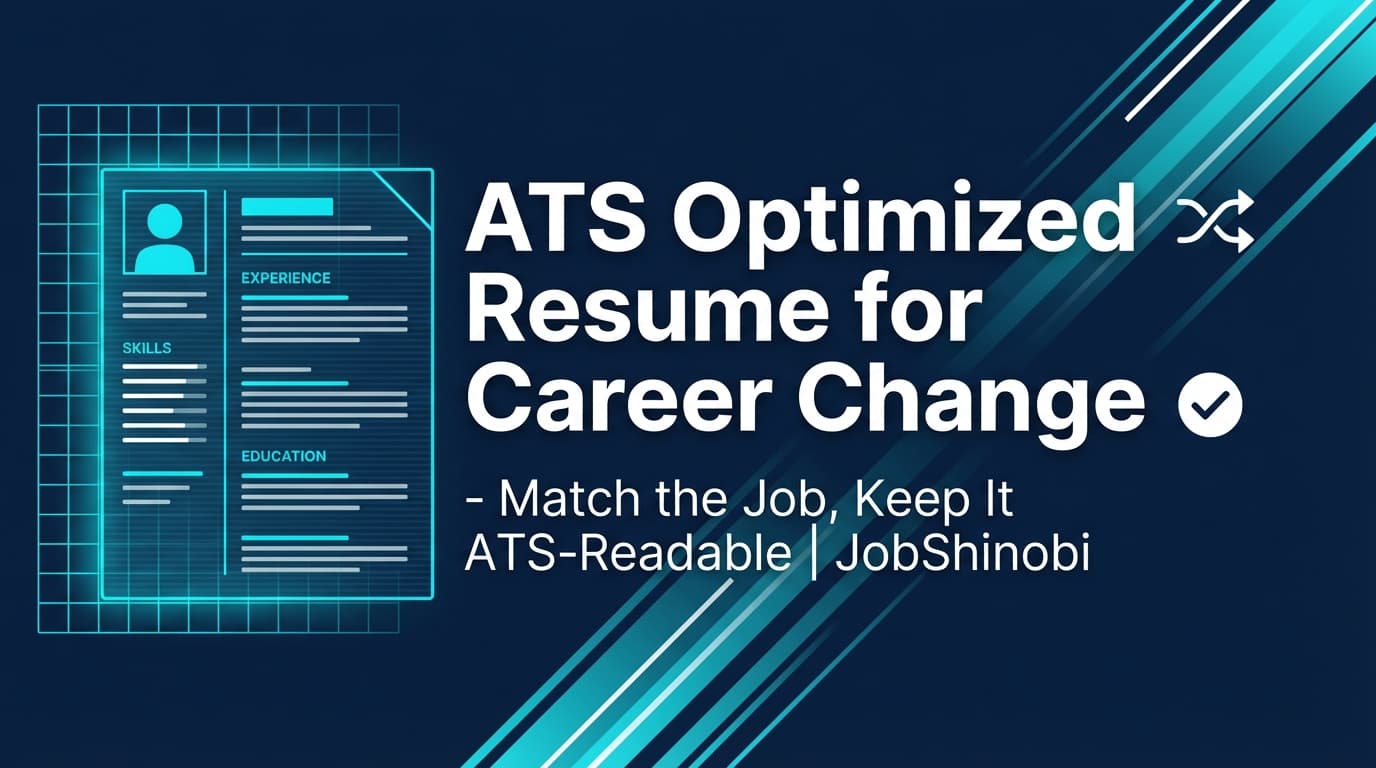
JobShinobi helps you create an ats optimized resume for career change using a LaTeX-based resume builder (clean structure), AI resume analysis (including ATS + keyword feedback), and resume-to-job matching (missing vs present keywords) so you can tailor a credible pivot resume to each job posting.
Get started: Sign in with Google
Why Choose JobShinobi for an ATS-Optimized Career Change Resume?
Most “career change resume” advice is a checklist. That’s not enough when your titles don’t match your target role and ATS systems are scanning for specific skills, tools, and terms.
JobShinobi is built to support the actual workflow career changers need:
- Start from structured templates (stored and edited as LaTeX source)
- Analyze your resume for ATS + keyword fit with a score breakdown and detailed feedback
- Extract job requirements from a job URL or pasted text
- Match your resume to that job (match score + missing/present keywords + recommendations)
- Apply changes in the editor or with the AI resume editor
- Save versions so each target role gets its own tailored resume
What makes career-change ATS optimization different?
If you’re not changing careers, keyword optimization is mostly about tailoring within a field.
If you are changing careers, you must also:
- prove relevance quickly (summary + skills + top bullets)
- bridge gaps with projects/certifications/training
- align to the target role without misrepresenting your background
- avoid formatting “experiments” that break parsing
JobShinobi supports all of that with a structured resume workflow, job matching, and iterative analysis.
The Career Change ATS Problem: You’re Qualified, But the Resume Doesn’t “Match”
ATS filters aren’t judging your potential. They’re matching text patterns.
Common career-change mismatch examples
- “Operations reporting” vs “business intelligence dashboards”
- “Training staff” vs “enablement programs”
- “Client onboarding” vs “customer lifecycle management”
- “Process improvements” vs “continuous improvement / SOP / Lean”
- “Spreadsheet modeling” vs “forecasting models”
Even if you’ve done the work, ATS won’t infer equivalence. You need to translate your accomplishments into the language of the target job posting—naturally and credibly.
JobShinobi is designed to help you do that in a repeatable way.
How JobShinobi Helps You Build an ATS Optimized Resume for Career Change
1) LaTeX Resume Builder (structure stays clean while you rewrite)
Career changers rewrite a lot. Most resume formats get unstable during heavy edits—spacing breaks, sections become inconsistent, and “fixes” pile up.
JobShinobi’s resumes are stored as LaTeX source and compiled to PDF for preview. That means you can iterate aggressively while keeping your structure consistent.
- Create/manage multiple resumes
- Start from a template library
- Download your resume as PDF (compiled) or .tex
Build your resume: Open Resume Builder
2) Resume Analysis with ATS + keyword feedback (not guesswork)
JobShinobi’s analysis returns:
- overall score
- category scores: Content Quality, Keywords, Formatting, Completeness, ATS Compatibility
- detailed feedback including strengths, weaknesses, missing sections, keyword analysis, and ATS issues
There are two analysis modes supported:
- Comprehensive analysis
- Enhanced analysis mode (when enabled)
This is how you avoid chasing generic advice and instead focus on the specific improvements that move your resume toward “ATS-readable + role-aligned.”
3) Job Description Extraction (URL or text) → structured job details
Career changes require clarity on what the employer actually wants.
JobShinobi lets you provide either:
- a job posting URL, or
- the full job description text
Then it extracts job details (including keywords) so you can tailor intentionally.
4) Resume-to-job matching: match score + missing vs present keywords
This is the heart of career-change ATS optimization.
Once you extract a job description, JobShinobi runs resume-to-job matching and returns:
- Job Match Score
- Matching Keywords (present)
- Missing Keywords
- Recommendations for improving alignment
This makes career-change tailoring less emotional and more mechanical: close the gap without faking experience.
5) AI Resume Editor (streaming) to rewrite faster—while preserving structure
JobShinobi includes an AI resume editor that works as a streaming chat. It’s designed for iterative editing workflows (and can compile-check LaTeX as part of the process).
Use it to:
- rewrite your summary for a new target role
- rewrite bullets in the target role’s language
- add a projects section that supports your pivot
- reorganize emphasis while keeping accuracy
6) Version history: keep separate “target role” resumes without chaos
Career changers rarely apply to one role. You might apply to:
- Role A (primary pivot)
- Role B (adjacent pivot)
- a “bridge role” (stepping-stone job)
JobShinobi supports resume version history, making it easier to tailor without losing your baseline resume.
How JobShinobi’s Career-Change Resume Workflow Works
Step 1: Create a resume from a template (LaTeX-based)
- Go to Resume in your dashboard
- Select a template from the template library
- Create a resume and open it in the editor
This gives you a clean, consistent foundation for ATS readability.
Start here: Resume templates & saved resumes
Step 2: Define your target role (the “translation anchor”)
Career-change resumes fail when they try to be everything at once.
Before you tailor, choose one clear target role per resume version (examples: “Data Analyst”, “Project Manager”, “Product Operations”, “Customer Success Manager”).
Then build your top-of-resume messaging around that target role:
- summary/objective
- skills
- top 3–5 bullets (first experience section)
Step 3: Run Resume Analysis (baseline)
Analyze your current resume to find:
- keyword gaps (in general)
- ATS issues
- missing sections
- formatting/completeness problems
You can re-run analysis repeatedly; the system can return cached results if your resume hasn’t changed since the last analysis.
Step 4: Extract a job description (URL or text)
In the job matching tab, paste:
- the job URL, or
- the job description text
JobShinobi extracts structured job details including keywords and requirements.
Step 5: Run Job Match (missing vs present keywords)
You’ll get:
- a match score
- missing keywords (what the job expects that your resume doesn’t show)
- present keywords (what you already demonstrate)
- recommendations to improve alignment
Step 6: Apply changes in the editor (manual or AI-assisted)
Use one of two approaches:
- Manual edits in the LaTeX editor for precise control
- AI resume editor to rewrite sections and bullets faster
Step 7: Save a version for that specific role
Save a version named after the role and/or company:
- “Data Analyst — Version”
- “PM — Company X”
- “Ops → PM (Bridge Resume)”
Now you can tailor again for the next job without rewriting from scratch.
Key Features for ATS-Optimized Career Change Resumes
| Feature | What It Does | Why It Matters for Career Change ATS Optimization |
|---|---|---|
| LaTeX Resume Builder | Create and manage resumes as LaTeX source | Keeps structure consistent while you rewrite heavily |
| Template Library | Start from structured resume templates | Reduces formatting chaos; faster setup for a clean layout |
| PDF Compile + Preview | Compiles LaTeX to PDF preview | Lets you verify layout consistency after edits |
| Resume Analysis (Comprehensive) | Scores and feedback including ATS + keywords | Gives you a baseline and clear priorities for improvement |
| Enhanced Analysis Mode | Adds deeper analysis objects (when enabled) | Helpful for career changers who need stronger positioning guidance |
| Job Description Extraction | Extract job details from URL or text | Turns postings into structured requirements/keywords |
| Resume-to-Job Matching | Match score + missing/present keywords + recommendations | The clearest “what to change” list for each job |
| AI Resume Editor (Streaming) | Chat-based editing workflow for resume text | Speeds up translation of experience into target-role language |
| Resume Version History | Save versions tied to changes/messages | Keep separate resumes per target role without losing your baseline |
| Job Tracker + Excel Export | Track applications, export to .xlsx | Career changes often involve higher-volume applications |
The ATS-Optimized Career Change Resume Blueprint (Use This With JobShinobi)
This is the exact structure that makes career changes easier for ATS and recruiters.
1) Summary: the “pivot translator” (3–5 lines)
Your summary should do three things:
- Name the target role
- Prove transferable impact
- Include target keywords naturally (tools/methods/domains you genuinely have)
High-performing summary pattern (career-change friendly):
Target Role Title + transferable strengths + proof + target-role keywords
Examples (replace bracketed content):
- “Operations professional transitioning into [Target Role], with [X years] improving [process/metric] across [scope]. Known for [transferable strengths] and experience with [relevant tools/methods]. Seeking to apply [keywords] to deliver [outcome].”
How JobShinobi helps:
- Use job matching to identify the most repeated keywords in the job post
- Use the AI resume editor to rewrite your summary to include those keywords without stuffing
2) Skills: structured, job-specific, and defensible
A career changer’s skills section should be intentional.
Best practice is to group skills so ATS scanning and recruiter reading both work:
- Tools / Platforms
- Methods / Frameworks
- Domain / Functional skills
How JobShinobi helps:
- Job match returns missing and present keywords
- Add missing skills only if you can defend them with bullets/projects/certifications
3) Experience: keep true titles, translate outcomes
Avoid rewriting job titles dishonestly. Instead:
- keep your real title
- translate bullet language to match the target role
- prioritize outcomes, scope, and cross-functional work
Bullet translation examples (conceptual):
- “Created weekly operational reports” → “Built recurring reporting cadence to track KPIs and improve decision-making”
- “Managed schedules” → “Coordinated timelines across stakeholders to deliver milestones”
- “Handled client requests” → “Managed stakeholder communication and requirements intake”
How JobShinobi helps:
- Resume analysis highlights weaknesses and keyword gaps
- AI resume editor can rewrite bullets while preserving truth
- Version history lets you tailor for different job families
4) Projects / Training: the credibility bridge
If your past titles don’t match the target role, projects are proof.
A strong pivot resume uses:
- relevant projects
- certifications/training
- volunteer leadership
- portfolio links (when applicable)
How JobShinobi helps:
- Use job extraction + matching to pull the target role’s keywords
- Build projects that include those keywords in a credible, evidence-based way
What NOT to Do (Career Change ATS Mistakes That Kill Match Scores)
Mistake #1: One resume for multiple target roles
If your summary says “seeking opportunities in analytics, operations, and product,” you’ll under-match all of them.
Fix: One target role per resume version. JobShinobi version history makes that manageable.
Mistake #2: Adding keywords without support
ATS might register a keyword, but recruiters will look for evidence in bullets/projects. Keyword stuffing hurts credibility.
Fix: Use missing keywords as a checklist for what to prove (through bullets/projects), not what to paste blindly.
Mistake #3: Hiding experience with a “skills-only” resume
Pure functional resumes can be risky because recruiters want timelines and context.
Fix: Use a clear summary + structured skills + chronological experience, with a project section to bridge the pivot.
Mistake #4: Formatting experiments that create parsing issues
Complex layouts and heavy visual elements can cause parsing problems.
Fix: Use a clean template and keep structure consistent while iterating.
How to Use Job Matching for Career Changes (The 15-Minute Tailoring Loop)
Career-change tailoring should be fast and repeatable. Here’s the loop:
- Extract the job (URL or pasted description)
- Run match to get missing vs present keywords
- Update:
- Summary (include target title + 2–4 high-value keywords)
- Skills (only defensible skills)
- Top bullets (add the missing keywords through proof)
- Re-run analysis for ATS + keyword feedback
- Save a version named after the role/company
Repeat per application.
Career Change Use Cases (How JobShinobi Fits Real Pivots)
Use case A: Operations → Project Manager
What ATS is scanning for: planning, coordination, stakeholders, timelines, delivery, metrics, tools/methods.
How to tailor with JobShinobi:
- Extract job description
- Use missing keywords to update:
- Summary (target title + delivery outcomes)
- Skills (tools/methods you actually used)
- Bullets (“coordinated”, “delivered”, “aligned stakeholders”, “improved cycle time”)
- Save a “PM version” resume
Use case B: Customer-facing → Customer Success / Account Management
What ATS is scanning for: retention, onboarding, adoption, renewals, stakeholder management, metrics.
How to tailor:
- Translate “helped customers” into measurable outcomes (adoption, response time, satisfaction)
- Use job match keywords and rewrite bullets to reflect lifecycle language
- Add a “Projects” section showing onboarding improvement or enablement work
Use case C: Admin / Coordinator → Data Analyst (entry pivot)
What ATS is scanning for: analysis, reporting, dashboards, data tools, structured problem solving.
How to tailor:
- Include “reporting cadence” and KPIs you tracked
- Add projects that show analysis work (even if self-directed)
- Use the AI editor to turn vague bullets into measurable outcomes
“ATS Optimized Resume for Career Change” vs. Generic ATS Checkers & Templates
Generic templates and advice pages (limitations)
- Give broad rules (“use one column”) but don’t validate your job-specific keyword fit
- Provide examples, but not your best narrative for your target role
- Don’t provide a repeatable “match → edit → re-check → version” system
JobShinobi’s career change advantage
- Job-specific matching: missing vs present keywords for the role you’re applying to
- ATS + keyword scoring: actionable breakdown and detailed feedback
- Extract job details from URL or text: quick setup per application
- AI editing + version history: tailor faster, keep separate target-role resumes
- LaTeX-based structure: stable formatting while you iterate
Bonus: Track Your Career Change Applications (And Spot What’s Working)
Career changers often apply at higher volume across multiple job families. JobShinobi includes:
Job Tracker (dashboard table)
- Add/edit/delete job applications
- Realtime updates
- Status tracking (Applied, Interview, Offer, Rejected, Other)
Export to Excel (.xlsx)
Export your job tracker to an Excel file when you want offline analysis.
Useful links:
Email forwarding for tracking (Pro-gated)
JobShinobi supports an email-forwarding workflow that processes inbound job-related emails and can create/update application records. This is designed to reduce manual tracking work during an active job search.
You can find your forwarding email in settings.
Pricing
JobShinobi offers paid subscriptions via Stripe:
- Monthly: $20.00
- Yearly: $199.99
Hosted Stripe checkout links:
- Monthly: https://buy.stripe.com/7sYeV61P10GS310eTy0VO02
- Yearly: https://buy.stripe.com/6oU9AM0KXexIdFE5iY0VO03
Frequently Asked Questions
What does “ats optimized resume for career change” actually mean?
It means your resume is:
- structured in a way that ATS systems can reliably parse, and
- aligned to the target role using job-relevant keywords and phrasing,
- without misrepresenting your experience.
In JobShinobi, this is accomplished through resume analysis (ATS + keyword feedback) and resume-to-job matching (missing vs present keywords) for each job you apply to.
How do I tailor my career change resume to each job in JobShinobi?
Use the job matching workflow:
- Open your resume analysis page
- Paste a job URL or the job description text to extract job details
- Run match to get missing/present keywords + recommendations
- Update summary/skills/bullets in the editor (manual or AI-assisted)
- Save a version for that specific role/company
Can JobShinobi analyze my resume against a job description?
Yes. JobShinobi supports job description extraction and resume-to-job matching, which provides a match score plus missing/present keywords and recommendations.
Does JobShinobi support multiple analysis modes?
Yes. Resume analysis supports a comprehensive mode and an enhanced analysis mode (when enabled).
Can I download my resume?
JobShinobi supports downloading your resume as a compiled PDF and downloading the .tex source.
Does JobShinobi auto-apply to jobs or integrate with job boards?
No. JobShinobi focuses on resume building, analysis, matching, and job application tracking—not auto-applying or job board integrations.
Get Started with JobShinobi Today
If you’re serious about a career change, you need more than templates and generic advice. You need a system:
Extract the job → match keywords → rewrite credibly → re-check ATS → save a version → repeat.
Start now: Sign in with Google
Next: Create or open your resume