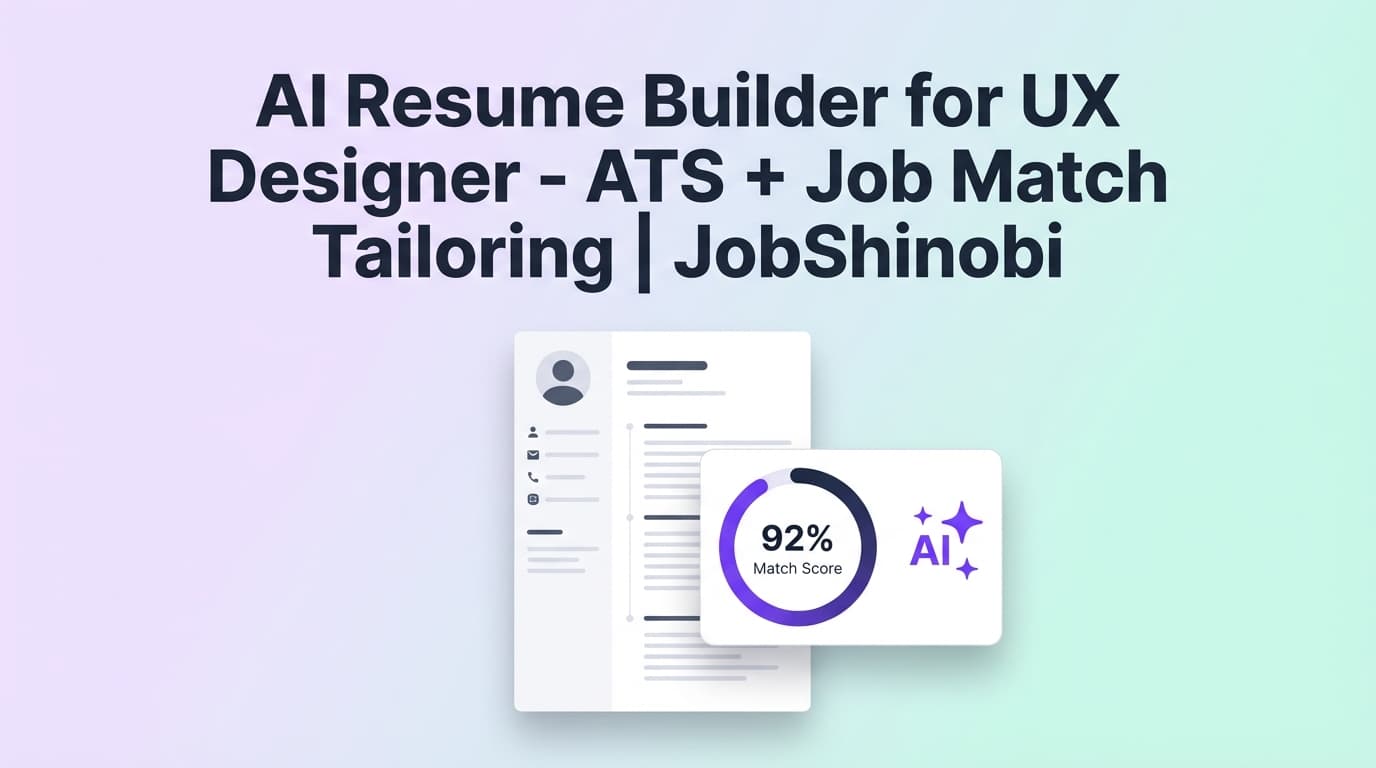
JobShinobi is an AI resume builder for UX designer candidates who need two outcomes at once:
- A resume that stays clean, structured, and ATS-readable
- A workflow to tailor keywords and content to each job description—fast
With JobShinobi, your resume lives as LaTeX source (not a fragile drag-and-drop layout), compiles to a PDF preview inside the editor, and can be evaluated using AI resume analysis (scores + keyword feedback + ATS issues). When you’re applying to a specific UX role, you can paste a job description or URL to extract job requirements and run resume-to-job matching—so you know what’s missing before you apply.
Why Choose JobShinobi for an AI Resume Builder for UX Designer Use Cases?
UX hiring is a balancing act. Recruiters need clarity and scanability. Hiring managers want evidence of thinking, process, and outcomes. ATS systems want structure and keyword alignment. Many UX designers get stuck in the same trap: a resume that looks like a portfolio piece but doesn’t perform well in screening—or a plain resume that lacks the language and positioning needed for specific UX job families.
JobShinobi is built to solve that problem with a workflow that combines:
- LaTeX-based resume creation (stable formatting + easy iteration)
- PDF compilation + preview (see what recruiters will see)
- AI analysis (scores, strengths/weaknesses, keyword feedback, ATS issues)
- Job matching (extract job details from URL/text and compare to your resume)
- AI editing + version history (create targeted versions for different UX roles)
- Job application tracking (realtime tracker + Excel export, plus email-forwarding automation for Pro members)
A UX resume builder that prioritizes structure (not just templates)
UX candidates often change their resumes frequently: one version for product design, another for UX research, another for design systems, another for a specific industry (healthcare, fintech, B2B SaaS). If your resume is built in a rigid design template, you’ll spend too much time fighting formatting instead of improving content.
JobShinobi resumes are stored as LaTeX (latex_source) and compiled to PDF. This gives you a reliable “source of truth” you can tailor without layout drift.
A keyword-driven workflow for UX job descriptions (without keyword stuffing)
Many UX roles share overlapping responsibilities, but job descriptions emphasize different terms and signals depending on the team:
- Growth UX may prioritize experimentation, funnels, and activation
- Platform UX may prioritize design systems, component libraries, and governance
- Research roles may prioritize methodology, synthesis, and stakeholder enablement
- Enterprise UX may prioritize complex workflows, information architecture, and accessibility
JobShinobi supports job description extraction and resume-to-job matching so you can identify missing vs present keywords and get recommendations—then implement changes in the editor.
AI resume analysis that supports real iteration
JobShinobi’s AI analysis returns structured feedback (including keyword analysis and ATS issues). If your resume hasn’t changed since your last run, analysis can be returned from cache—so your workflow stays fast while you iterate.
What UX Recruiters and ATS Systems Commonly Filter For (And How JobShinobi Helps)
A strong UX resume is not “more design.” It’s more signal per line, clearer outcomes, and better alignment to the job’s language.
Below are the most common breakdown points for UX resumes—paired with what JobShinobi enables you to do about them.
1) Your resume reads like responsibilities, not outcomes
Weak UX bullets often sound like:
- “Worked on redesigns”
- “Collaborated with engineering”
- “Conducted research”
Better bullets show scope + impact:
- What changed?
- How was it validated?
- What was the outcome?
- What constraints existed?
- Who did you influence?
How JobShinobi helps: use analysis feedback to spot weak areas, then refine bullets using the AI editor workflow and keep role-specific versions.
2) Keyword mismatch (you’re qualified, but your resume doesn’t match the posting language)
Two UX designers can do similar work but describe it differently. ATS systems (and many recruiters) scan for the vocabulary in the job post. If the job wants “information architecture” and you only say “site map,” you may be under-credited. If the job wants “usability testing” and you only say “user testing,” you might still be fine—but it depends on what else is missing.
How JobShinobi helps: job extraction + match analysis shows which keywords are present and missing, plus recommendations you can apply.
3) Your portfolio link isn’t obvious
For UX roles, your portfolio is often the main proof. Your resume should make the portfolio easy to find quickly—especially for high-volume recruiter screens.
How JobShinobi helps: a stable resume structure makes it easier to keep the header consistent across multiple role variants while you tailor experience bullets and skills.
4) You’re applying across different UX role families with one resume
A “one resume for everything” approach usually underperforms in UX because job families have different emphasis:
- UX Researcher: rigor, methods, synthesis, insights → product impact
- Product Designer: feature delivery, collaboration, tradeoffs, systems thinking
- Design Systems: scalability, component libraries, accessibility, governance
- UX Writer: content strategy, IA, voice/tone systems, cross-functional partnership
How JobShinobi helps: resume version history supports maintaining multiple targeted versions without losing your baseline.
Why LaTeX Works for UX Resumes (Even If You’re Not “A LaTeX Person”)
Most UX designers are visual. LaTeX sounds intimidating. But for resumes, the goal isn’t to be clever—it’s to be consistent.
A LaTeX-first workflow is powerful because:
- Your structure is explicit and repeatable
- Changes don’t accidentally break layout the way they can in design-heavy editors
- You can iterate quickly while keeping a clean, professional PDF
JobShinobi makes this approachable with:
- A resume templates library to start from
- A resume editor that compiles LaTeX and previews the PDF
- AI editing workflows that can update LaTeX-based resumes
How JobShinobi’s AI Resume Builder for UX Designer Roles Works
Step 1: Start from a LaTeX template (template library)
From your resume dashboard, choose a template to start. Your resume is saved and managed in the app, stored as LaTeX source.
What this means in practice:
- You can create multiple resumes (e.g., “UX Designer - Growth”, “Product Designer - B2B”, “UX Researcher”)
- You can duplicate and adjust without losing formatting consistency
- You keep a single, editable source rather than juggling disconnected PDFs
Recommended UX move: create one “baseline” resume that reflects your full scope, then duplicate it into role-specific variants for different applications.
Step 2: Edit in the LaTeX editor and preview the PDF
In the resume editor, you can:
- Edit LaTeX manually
- Compile and preview the resulting PDF
- Download your resume as PDF
- Download your resume as .tex
- Save your changes to the database
This is where UX candidates benefit most: you can adjust content density (more compact or more spacious), fix section emphasis, and test different ordering—without reformatting from scratch.
Step 3: Run AI Resume Analysis (scores + keyword feedback + ATS issues)
JobShinobi’s resume analysis returns structured data such as:
- Overall score and category scores (content, keywords, formatting, completeness, ATS)
- Strengths and weaknesses
- Missing sections
- Keyword analysis (present, missing, overused; plus density/context-related metrics)
- ATS issues
- Additional structured analysis objects (like section-level scoring and more), depending on mode
You can also re-run analysis as you iterate. If your resume hasn’t changed since the last analysis, the system can return cached results—helpful when you’re checking the impact of small changes.
Step 4: Paste a job description (or job URL) to extract job requirements
In the job matching workflow, you provide a job input (URL or text). JobShinobi extracts job details and then compares them against your resume.
This is ideal for UX roles because requirements vary by:
- Seniority (junior/mid/senior/staff/principal)
- Product domain (B2B, B2C, enterprise, regulated)
- Scope (end-to-end vs specialized)
- Team structure (centralized UX vs embedded)
Step 5: Run resume-to-job match and implement changes
After extraction, JobShinobi can compute a match analysis that includes:
- Match score
- Missing keywords vs present keywords
- Recommendations and tailored suggestions
Then you apply changes in the editor (manual edits or via AI editor chat), save a new version, and export the PDF you’ll submit.
Start tailoring your UX resume
Key Features for an AI Resume Builder for UX Designer Candidates
| Feature | What It Does | Why It Matters for UX Designers |
|---|---|---|
| LaTeX-based resume builder | Create/manage resumes stored as LaTeX (latex_source) |
Stable structure that won’t drift as you tailor |
| Resume template library | Start from a template catalog and create your resume | Faster setup for multiple role variants |
| PDF compilation + preview | Compile LaTeX and preview a PDF inside the editor | You see what recruiters see before exporting |
| Download PDF + .tex | Export your resume as PDF and also download the LaTeX source | Easy submission + full control if you want it |
| AI Resume Analysis | Scores your resume and returns structured feedback (keywords, ATS issues, strengths/weaknesses) | Quickly spot why your resume might be filtered |
| Enhanced analysis mode | Optional deeper analysis mode (when enabled) | More detailed guidance when iterating heavily |
| Job description extraction | Paste a job URL or description and extract structured job details | Faster tailoring vs manual interpretation |
| Resume-to-job matching | Compares resume content to job requirements/keywords and returns a match analysis | Identify missing keywords before you apply |
| Streaming AI resume editor | Chat-based AI workflow that can update your LaTeX resume and check compilation | Faster editing and iteration without losing structure |
| Resume version history | Saves versions from manual edits and AI chat updates | Keep separate “UX Designer vs Research vs Systems” variants |
| Job tracker dashboard | Track job applications with realtime updates and export to Excel (.xlsx) | Organize a high-volume UX job search with less manual work |
| Email-forwarding job tracking (Pro) | Forward job-related emails; system parses and updates job applications | Reduce spreadsheet busywork during the search |
UX Resume Tailoring Playbook (Use This Inside JobShinobi)
JobShinobi gives you the tooling; the outcome depends on how you tailor. Here’s a proven structure you can implement as you build and refine your UX resume.
1) Create 2–4 targeted versions (don’t overload one resume)
If you’re applying across multiple UX role families, create multiple versions. Example set:
- Product Designer (Generalist) – feature work, collaboration, outcomes
- Product Designer (Growth) – experiments, funnels, conversion, iteration speed
- UX Researcher / Research-heavy – methods, insights, influence, rigor
- Design Systems – component libraries, governance, accessibility, scale
Because JobShinobi saves versions, you can maintain separate directions without losing your baseline.
2) Tailor the Summary to the job’s “identity”
Your summary should signal:
- your core identity (what you do best)
- the product environment you thrive in
- the type of problems you solve
Examples (patterns you can adapt, not promises):
- “Product designer focused on end-to-end flows and cross-functional delivery, with experience shipping B2B SaaS features and improving onboarding activation.”
- “UX researcher with experience running mixed-method studies, translating insights into product strategy, and enabling stakeholders through clear synthesis.”
Use job matching to pick language the job uses (e.g., “stakeholder management” vs “influence” vs “facilitation”).
3) Build a Skills section that balances tools + methods + collaboration
A UX skills section often fails because it only lists tools (or only lists vague soft skills). Aim for a balanced set aligned to the job post.
Suggested skill buckets (choose what fits your experience):
- Tools: Figma, FigJam, Miro, Jira, Confluence, Dovetail (only include what you’ve actually used)
- Methods: usability testing, user interviews, surveys, heuristic evaluation, journey mapping, information architecture, prototyping
- Systems: design systems, components, accessibility, responsive design
- Collaboration: stakeholder alignment, cross-functional partnership, workshops, design critiques
JobShinobi’s job matching can highlight missing keywords so you can adjust this section per job.
4) Rewrite Experience bullets to prove scope + impact
A strong UX bullet often contains 4 parts:
- Action: what you did (designed, led, shipped, tested, synthesized)
- Method: how you did it (research, prototyping, workshops, experiments)
- Collaboration: who you worked with (PM/Eng/Data/Content)
- Outcome: what changed (conversion, time-on-task, errors, adoption)
If you don’t have exact numbers, quantify with:
- scale (users, markets, teams)
- process volume (studies run, participants, sessions)
- delivery cadence (iterations, releases)
- complexity (number of workflows, constraints, integrations)
JobShinobi analysis helps you see where content quality is weak, and the AI editor can help you rewrite, then you can compile and preview the final output.
UX Keyword Map: What UX Job Descriptions Commonly Emphasize
Use this as a reference when you run job matching and see missing keywords. Don’t add keywords you can’t defend—add the ones that reflect real work, and support them with bullets.
Core UX craft terms (common across roles)
- user-centered design
- interaction design
- information architecture
- wireframing
- prototyping
- user flows
- journey mapping
- usability testing / user testing
- design critiques
- accessibility
Research and discovery terms (research-heavy roles)
- qualitative research
- quantitative research
- user interviews
- surveys
- synthesis
- insights
- research repository
- stakeholder enablement
- study design
Design systems and scalability terms
- design systems
- component library
- tokens
- patterns
- governance
- accessibility standards
- documentation
Product and delivery terms (product design roles)
- cross-functional collaboration
- product strategy
- requirements
- tradeoffs
- iteration
- roadmap
- handoff
- design QA
Growth and experimentation terms
- funnels
- activation
- retention
- A/B testing
- experimentation
- conversion rate
- onboarding
JobShinobi’s resume-to-job match analysis is designed to help you choose which of these terms matter most for a specific posting.
AI Resume Builder for UX Designer vs. Common Alternatives
JobShinobi vs. template-first resume builders
Template-first tools are great until you need to tailor quickly. UX candidates often apply to many roles and tweak content frequently, and template-based layouts can become brittle.
What JobShinobi changes:
- Your resume is structured in LaTeX and compiled to PDF
- Tailoring doesn’t require redoing layout work
- You can maintain multiple role-specific versions
JobShinobi vs. “AI generates a resume from scratch”
Some tools are optimized for fast generation. But UX resumes benefit from:
- specificity
- clarity
- real project context
- credible outcomes
If AI output is generic, you risk blending in with every other resume.
What JobShinobi changes:
- Analysis + job match encourages targeted, job-relevant improvements
- Version history helps you refine over time instead of starting over
- You can iterate quickly and preview the PDF output
JobShinobi vs. ATS checkers without a resume editing workflow
ATS checkers can tell you what’s wrong, but if you still have to fix everything in a separate doc editor, iteration becomes slow.
What JobShinobi changes:
- Analysis, job matching, editing, versioning, and export are part of one workflow
- You can apply changes and re-check without jumping between tools
JobShinobi vs. spreadsheets for job tracking
Spreadsheets are flexible, but they’re manual. JobShinobi includes a job tracker with:
- realtime updates
- status tracking
- export to Excel (.xlsx)
And for Pro members, JobShinobi supports email-forwarding job tracking so job-related emails can be parsed and matched to applications—reducing manual status updates during a busy search.
Pricing
JobShinobi offers paid subscriptions via Stripe payment links:
- Monthly: $20.00
- Yearly: $199.99
Some automation features—like email-forwarding job tracking—require Pro membership.
Frequently Asked Questions
What makes JobShinobi an AI resume builder for UX designer roles (specifically)?
UX resumes need both ATS clarity and human readability. JobShinobi combines:
- a LaTeX resume builder (structured, stable formatting)
- PDF compilation + preview (see the final output)
- AI resume analysis (keyword feedback, ATS issues, strengths/weaknesses)
- resume-to-job matching (tailor to each job description or URL)
Can I tailor my UX resume to a job description with JobShinobi?
Yes. You can provide a job description or job URL. JobShinobi extracts job details and then runs a resume match analysis that highlights missing vs present keywords and provides recommendations you can apply in the editor.
Does JobShinobi export my resume as a PDF?
Yes. JobShinobi compiles your LaTeX resume and lets you download the PDF. You can also download the .tex file.
Does JobShinobi support resume version history?
Yes. JobShinobi saves resume versions tied to manual saves and AI chat updates, which is useful when you want separate UX resume variants (e.g., Product Designer vs UX Researcher).
Does JobShinobi integrate with LinkedIn/Indeed to auto-apply?
No. JobShinobi does not auto-apply to jobs or connect directly to job boards. It focuses on building, analyzing, and tailoring your resume, plus tracking applications.
Can JobShinobi track my UX job applications?
Yes. JobShinobi includes a job tracker dashboard with realtime updates and Excel (.xlsx) export. Pro members can also use email-forwarding job tracking where forwarded job emails can be parsed to update application records.
Is JobShinobi “free”?
JobShinobi offers paid subscriptions (Monthly and Yearly). If you want access to Pro automation features, you’ll need a paid plan.
Get Started with JobShinobi Today
If you’re applying to UX roles and you’re tired of guessing whether your resume is failing due to formatting, keywords, or targeting, JobShinobi gives you a clear workflow:
Build → Preview → Analyze → Match to the job → Tailor → Export → Track your applications
Start now (Sign in with Google)
Go to Resume Dashboard
Track Applications