If you searched “ai resume builder docx download”, you’re likely in one of these situations:
- A job portal only accepts
.docx(common with older ATS setups or agency recruiters). - You want Word-editable output so you can make quick changes without reformatting.
- You’re trying to avoid resume builders that trap downloads behind aggressive paywalls.
JobShinobi is an AI resume builder built around a different premise: your resume should be stable, structured, and easy to tailor—not a fragile Word layout you constantly fight.
- JobShinobi is LaTeX-based (structure-first, ATS-conscious formatting)
- You can download a PDF (most common application format)
- You can download your
.texsource (your long-term “master file”) - You can use JobShinobi’s AI Resume Agent (streaming chat) to tailor and improve your resume quickly
- You can run resume analysis (scores + keyword gaps + ATS issues)
- You can run job description matching and apply suggestions back in the editor
- You get resume version history so you can revert, compare, and tailor without losing your best drafts
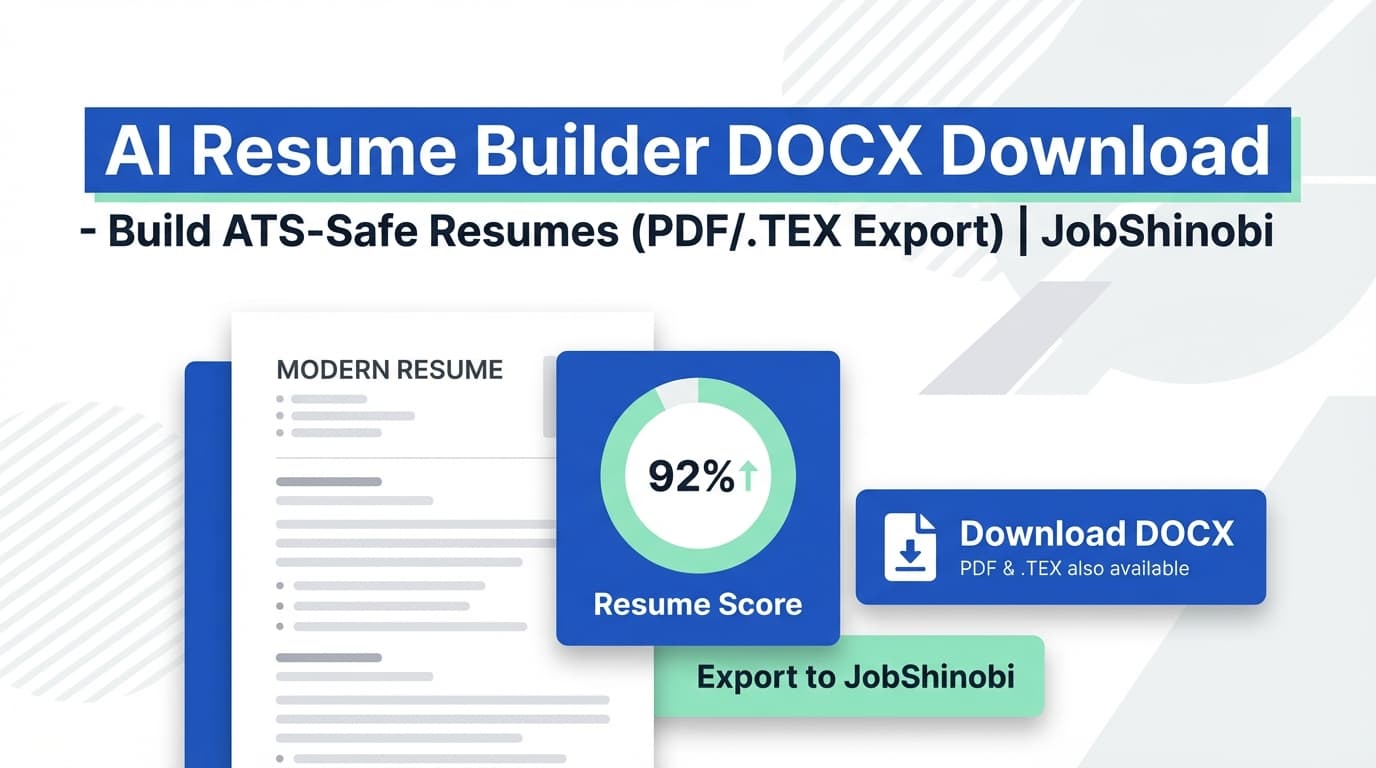
Transparent limitation (important): JobShinobi does not currently offer a one-click DOCX export.
If you must submit DOCX, JobShinobi supports a reliable workflow: export.texor PDF → convert to.docxusing the converter you prefer.
CTA: Create your resume in JobShinobi → export PDF / .tex → convert to DOCX only when required.
Who this page is for (and who it isn’t)
This is for you if…
- You care about ATS-friendly structure and want consistent output.
- You tailor resumes frequently and want a workflow that’s repeatable.
- You want an AI editor that can rewrite bullets, strengthen impact, and keep formatting intact.
- You’re okay using a conversion step when a portal requires DOCX.
This is not for you if…
- You need native “Download DOCX” inside the builder with zero conversion.
- You want a Word-first, drag-and-drop designer resume tool.
JobShinobi is built for candidates who want control + iteration + ATS alignment, not just templates.
Why JobShinobi fits “AI Resume Builder DOCX Download” intent (even without native DOCX export)
Most people searching this keyword don’t actually want “DOCX” as the end goal—they want a resume that:
- passes ATS parsing without weird formatting issues
- matches job descriptions (keywords + role alignment)
- is easy to update and tailor across many applications
- can still be delivered as DOCX when a portal forces it
JobShinobi is strong here because it’s not “just a resume maker”—it’s a resume workflow:
- LaTeX templates keep structure stable
- Cloud compilation + PDF preview makes output predictable
- AI Resume Agent accelerates tailoring without breaking layout
- Resume analysis + job matching reduces guesswork
- Version history prevents “resume_final_v12.docx” chaos
So even if DOCX is required occasionally, you don’t have to build your whole process around Word.
What you can download in JobShinobi (supported) vs DOCX (not supported)
Supported downloads (built into the editor)
From JobShinobi’s resume editor, you can:
- Download PDF (compiled output)
- Download
.tex(LaTeX source)
Not supported (today)
- DOCX download/export is not a built-in feature in JobShinobi.
This page exists to help you still satisfy the DOCX requirement with a practical conversion workflow—without sacrificing resume quality or your ability to tailor fast.
The simplest DOCX workflow: Use JobShinobi as your “master,” convert only when required
If you apply to many roles, the best approach is usually:
- Maintain your resume in JobShinobi (LaTeX + AI edits + versioning).
- Submit PDF whenever the portal allows it.
- When a portal forces DOCX, convert from:
.tex → .docx(best “source-of-truth” approach), orPDF → .docx(quick fallback)
That’s it. You avoid rebuilding and reformatting every time.
How JobShinobi’s AI Resume Builder works (real product flow)
Step 1: Sign in and open the Resume Builder
JobShinobi supports Google sign-in. After signing in, you can open the resume area here:
- Internal link: /dashboard/resume
Step 2: Start from a template (LaTeX templates library)
You can start from a template and generate a structured resume draft. Templates are stored and loaded in the product, and you can maintain multiple resumes.
What this gives you:
- consistent sections (Experience, Projects, Skills, Education, etc.)
- stable spacing and hierarchy
- less risk of “Word drift” (when spacing changes randomly over time)
Step 3: Edit with the AI Resume Agent (streaming) or manual LaTeX
JobShinobi supports two editing modes:
- AI mode: Chat with the AI Resume Agent (streaming responses) to rewrite bullets, adjust sections, and tailor content.
- Code mode: Edit LaTeX manually when you want direct control.
Because the resume is LaTeX, you’re not fighting invisible Word formatting—your structure remains predictable.
Step 4: Compile + preview PDF
JobShinobi compiles LaTeX and provides a PDF preview, so you can verify exactly what recruiters will see.
This matters for applications because it reduces:
- last-minute formatting surprises
- broken bullets or strange spacing after edits
- inconsistent section titles across versions
Step 5: Analyze your resume (scores + ATS/keyword insights)
JobShinobi includes a resume analysis endpoint that can generate:
- an overall score
- component scores (content, keywords, formatting, completeness, ATS)
- strengths + weaknesses/improvements
- keywords found + missing keywords
- ATS issues
It can also return cached analysis results when the resume hasn’t changed, which helps when you’re iterating rapidly.
Step 6: Match your resume to a job description (tailoring support)
You can run job matching by providing a job description (or job content) and generating match insights, then apply suggestions back to the editor.
This is the difference between “a resume” and “a resume tailored for this job.”
Step 7: Download PDF / .tex
When ready:
- download PDF for standard applications
- download
.texas your master/source file
Then convert to DOCX if required (next section).
How to get a DOCX file from JobShinobi (conversion options)
Option A (recommended): Convert .tex → .docx (source-of-truth approach)
Best for: repeatable conversion over time, fewer surprises, clean “master file” process.
- In JobShinobi, download your resume as
.tex - Convert
.texto.docxusing a converter tool (commonly Pandoc) - Open the DOCX in Word and proofread (always)
A commonly referenced Pandoc command looks like this:
pandoc resume.tex -o resume.docx
What to expect:
- Text and section structure usually converts well.
- Exact spacing/fonts may vary based on your LaTeX template and packages.
- Always do a quick formatting check before submitting.
Option B: Convert PDF → .docx (fast fallback)
Best for: one-off submissions when the portal forces DOCX and you need it quickly.
- Download PDF from JobShinobi
- Use your preferred PDF-to-DOCX converter
- Review spacing, bullets, and headings in Word
Trade-off: PDF-to-DOCX conversion can introduce weird line breaks or bullet indentation, especially with complex layouts.
Option C: Keep two deliverables: PDF for most jobs, DOCX only when forced
This is the most practical pattern for high-volume applicants:
- Use JobShinobi to generate strong, tailored PDF output
- Convert to DOCX only for portals or recruiters who explicitly require it
Key features that matter for “DOCX download” search intent
Even though JobShinobi is not a native DOCX exporter, it covers the underlying need: create, tailor, validate, and output a resume reliably.
| Feature | What it does in JobShinobi | Why it matters when DOCX is required |
|---|---|---|
| LaTeX Resume Templates | Start with structured templates in the resume dashboard | Stable structure makes conversion and tailoring easier |
| AI Resume Agent (Streaming Chat) | Edit your resume via chat; updates your LaTeX content | Faster tailoring without reformatting in Word |
| Cloud LaTeX Compilation + PDF Preview | Compiles LaTeX to PDF and previews it | You can validate output before submitting anywhere |
| Resume Analysis (Scoring + Feedback) | ATS score + keyword gaps + strengths/improvements | Fix issues before converting/exporting |
| Job Description Match | Compares your resume to a specific job and suggests improvements | Helps you tailor for each application instead of sending the same DOCX everywhere |
| Resume Version History | Stores versions and allows reverting | Makes it easy to maintain role-specific variants (e.g., Backend vs Data) |
| Export PDF | Built-in download from the editor | Use PDF wherever allowed |
Export .tex |
Built-in download from the editor | Convert to DOCX when necessary without rebuilding your resume |
PDF vs DOCX for ATS: what to do when you’re unsure
Different employers and ATS setups behave differently. A practical rule:
- If the job posting tells you a format, follow it.
- If it doesn’t, PDF is commonly acceptable and keeps formatting consistent.
- Some workflows (especially agencies) request DOCX so they can edit/annotate.
JobShinobi supports the safest operational approach:
- maintain a structured master resume
- export PDF for consistency
- convert to DOCX when required
Why JobShinobi’s LaTeX approach is valuable for ATS-focused resumes
Many resume builders optimize for visual design, but ATS success often depends on:
- clear section headings
- consistent formatting
- predictable structure (not layout tricks)
A LaTeX-first workflow encourages:
- clean structure over decorative formatting
- consistent spacing and typography
- fewer “mystery” formatting artifacts that appear after edits
JobShinobi then layers AI on top of that structure:
- rewrite and tailor content quickly
- analyze keyword gaps and ATS issues
- match to job descriptions to reduce “generic resume” submissions
JobShinobi vs DOCX-first resume builders (honest comparison)
DOCX-first builders
What they’re good at
- one-click Word export
- familiar editing experience for Word users
Common drawbacks
- formatting can drift as you edit and tailor repeatedly
- template layouts can become fragile over time
- some tools restrict downloads aggressively
JobShinobi (LaTeX-first + AI + analysis)
What it’s good at
- stable formatting through structure
- PDF output you can trust
- AI editing and resume scoring inside the workflow
- job matching + apply-suggestions loop
- version history for multiple tailored variants
Current drawback
- no native “Download DOCX” button
If DOCX export is your only deciding factor, choose a DOCX-first tool.
If you want an ATS-conscious resume workflow that stays stable and easy to tailor, JobShinobi is built for that—while still letting you create DOCX via conversion.
Bonus: Job tracking (if you’re applying at volume)
Many job seekers who care about “resume output formats” are also doing high-volume applications—and lose track of what they sent where.
JobShinobi includes a job tracker with:
- a dashboard to track applications
- realtime updates
- export to Excel (.xlsx)
It also supports an email-forwarding workflow (automation depends on membership status), but the key point is: JobShinobi can be your system for both resume iteration and application tracking.
Internal link: /dashboard/job-tracker
Pricing
JobShinobi offers paid subscriptions via Stripe payment links:
- Monthly: $20.00
- Yearly: $199.99
Internal link: /subscription
Note: do not purchase based solely on a promise of DOCX export—JobShinobi’s resume editor exports PDF and
.tex, and DOCX requires conversion.
Frequently Asked Questions
Does JobShinobi support AI resume builder DOCX download?
JobShinobi does not currently offer a native DOCX download/export button. JobShinobi supports PDF download and .tex download, and you can convert those files to DOCX using your preferred converter when required by a portal.
What formats can I download from JobShinobi?
From the resume editor, JobShinobi supports:
- PDF download
.tex(LaTeX source) download
What’s the best way to get a DOCX file from JobShinobi?
The most repeatable method is:
- download
.texfrom JobShinobi - convert
.tex → .docxusing a LaTeX-to-DOCX converter (commonly Pandoc) - open and proofread the DOCX before submitting
Can JobShinobi help tailor my resume to a job description?
Yes. JobShinobi supports job description input and resume-to-job matching, then you can apply suggestions back in the resume editor.
Does JobShinobi provide resume scoring / ATS feedback?
Yes. JobShinobi includes resume analysis that returns scores and structured feedback, including keyword analysis (present/missing/overused) and ATS-focused issues.
Can I keep multiple tailored versions of my resume?
Yes. JobShinobi stores resumes and resume versions, making it easier to maintain multiple variants and revert when you want to roll back changes.
If a portal accepts PDF, should I still submit DOCX?
If the portal accepts PDF and doesn’t request DOCX, PDF is often the simplest because formatting remains consistent. If the portal explicitly requires DOCX, convert and submit DOCX.
Get started with JobShinobi
If you need a resume workflow that’s built for tailoring, validation, and stability—and you’re okay converting to DOCX when required—JobShinobi is designed for you.
- Sign in: /login
- Start building: /dashboard/resume
- Track applications: /dashboard/job-tracker
- View subscription options: /subscription