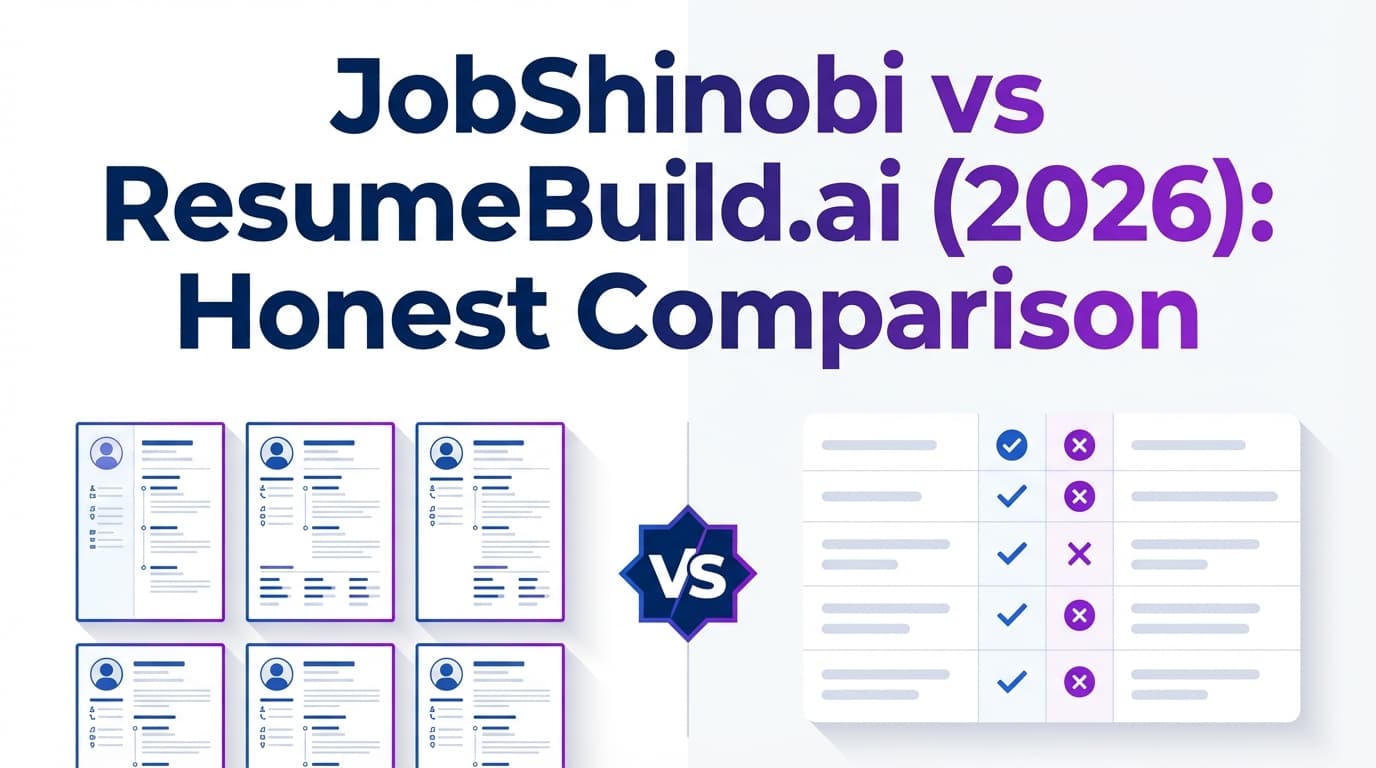
If you’re comparing JobShinobi and ResumeBuild.ai, you’re probably trying to answer one question: Which tool will help me get more interviews—with less wasted time? Both are positioned as ATS-friendly, AI-powered resume builders, but they take very different approaches.
Quick Verdict:
Choose JobShinobi if you want an ATS-focused workflow + resume scoring/matching + an automated job application tracker (especially the email-forwarding auto-tracker). Choose ResumeBuild.ai if you primarily want a simple resume builder with a very large template library (340+ templates) and you prefer an all-in-one “career tool” style product.
TL;DR Comparison
| Feature | JobShinobi | ResumeBuild.ai |
|---|---|---|
| Primary focus | ATS optimization + tracking automation | Resume building + templates (career-tool positioning) |
| Resume building approach | LaTeX-based editor with PDF preview + version history | Template-driven AI resume builder (ATS-friendly templates) |
| ATS analysis / scoring | ✅ Yes (resume scoring + breakdown + keyword/ATS feedback) | Not clearly advertised as a “scoring” product (markets ATS-friendly resumes/templates) |
| Resume-to-job matching | ✅ Yes (job description extraction + match score + keyword gaps) | Markets “resume tailoring” (plan limits not clearly shown in crawlable HTML) |
| Job application tracking | ✅ Yes (including email-forwarding → auto-logged applications) | Markets “job searching” as an extra feature (details unclear in crawlable HTML) |
| Templates | Smaller curated LaTeX templates (quality/structure focus) | ✅ 340+ cloneable templates |
| Starting price | $20/month (Pro) | Free (Basic) |
| Other paid options | $199.99/year (Pro) | $29/month (Pro), $129 one-time (Lifetime promo shown in site snippets) |
| Best for | People serious about ATS + tracking lots of applications | People who want a fast, template-heavy resume builder |
JobShinobi Overview
JobShinobi is built for job seekers who are tired of two pain points: ATS rejections and manual job tracking. It combines an AI resume builder with an ATS-style analysis workflow and a job application tracker that’s designed to reduce “admin work” during a job search.
A standout difference is JobShinobi’s email-forwarding automation: you get a unique forwarding address and can forward application-related emails (confirmations, interview invites, rejections). JobShinobi uses AI extraction and fuzzy matching to create or update the right job application entry automatically.
Key Strengths
- Email-forwarding → automated job tracking: Forward emails and JobShinobi auto-logs applications and updates statuses (Applied/Interview/Offer/Rejected, etc.).
- ATS analysis + job matching: Resume scoring with breakdowns, plus job description extraction and resume-to-job match scoring with keyword gaps.
- LaTeX-first resume workflow: Designed to preserve structure and formatting consistency, with PDF compilation and preview.
Limitations (Being Transparent)
- LaTeX isn’t for everyone: Even with an AI agent, a LaTeX-based workflow can feel less “WYSIWYG” than traditional drag-and-drop editors.
- Automation is Pro-gated: The email-processing workflow requires a Pro membership.
ResumeBuild.ai Overview
ResumeBuild.ai positions itself as “the best AI resume builder” and prominently claims it’s “trusted by 1.4M+” (from its homepage title tag). It’s heavily template-oriented and emphasizes getting started quickly, with 340+ cloneable templates highlighted on its AI resume builder page.
ResumeBuild.ai also markets itself as more than a resume builder, mentioning extra capabilities like mock interview, job searching, and resume tailoring across its site metadata and pricing/features messaging—though in our verification, the plan-by-plan details are not fully visible in crawlable HTML, so it’s best to confirm inside the product during signup.
Key Strengths
- Very large template library: 340+ cloneable templates are prominently advertised on its AI resume builder page.
- Easy “get started” positioning: Designed for quick onboarding and fast resume creation.
- Free entry plan: A “Basic plan” is shown on the pricing page.
Limitations (Based on Verified Signals + Common Buyer Risks)
- Thin public plan detail: The pricing page is relatively thin in crawlable content, making it harder to verify exact feature limits before purchase.
- Refund window appears strict: Their FAQ snippet states refunds can be requested for the current month within 24 hours of the transaction (verify in-product/FAQ before purchasing).
- Independent review footprint is unclear: Many “reviews” ranking in search results appear to be for other domains (e.g., resumebuild.com) or low-signal aggregator sites, so it’s harder to validate consistent third-party feedback specifically for resumebuild.ai.
Feature-by-Feature Comparison
1) Resume Creation Experience (Templates vs. Structure Control)
JobShinobi:
JobShinobi’s resume builder is LaTeX-based, with a cloud compilation pipeline that generates a PDF preview. If you care about repeatable, consistent formatting and want a workflow that’s closer to “source of truth → compiled output,” this is a strong approach. It also supports resume version history (useful when you’re tailoring multiple variants).
ResumeBuild.ai:
ResumeBuild.ai is strongly template-led, emphasizing 340+ cloneable templates. If you want lots of visual starting points (and you prefer not to think about formatting mechanics), this approach can feel faster.
Winner: Depends on preference
- Choose ResumeBuild.ai for template variety and quick starts.
- Choose JobShinobi for formatting control, consistent structure, and versioning workflows.
2) ATS Optimization & Feedback
JobShinobi:
JobShinobi includes a dedicated resume analysis flow: score breakdowns (including ATS-focused checks), strengths/weaknesses, keyword analysis, and job-alignment feedback. It’s built for iterative improvement—analyze → adjust → re-check.
ResumeBuild.ai:
ResumeBuild.ai repeatedly markets “ATS-friendly templates” and “resume tailoring,” but it’s not clearly presented as an ATS scoring product (at least in the pages we verified). If ATS scoring is your main decision factor, you’ll likely want to confirm whether the product provides measurable scoring, keyword gap analysis, and structured feedback.
Winner: JobShinobi (for verified scoring + analysis depth)
3) Resume Tailoring to a Specific Job
JobShinobi:
JobShinobi supports job description extraction (URL or paste) and resume-to-job matching, including match score and missing/present keywords. This is geared toward making targeted edits for each application.
ResumeBuild.ai:
ResumeBuild.ai markets “resume tailoring” as a feature across its site messaging. However, exact workflow, limits, and outputs aren’t fully confirmed from crawlable public pages—so treat this as “available, but verify how it works” before relying on it.
Winner: JobShinobi (for verified, explicit match workflow)
4) Job Application Tracking (Where JobShinobi Is Fundamentally Different)
JobShinobi:
This is JobShinobi’s biggest differentiator: email forwarding → automatic tracking. Instead of maintaining a spreadsheet, you forward job emails and JobShinobi extracts key details (company, role, status, etc.) and updates your tracker. It also supports manual CRUD editing, real-time updates, and export to Excel.
ResumeBuild.ai:
ResumeBuild.ai mentions “job searching” in its pricing/features messaging, but that’s not the same as a built-in application tracker—so you should confirm whether it includes tracking, what fields it supports, and whether it integrates with email or ATS systems.
Winner: JobShinobi (clear, verified automation + tracking workflow)
Pricing Comparison (Verified 2026-01-21)
Note: Pricing can change quickly. The amounts below reflect what was visible in verified site snippets and analyzed pages on 2026-01-21.
| Plan | JobShinobi | ResumeBuild.ai |
|---|---|---|
| Free | Limited (core email automation requires Pro) | Basic: Free |
| Monthly | $20/month (Pro) | $29/month (Pro) |
| Yearly | $199.99/year (Pro) | Not prominently verified in crawlable pricing HTML |
| Lifetime | Not offered (verified in product plan config) | $129 one-time (Lifetime) shown in site snippets (often presented as a promo/discount) |
Value Analysis:
- If you want a free starting point and mainly care about generating a resume quickly, ResumeBuild.ai has a clear advantage with its Basic plan.
- If you’re applying to many roles and want to reduce job-search overhead, JobShinobi’s tracking automation can justify the paid plan quickly.
- If you strongly prefer a one-time purchase, ResumeBuild.ai’s Lifetime option may be attractive—but confirm what it includes (some lifetime plans exclude “unlimited credits” or ongoing reviews, per pricing snippets).
Who Should Choose JobShinobi?
You’ll prefer JobShinobi if you:
- Want ATS-style analysis, scoring, and keyword feedback you can iterate on.
- Are applying to many jobs and want email-forwarding → automatic application tracking instead of spreadsheets.
- Like the idea of a LaTeX-based resume with predictable formatting and version history.
- Want resume-to-job match scoring and structured tailoring guidance.
Who Should Choose ResumeBuild.ai?
You’ll prefer ResumeBuild.ai if you:
- Want a large template library (340+ templates) and a fast “clone and edit” experience.
- Want a free plan to test the product before paying.
- Prefer a resume builder that feels more like an “all-in-one career tool” (it markets mock interviews, job searching, and tailoring—verify exact implementation and plan limits).
Switching from ResumeBuild.ai to JobShinobi
- Data migration: There’s no verified one-click import from ResumeBuild.ai into JobShinobi. Expect to copy/paste content and reformat into a JobShinobi template (or rebuild using the AI agent).
- Learning curve: If you’ve never used LaTeX-style editing, plan for a short ramp-up. The upside is consistency once you’re set up.
- Support/workflow tips: Start with one “master” resume in JobShinobi, then create tailored variants using the job match workflow and version history.
FAQ
Is JobShinobi really better than ResumeBuild.ai?
It depends on what “better” means for your job search.
- If you want ATS feedback + matching + automated tracking, JobShinobi is typically the stronger fit.
- If you want lots of templates and a free plan, ResumeBuild.ai may be a better starting point.
Which is cheaper?
- Free: ResumeBuild.ai offers a free Basic plan (verified on its pricing page headings).
- Paid monthly: JobShinobi is $20/month, ResumeBuild.ai is $29/month (verified via pricing snippets and pricing page structure).
- One-time: ResumeBuild.ai advertises a $129 lifetime promo in site snippets; JobShinobi does not advertise a lifetime plan.
Can I migrate from ResumeBuild.ai to JobShinobi?
Not automatically (no verified import tool). Most users will migrate by moving content (experience, projects, skills) and then using JobShinobi’s templates + analysis tools to refine structure and keywords.
I searched “Jobscan vs AI resume builder”—where does JobShinobi fit?
Jobscan is commonly associated with ATS scanning and keyword match-style workflows, while many “AI resume builders” focus on writing and templates. JobShinobi sits in between: it’s a resume builder, but it also includes ATS-oriented analysis and job matching, plus a job application tracker—so it’s often evaluated by the same buyers comparing Jobscan-style analysis tools and resume builders.
What is ResumeBuild.ai’s refund policy?
ResumeBuild.ai’s FAQ snippet (visible in search results) states you can request a refund for the current month within 24 hours of the transaction, with additional restrictions mentioned. Policies can change—confirm the current terms on resumebuild.ai before purchasing.