If you’re searching Reddit for AI-powered resume builder recommendations for 2026, you’ll see a consistent pattern:
- Some people want the fastest path to a clean, ATS-friendly resume
- Others want a system that helps them tailor per job and actually manage the application grind (tracking, statuses, follow-ups)
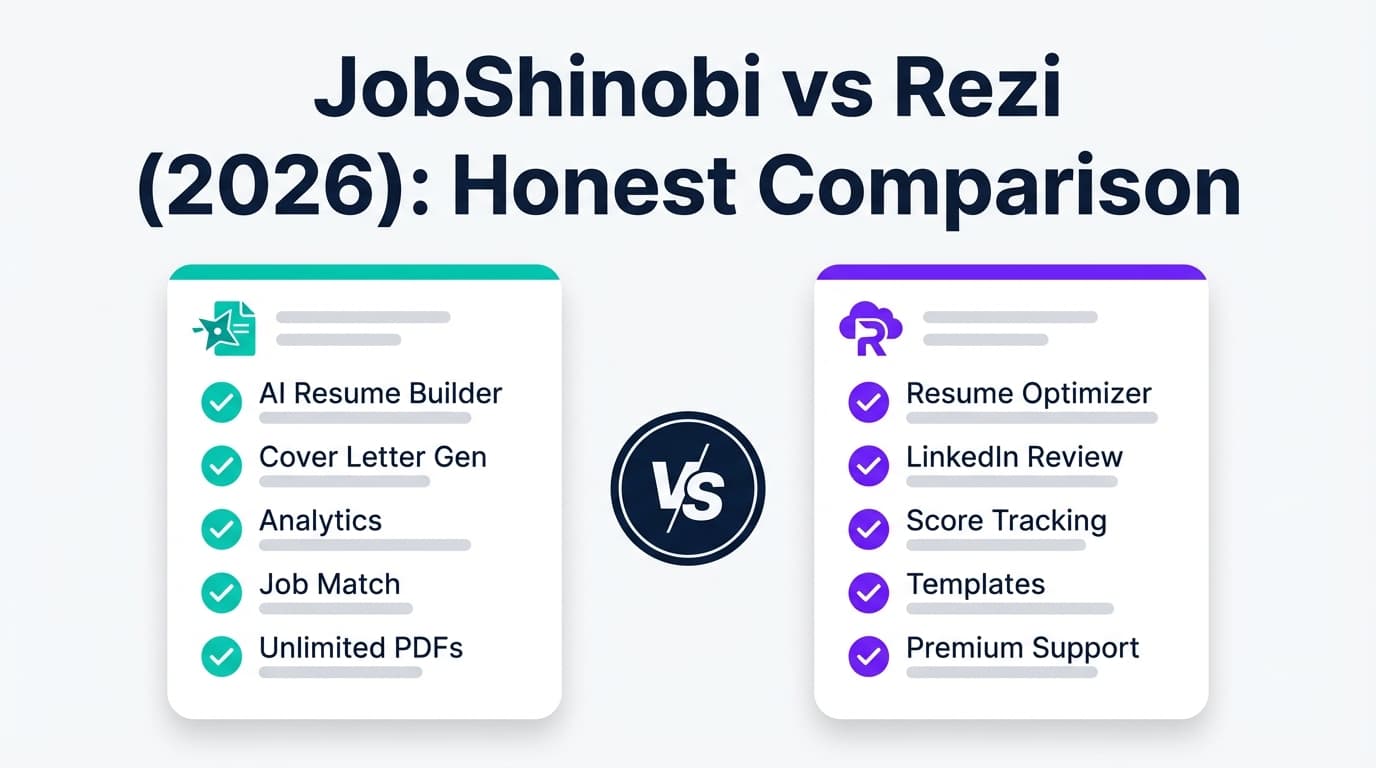
JobShinobi and Rezi both aim to help you beat ATS filters—but they’re built for different workflows.
Quick Verdict:
Choose Rezi if you want a polished, mainstream AI resume builder with strong ATS-focused guidance, lots of educational content, and a low-friction UI. Choose JobShinobi if you want an ATS resume builder plus an application system—especially if you like structured formatting (LaTeX), version control, resume-to-job matching, and email-forwarded job tracking.
TL;DR Comparison
| Feature | JobShinobi | Rezi |
|---|---|---|
| Primary focus | Resume building + ATS analysis + job application tracking | ATS-focused resume + cover letter builder |
| Resume format approach | LaTeX-first editor + cloud PDF compilation | Traditional resume builder workflow (web app) |
| ATS/Resume scoring | ✅ Yes (resume scoring + ATS feedback) | ✅ Yes (“Rezi Score” / ATS scoring & checks) |
| Resume-to-job matching | ✅ Yes (job description extraction + match analysis) | ✅ Yes (keyword targeting vs job description) |
| Job application tracking | ✅ Yes (dashboard + analytics + export) | ⚠️ Not the core product (resume-focused) |
| Email forwarding → auto-tracking | ✅ Yes (Pro feature) | ❌ No (not advertised/available) |
| Version history / rollback | ✅ Yes (versioned saves + “unlimited undo” UI) | ⚠️ Not a primary advertised feature |
| Starting price | $20/mo | $29/mo |
| One-time/lifetime option | ❌ No | ✅ Yes ($149 one-time, per Rezi pricing) |
| Free plan | ✅ Limited (automation gated to Pro) | ✅ Yes (but restrictive: 1 resume, 3 PDF downloads, per Rezi docs/pricing) |
| Best for | Power users applying to many roles who want tracking + tailoring | Most job seekers who want ATS-focused resume help fast |
JobShinobi Overview
JobShinobi is an AI resume builder designed around two realities of modern job searching:
- You need to beat ATS filters and tailor your resume to each job.
- You also need to track dozens (or hundreds) of applications without living in spreadsheets.
It combines a LaTeX-based resume workflow (structured formatting and consistent output) with AI features like resume scoring, job matching, and a chat-style resume agent. The standout differentiator is its email-forwarding automation: you forward application emails to a unique address and JobShinobi uses AI to extract company/title/status and update your job tracker automatically (Pro feature).
Key Strengths
- Email-forwarding job application tracking (Pro): forward confirmation/interview emails and auto-create/update applications.
- LaTeX editor + live PDF preview: structured resumes with cloud compilation and export to PDF /
.tex. - AI resume workflow depth: chat-based resume agent, resume scoring, job description extraction, and match analysis.
- Built-in analytics: response rate, interview conversion, trends based on your tracked applications.
Limitations (Honest)
- LaTeX isn’t for everyone: if you prefer drag-and-drop design tools, JobShinobi can feel more “power user.”
- Automation is Pro-gated: email parsing/auto-tracking is restricted to Pro members.
- Free trial messaging vs implementation: marketing mentions a “7-day free trial,” but trial logic may be configured externally (e.g., in Stripe) rather than visible in code.
Rezi Overview
Rezi is one of the most frequently mentioned ATS-focused resume tools across job-search communities, including Reddit. Its positioning is clear: help you build an ATS-friendly resume with AI-driven writing help, keyword targeting, and scoring/feedback.
On Rezi’s site, it emphasizes being a “Free AI Resume Builder” and highlights features like keyword targeting and resume scoring. It also publishes extensive supporting content and tool pages (for example, a free ATS resume checker page and documentation explaining subscription plans and cancellation).
Key Strengths (Verified)
- Strong ATS + keyword targeting focus: Rezi heavily emphasizes keyword matching and ATS readiness across its product pages.
- Clear personal pricing options: includes a subscription and a one-time payment option (helpful if you don’t want recurring billing).
- Large social proof footprint: Rezi markets itself as trusted by millions of job seekers (claimed on homepage) and implements schema like AggregateRating/FAQ on key pages.
Limitations (Based on research & common feedback patterns)
- Free plan is restrictive: Rezi’s docs/pricing indicate the free plan allows 1 resume and 3 PDF downloads (total).
- Less “job search system” functionality: Rezi is primarily a resume/cover-letter tool; it doesn’t position itself as an application-tracking automation platform.
- ATS scores aren’t a guarantee: like any scoring system, it can guide improvements, but it can’t guarantee outcomes across different ATS platforms and recruiter preferences.
Feature-by-Feature Comparison
1) ATS Optimization & Resume Scoring
JobShinobi:
JobShinobi provides resume scoring with structured feedback (overall + sub-scores like keywords/formatting/completeness/ATS) and stores analyses with caching so you can re-check without repeating identical evaluations. It also supports job matching against a pasted job description or URL (extracting structured details and keywords).
Rezi:
Rezi centers its product around ATS optimization. Its pages and tools emphasize resume scoring and ATS checks; it also offers keyword targeting against job descriptions and a dedicated free ATS resume checker page.
Winner: Tie
- Choose Rezi if you want ATS optimization as the main product experience and you prefer a mainstream UI.
- Choose JobShinobi if you want ATS scoring plus job matching and a tighter loop between “analyze → revise → version → re-analyze,” especially in a structured format.
2) Tailoring to Specific Jobs (Keyword Matching)
JobShinobi:
You can paste a job URL or description, extract structured requirements/keywords, then run a resume-to-job match analysis (including missing vs present keywords) and apply suggestions back in the editor.
Rezi:
Rezi promotes “ATS keyword targeting” and job-description-driven keyword guidance to increase match likelihood.
Winner: Slight edge to Rezi for simplicity; JobShinobi for workflow depth
- Rezi tends to win when you want the fastest “paste JD → get keywords → update resume” flow.
- JobShinobi wins if you want deeper analysis + integrated version history and a more systematized workflow.
3) Resume Editing Experience (LaTeX vs Traditional Builder)
JobShinobi:
LaTeX-first editing with cloud compilation and live PDF preview is powerful for consistent formatting and structure. It’s especially attractive if you care about repeatability and want fewer “mysterious formatting shifts.”
Rezi:
Rezi’s approach is built for broad accessibility. If you don’t want to think about markup or compilation, Rezi’s style is usually quicker to adopt.
Winner: Depends on your preference
- JobShinobi for structured, consistent formatting and power-user control
- Rezi for faster onboarding and a more “standard” resume builder feel
4) Job Application Tracking & Job Search Management
JobShinobi:
This is where JobShinobi separates from most resume builders: it includes a job tracker dashboard (CRUD, realtime updates) plus analytics (response rate, interview conversion, trends). You can also export tracked applications to Excel.
Most importantly, JobShinobi can auto-track applications via email forwarding: forward job-related emails to your unique forwarding address and it can create/update applications automatically (Pro-gated).
Rezi:
Rezi’s public positioning is resume + cover letter + ATS optimization. It does not advertise email-forwarding job tracking or a built-in application CRM as a core feature.
Winner: JobShinobi
If you’re applying to many roles and you want your resume tool to double as a job-search operating system, JobShinobi is the clear fit.
5) Version History / Iteration Speed
JobShinobi:
JobShinobi supports resume version history and a workflow that encourages iteration (manual saves, chat-driven changes, and reverting). If you tailor frequently, this matters.
Rezi:
Rezi has strong guidance and scoring, but versioning/rollback isn’t positioned as a core “feature set” in the same way.
Winner: JobShinobi (for heavy tailoring)
If you treat your job search like an experiment loop, versioning is a big deal.
Pricing Comparison (Verified)
Pricing can change quickly. The following was verified on 2026-01-21 from vendor pages/docs.
| Plan | JobShinobi | Rezi |
|---|---|---|
| Free | Limited (dashboard access; key automation like email processing gated to Pro) | Free plan available, but restrictive (docs/pricing indicate 1 resume + 3 PDF downloads) |
| Monthly | $20/month (Pro) | $29/month (Pro) |
| Yearly | $199.99/year | Not confirmed from Rezi’s main pricing page headings during verification |
| One-time / Lifetime | ❌ No | ✅ $149 one-time (lifetime option advertised) |
Value Analysis:
- If you want the lowest long-term cost, Rezi’s $149 one-time option can be compelling (especially if you update your resume occasionally over years).
- If you want the best “job search workflow” value, JobShinobi’s price includes tooling beyond resume writing—tracking, analytics, and email-forwarding automation.
Who Should Choose JobShinobi?
You’ll prefer JobShinobi if you:
- Apply to lots of roles and want job application tracking + analytics in the same tool as your resume builder
- Want a workflow where you can tailor, score, match, and iterate repeatedly (with version history)
- Like (or are willing to learn) a LaTeX-first resume workflow for consistent formatting
- Want email-forwarding automation to reduce manual tracking work
Who Should Choose Rezi?
You’ll prefer Rezi if you:
- Want a well-known, ATS-focused resume builder that’s commonly mentioned in job-search communities
- Prefer a more mainstream resume-builder experience and want to move fast
- Want ATS keyword targeting + scoring as your primary workflow
- Like the idea of a one-time payment instead of a monthly subscription
Switching from Rezi to JobShinobi
- Data migration: Rezi exports are typically PDF/Doc-oriented. JobShinobi is LaTeX-based, so expect to copy and re-structure your content into a JobShinobi template rather than a one-click import (no official import flow was verified).
- Learning curve: Moderate if you’ve never used LaTeX-style editing. Easier if you already prefer structured, consistent formatting.
- Best practice: Use Rezi’s output as a reference, then rebuild once in JobShinobi and rely on JobShinobi’s versioning + job matching for ongoing tailoring.
FAQ
Is JobShinobi really better than Rezi?
It depends on what “better” means for your job search.
- If you mainly want ATS-focused resume writing help with keyword targeting and scoring, Rezi is a strong choice.
- If you want a tool that helps you manage the entire job search workflow—tracking applications, seeing analytics, and automating updates from email confirmations—JobShinobi is the better fit.
Which tool is more “Reddit-recommended” in 2026?
Rezi is commonly mentioned in job-search discussions as an ATS-focused resume builder. JobShinobi fits a slightly different “power user” category—more like a resume builder + job search system—so it may show up less often in generic “best resume builder” threads, but it can be a better match for people applying at high volume.
Which is cheaper?
- Short-term monthly: JobShinobi ($20/mo) is cheaper than Rezi ($29/mo).
- Long-term: Rezi can be cheaper if you choose the $149 one-time option and keep using it for years.
Can I migrate from Rezi to JobShinobi?
Yes, but it’s not typically a one-click import. Plan to transfer your content into JobShinobi’s LaTeX template format, then use JobShinobi’s scoring + job matching to optimize and iterate.