If you’re comparing AI resume builders in 2026, you’re probably trying to answer one core question: which tool will actually help you land more interviews—without wasting hours rewriting the same resume and losing track of applications.
JobShinobi and Rezi both focus on ATS-friendly resumes, but they take very different approaches:
- Rezi is a guided, ATS-optimization-first resume builder with keyword targeting, scoring, and a large content/education footprint.
- JobShinobi is a LaTeX-first resume system plus ATS analysis + job-to-resume matching, with a standout differentiator: email-forwarding that auto-tracks your job applications.
Quick Verdict:
Choose Rezi if you want a traditional resume builder experience with strong ATS guidance, keyword targeting, and straightforward “write + score + export” workflow. Choose JobShinobi if you want a LaTeX-based resume workflow and you’re serious about tracking applications automatically (without spreadsheets) while tailoring resumes to job descriptions.
TL;DR Comparison
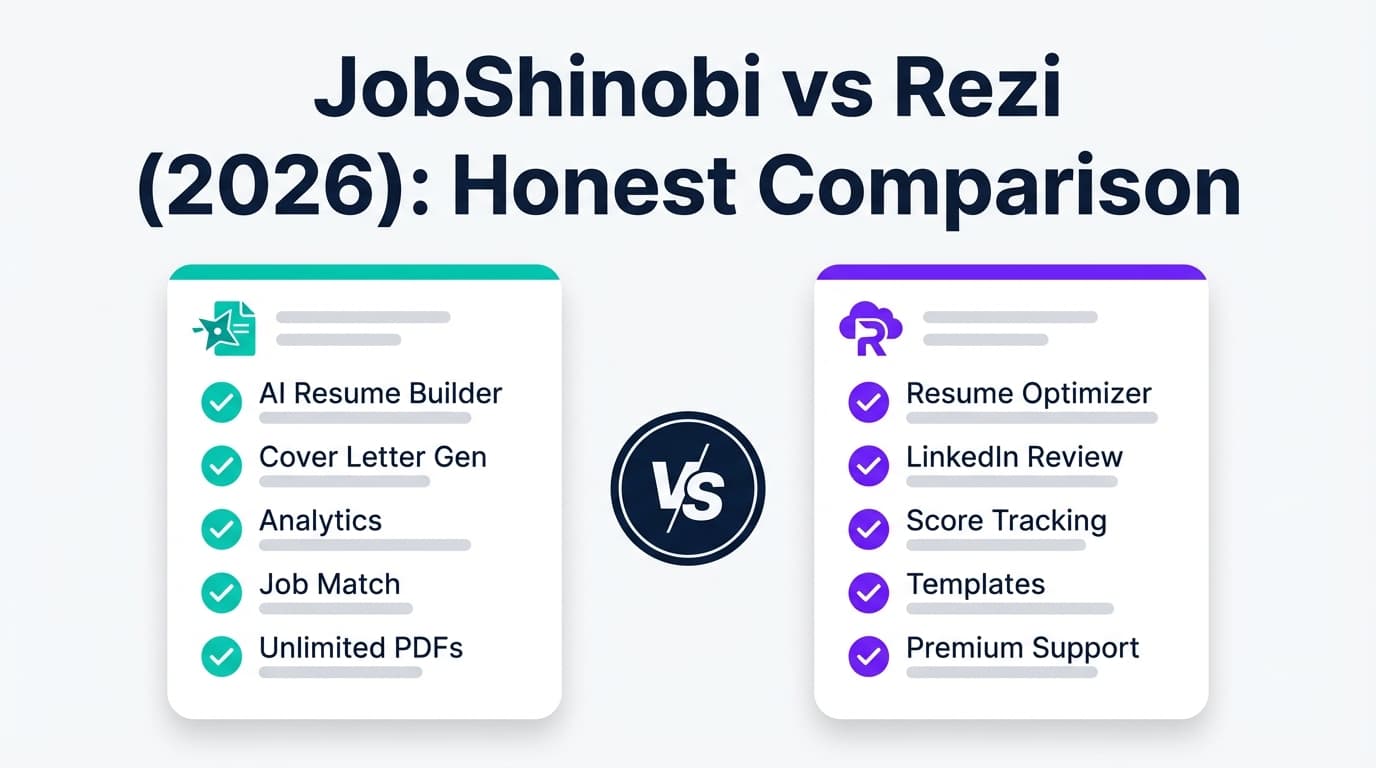
| Feature | JobShinobi | Rezi |
|---|---|---|
| ATS resume scoring & feedback | ✅ Yes (resume scoring + ATS analysis) | ✅ Yes (resume scoring + resume checker) |
| Keyword gap / job targeting | ✅ Yes (job description extraction + match analysis) | ✅ Yes (“AI Keyword Targeting”) |
| Resume editing workflow | LaTeX-first editor + PDF compile/preview | Form-based builder (traditional resume builder UX) |
| Version history / revert | ✅ Yes (version history + “unlimited undo” implemented) | Not clearly positioned as version-history-first (varies by workflow) |
| Job application tracking | ✅ Yes (job tracker + email forwarding → auto log) | ❌ Not a core feature (Rezi is primarily resume-focused) |
| Automation for tracking applications | ✅ Email parsing + fuzzy matching updates | ❌ No equivalent email-forwarding tracker found |
| Starting price | $20/mo (Pro) | $29/mo (Pro) |
| Lifetime plan | ❌ No | ✅ Yes ($149 one-time) |
| Free plan | Limited (core automation gated to Pro) | ✅ Yes (notable limits like 1 resume + 3 downloads, per Rezi docs/pricing) |
| Best for | Job seekers applying to many roles who want resume + tracking + analytics | Job seekers who want ATS-guided resume building and keyword targeting |
JobShinobi Overview
JobShinobi is built for job seekers who feel stuck in a loop: apply → hear nothing → tweak resume → apply again → lose track of everything. It combines:
- A LaTeX-based resume builder (with a cloud compile + PDF preview workflow)
- AI resume scoring / ATS feedback plus job-to-resume matching
- A job tracker with a unique automation workflow: forward your application confirmation emails and JobShinobi extracts the company/title/status and logs it automatically.
That last piece is the biggest differentiator. Most resume builders stop at “export PDF.” JobShinobi tries to help you run the whole process like a lightweight job-search CRM.
Key Strengths
- Email-forwarding → automatic job application tracking: forward confirmation emails to a unique address and JobShinobi logs/updates applications automatically (Pro-gated).
- LaTeX-first workflow: good fit for candidates who want consistent formatting and a more “code + compile” style resume process.
- Analytics dashboard: calculates metrics like response rate / interview conversion from your tracked applications.
Limitations (being candid)
- LaTeX isn’t for everyone: if you prefer drag-and-drop templates, JobShinobi may feel technical.
- Pro gating for automation: the email processing workflow is restricted to paid users.
- Trial messaging vs implementation: the product marketing mentions a “7-day free trial,” but trial enforcement may be handled in Stripe rather than directly visible in product code.
Rezi Overview
Rezi is a well-known ATS-focused resume builder positioned around making resumes that pass screening software and read well to recruiters. Its site emphasizes:
- AI Keyword Targeting (paste a job description, get keyword suggestions)
- Resume scoring + feedback
- A free ATS resume checker that scans for many issues (keywords, spelling, formatting, etc.)
- Paid plans with a 30-day money-back guarantee (as stated on Rezi’s pricing page)
Rezi also has a strong content footprint (guides, comparisons, and tool pages), which is part of why it’s frequently mentioned in “AI resume builder reviews 2026” lists.
Key Strengths (verified)
- Strong ATS optimization workflow: keyword targeting + resume scoring are core to the product.
- Clear plan options: Free, Pro ($29/month), and Lifetime ($149 one-time) were listed on Rezi’s pricing/docs pages at time of review.
- Social proof & reviews presence: Rezi has a large volume of on-site reviews content plus third-party review coverage (e.g., Trustpilot listing).
Limitations (based on common user feedback themes)
- Keyword suggestions can be hit-or-miss: some users report that AI keyword targeting can feel “wonky” or include irrelevant keywords (commonly discussed in community threads).
- Primarily a resume tool: if you need job application tracking (especially automated), you may end up using spreadsheets or another tracker alongside Rezi.
- Free plan constraints: Rezi’s free plan is usable, but limited (e.g., resume count/download limits mentioned in Rezi’s own plan documentation).
Feature-by-Feature Comparison
1) ATS Optimization & Resume Scoring
JobShinobi:
JobShinobi provides structured resume scoring and ATS-focused feedback (including a breakdown across categories), plus deeper analysis objects and caching so you can re-run analysis when the resume changes. It also supports job matching: you can paste a job description or URL, extract requirements, and get match insights.
Rezi:
Rezi is built around ATS optimization as a primary value proposition. It offers resume scoring, an ATS resume checker, and keyword targeting against job descriptions—this is the center of the product experience.
Winner: Tie (different styles)
- Choose Rezi if you want a streamlined, resume-first ATS workflow.
- Choose JobShinobi if you want ATS scoring plus job matching and a broader “job search system.”
2) Resume Builder Experience (Editing + Output)
JobShinobi:
- LaTeX editor + cloud compilation + PDF preview
- Exports PDF and
.texsource - Version history is part of the workflow (save versions, revert/undo)
Rezi:
- Traditional resume builder UX
- Guided sections and ATS-oriented structure
- Focus is on producing an ATS-ready output without needing a “code editor” experience
Winner: Depends on your preference
- Rezi wins for most users who want a familiar builder.
- JobShinobi wins if you specifically want LaTeX control and reproducible formatting.
3) Job Targeting (Job Description → Tailored Resume)
JobShinobi:
JobShinobi supports job description extraction (URL or pasted text) and performs resume-to-job matching, including keywords present/missing and tailoring suggestions. This is designed to reduce the “rewrite from scratch” cycle.
Rezi:
Rezi’s “AI Keyword Targeting” is designed to analyze a job description and suggest keywords and improvements aligned to ATS screening.
Winner: Slight edge to JobShinobi (for tailoring workflow depth)
Rezi is very strong at keyword targeting, but JobShinobi adds a broader job-to-resume matching layer and a workflow that can connect tailoring to tracking and analytics.
4) Job Application Tracking (Where Most Resume Builders Stop)
JobShinobi:
This is where JobShinobi clearly differentiates. It includes:
- A job application tracker (CRUD table, status management, export)
- Email forwarding automation: forward job-related emails and JobShinobi extracts company/title/status and updates your tracker automatically (Pro feature)
Rezi:
Rezi is primarily a resume-building and resume-optimization platform. It does not position email-forwarding application tracking as a core feature.
Winner: JobShinobi
If your biggest pain is “I can’t keep track of all these applications,” JobShinobi is built for that.
Pricing Comparison (Verified)
| Plan | JobShinobi | Rezi |
|---|---|---|
| Free | Limited (core automation like email parsing is Pro-gated) | ✅ Free plan available (with limits such as resume/download caps mentioned in Rezi docs) |
| Monthly | $20/month (Pro) | $29/month (Pro) |
| Annual | $199.99/year (Pro yearly) | Not highlighted as the main default option (Lifetime plan is emphasized) |
| Lifetime | ❌ No | ✅ $149 one-time |
| Refund policy | Not clearly standardized publicly (depends on billing terms) | ✅ 30-day money-back guarantee stated on pricing |
Value analysis:
- Rezi offers strong value if you want a one-time payment option (lifetime) and a resume-only workflow.
- JobShinobi can be better value if you’ll actually use the tracking + analytics + automated email logging—because replacing a separate tracker/tool saves time and context switching.
Who Should Choose JobShinobi?
You’ll prefer JobShinobi if you:
- Apply to lots of roles and want application tracking without spreadsheets
- Like the idea of simply forwarding confirmation emails and having your tracker update automatically
- Want a LaTeX-based resume workflow with PDF compilation and repeatable formatting
- Care about measuring your job search (response rate, interview conversion) and improving the process systematically
Who Should Choose Rezi?
You’ll prefer Rezi if you:
- Want a resume builder first, not a job-search system
- Care most about ATS-focused guidance (keyword targeting + scoring) with minimal setup
- Want a lifetime plan so you can avoid another monthly subscription
- Prefer a more traditional resume-building UI (and don’t want to touch LaTeX)
Switching from Rezi to JobShinobi
If you’ve built resumes in Rezi and want JobShinobi’s tracking + LaTeX workflow:
- Data migration: No one-click import was verified. Expect to copy/paste your content and rebuild in a LaTeX template.
- Learning curve: Moderate. If you’ve never edited LaTeX, plan on a short ramp-up (but you get more control).
- Support/workflow: Once set up, JobShinobi’s email-forwarding job tracking can reduce ongoing admin work significantly.
FAQ
Is JobShinobi really better than Rezi?
It depends on what “better” means for you. Rezi is often a better fit if your goal is purely “build an ATS-friendly resume quickly with guided optimization.” JobShinobi is a better fit if you want resume optimization plus job tracking and automation, especially if you apply at volume.
Can I migrate from Rezi to JobShinobi?
Yes, but it’s likely manual. Plan to transfer your resume content into JobShinobi’s template/editor workflow and re-run ATS/job match analysis inside JobShinobi.
Which is cheaper?
- Monthly: JobShinobi ($20/mo) is cheaper than Rezi ($29/mo).
- Long-term: Rezi can be cheaper if you choose the $149 lifetime plan and only need resume features (not tracking automation).
Which one is better for ATS optimization?
Both are strong, but in different ways:
- Rezi is extremely ATS-centric in its product design (keyword targeting + scoring are core).
- JobShinobi adds ATS analysis plus job matching and a broader workflow for iterating resumes across applications.