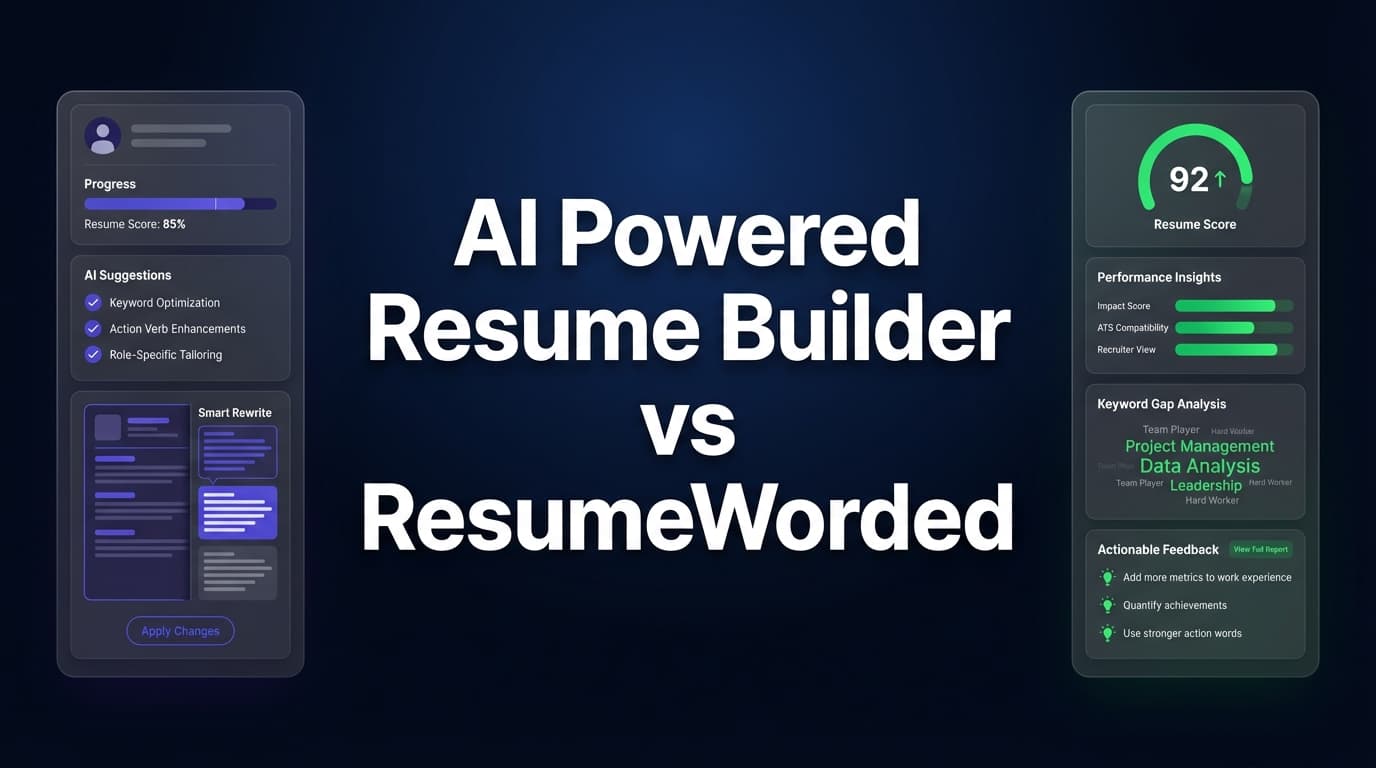
If you’re comparing JobShinobi vs Resume Worded, you’re likely trying to decide between two very different approaches:
- Resume Worded is a grader + optimizer (resume score, ATS scan, Targeted Resume keyword matching, LinkedIn review, templates/examples).
- JobShinobi is a resume-building + tailoring workflow with an added advantage: job application tracking, including email-forwarding automation that can log application emails into your tracker.
This page is written to help you choose fairly—including where Resume Worded is genuinely the better pick.
Quick Verdict:
- Choose Resume Worded if you want quick, guided scoring across resume + LinkedIn, plus a simple keyword-targeting tool and lots of templates/examples—without changing how you write your resume.
- Choose JobShinobi if you want an end-to-end workflow: build + tailor + version your resume (with an AI editing agent) and track your job applications (including optional email-forward logging).
TL;DR Comparison
| Feature | JobShinobi | Resume Worded |
|---|---|---|
| Primary workflow | Resume builder + tailoring + tracking | Resume/LinkedIn grader + optimization tools |
| Resume editing experience | LaTeX editor + live PDF preview + AI agent edits | Primarily upload → score → fix (not an editor-first builder on the pages reviewed) |
| ATS resume scan | ✅ Yes (ATS + formatting + keywords + structured scoring) | ✅ Yes (“Resume Scanner - Get a Free ATS Resume Scan”) |
| Job-specific tailoring | ✅ Yes (job extraction + match score + missing keywords) | ✅ Yes (“Targeted Resume” compares resume to job posting; keyword targeting) |
| LinkedIn optimization | Not a core focus | ✅ Yes (“Free LinkedIn Profile Review powered by AI”) |
| Resume templates | Templates inside JobShinobi (LaTeX-based) | ✅ Templates library (free + premium ATS templates) |
| Resume examples / bullet library | AI agent helps rewrite bullets; versioning | ✅ Bullet point/examples library is a highlighted value prop |
| Version history | ✅ Yes (resume versions + revert/undo workflow) | Not a core advertised differentiator on main product pages reviewed |
| Job application tracker | ✅ Yes | ❌ No |
| Email-forward job tracking | ✅ Yes (Pro feature; forward emails → parsed into tracker) | ❌ No |
| Starting paid price | $20/month | $49/month (monthly plan shown on Pro page) |
| Other billing options | $199.99/year | $99/quarter ($33/mo equiv) and $229/year ($19/mo equiv) shown on Pro page |
| Best for | High-volume applicants who want one system | People who want fast scoring + LinkedIn help |
JobShinobi Overview
JobShinobi is an AI resume builder that combines three things in one product:
- Resume building and editing (LaTeX-based templates)
- AI resume optimization (ATS scoring, keyword analysis, job matching, AI editing agent)
- Job application tracking (dashboard + analytics), including a standout capability: email-forwarding automation that can parse job emails and log/update applications automatically.
If your pain is “I’m applying everywhere, tweaking resumes constantly, and losing track of follow-ups,” JobShinobi is designed around that real workflow—not just a one-time score.
Key Strengths
- Email-forwarding → automatic job tracking (rare feature): Forward application-related emails and JobShinobi can extract company/title/status and log or update entries in your tracker (Pro-only processing).
- LaTeX-first resume workflow + live PDF compilation: You edit structured content and preview the compiled PDF, which can reduce formatting drift over time.
- AI Resume Agent (chat-based editing): You can ask the agent to rewrite bullets, tailor sections, and iterate while maintaining structure.
- Resume version history + revert: Helpful when tailoring for multiple roles and you need to roll back quickly.
- Built-in job search analytics: Track response rate and interview conversion trends from your logged applications.
Limitations (Honest)
- Not the simplest “upload and get a score” experience: If you want a quick grader with minimal setup, Resume Worded can feel faster.
- Learning curve (LaTeX-style editing): Many users are used to Word/Docs; JobShinobi is more “builder/editor” than “grader.”
- Automation is gated to Pro: Email parsing/processing for auto-tracking is explicitly restricted to Pro members.
Resume Worded Overview
Resume Worded is best understood as an AI-powered career document optimization platform. The core loop is:
Upload your resume → get a score/feedback → apply fixes → repeat
(and do the same for LinkedIn)
From Resume Worded pages reviewed, their major capabilities include:
- Resume scoring / grading (“Score My Resume” / resume checker and grader)
- ATS scanning (“Resume Scanner - Get a Free ATS Resume Scan”)
- Job-targeting / keyword matching (“Targeted Resume” compares resume to a job posting and identifies missing keywords/skills)
- LinkedIn profile review (“Free LinkedIn Profile Review powered by AI”)
- Templates and examples (ATS resume templates; extensive resume examples; “resume lines”/bullet examples and AI rewrites highlighted on Pro page)
Resume Worded is a strong option when you want direct guidance and lots of examples—without adopting a new resume editor.
Key Strengths
- LinkedIn is a first-class feature: Many resume tools ignore LinkedIn; Resume Worded actively scores it and provides optimization advice.
- Clear ATS + keyword targeting positioning: Dedicated tools for ATS scanning and job-posting comparisons.
- Examples/templates ecosystem: Resume templates and example content are heavily emphasized, which can help people who struggle with phrasing or structure.
- Multiple pricing cadences: Monthly, quarterly, and yearly options are shown on their Pro page.
Limitations (Based on research + common feedback themes)
- “Score chasing” can be misleading: Some users (notably in Reddit discussions) report that the score can feel like a pressure tactic. Even if you love the tool, it’s smart to treat any score as directional, not truth.
- Not a job tracker: There’s no application CRM, analytics dashboard, or email-forward automation for tracking.
- Refund policies vary by product/plan: Their Terms mention no refunds due to the nature of the offering (and payments are handled by Paddle). Separately, their help center includes refund-policy guidance for coach/business plans (for those plan types). Either way: it’s worth reading the terms and plan-specific policies before buying.
Feature-by-Feature Comparison
1) Workflow: Builder vs Grader
JobShinobi:
- Designed for building and iterating: template → edit → compile → analyze → tailor → version.
- The AI agent can directly help you rewrite content, and version history makes experimentation safer.
Resume Worded:
- Designed for grading and guiding: upload → score → checklist-style improvements.
- Great when you want fast feedback and you’re already comfortable editing your resume elsewhere.
Winner: Depends on your goal
- Want a workflow to author + tailor? JobShinobi
- Want fast guidance and scoring? Resume Worded
2) ATS Scan Quality & Practical Actionability
JobShinobi:
JobShinobi’s ATS/keyword analysis is built to connect directly into editing:
- Score + breakdown → apply changes in the editor/agent → re-run analysis → compare versions.
Resume Worded:
Resume Worded has dedicated pages for:
- Free ATS scan (“Resume Scanner”)
- Resume scoring (“Score My Resume”)
It’s built to quickly surface “what recruiters/ATS look for” and highlight issues.
Winner: Tie (different strengths)
- Resume Worded wins on speed and clarity of grading.
- JobShinobi wins on closing the loop (analysis → edit → version → track performance).
3) Job Targeting / Keyword Matching (Resume-to-JD)
JobShinobi:
- Job description extraction (URL or text) + match analysis + missing/present keywords.
- “Apply suggestions” flow ties back into editing.
Resume Worded:
- “Targeted Resume” is explicitly about comparing your resume to a job posting and identifying missing skills/keywords (ATS-focused).
Winner: Slight edge to Resume Worded for simplicity
If you want a straightforward “tell me which keywords I’m missing,” Resume Worded feels purpose-built.
If you want keyword gaps plus a deeper editing/versioning workflow, JobShinobi has the advantage.
4) LinkedIn Optimization
JobShinobi:
- Resume and job-search workflow is the focus; LinkedIn review isn’t positioned as a core module.
Resume Worded:
- LinkedIn review is one of their main pillars, with dedicated LinkedIn optimization guidance.
Winner: Resume Worded
5) Staying Organized: Tracking + Analytics
JobShinobi:
- Job application tracker dashboard (create/edit/delete applications, status updates)
- Analytics (response rate, interview conversion trends)
- Export to Excel
- Email-forwarding automation that can create/update applications from inbox emails (Pro feature)
Resume Worded:
- Not positioned as a tracker—more “improve the documents” than “manage the pipeline.”
Winner: JobShinobi (clear)
Pricing Comparison (Verified)
Pricing can change, so the key is what Resume Worded shows publicly right now.
| Plan | JobShinobi | Resume Worded |
|---|---|---|
| Free | Limited (core automation like email processing is Pro-only) | Free tools exist (resume score, ATS scan, LinkedIn review pages) |
| Monthly | $20/month | $49/month |
| Quarterly | Not listed (monthly/yearly are primary) | $99 every 3 months ($33/month equivalent) |
| Yearly | $199.99/year | $229/year ($19/month equivalent) |
| Payments | Stripe subscriptions | Payments handled by Paddle (merchant of record) |
Value Analysis:
- If you want month-to-month flexibility, JobShinobi ($20/mo) is meaningfully cheaper than Resume Worded ($49/mo).
- If you want the lowest effective monthly price and you’re comfortable paying upfront, Resume Worded’s yearly ($229/year) is roughly $19/mo equivalent—close to JobShinobi’s $20/mo but with different functionality (LinkedIn + grading vs tracking + builder workflow).
Who Should Choose JobShinobi?
You’ll likely prefer JobShinobi if you:
- Apply to lots of roles and need tracking + analytics (not just a resume score).
- Want to tailor and iterate quickly with an AI agent while keeping structure consistent.
- Care about version control (e.g., “SWE resume v3,” “PM resume v5,” etc.).
- Love the idea of forwarding job emails and having applications auto-logged (instead of manual spreadsheets).
Who Should Choose Resume Worded?
You’ll likely prefer Resume Worded if you:
- Want a tool that grades your resume and LinkedIn and tells you what to fix—fast.
- Rely heavily on LinkedIn for inbound recruiter outreach and want dedicated LinkedIn optimization.
- Want lots of templates, examples, and “resume lines” inspiration to improve phrasing quickly.
- Prefer staying in Word/Google Docs and just want feedback rather than switching to a new editing workflow.
Switching from Resume Worded to JobShinobi
If Resume Worded helped you identify weaknesses but you want a deeper workflow + tracking:
-
Resume content migration:
Likely manual (copy/paste and reformat into a JobShinobi template). This is normal when moving between resume ecosystems. -
Workflow change:
Resume Worded = “diagnose + suggest.”
JobShinobi = “build + tailor + track.”
Expect a short adjustment, but you gain repeatability (templates, versions, job matching, tracking). -
Best hybrid approach (common):
Use Resume Worded for quick scoring/LinkedIn checks, then implement and manage variants inside JobShinobi.
FAQ
Is JobShinobi better than Resume Worded?
It depends on what “better” means for you.
- Resume Worded is often better for LinkedIn optimization and a fast grading experience with lots of examples/templates.
- JobShinobi is better if you want a resume-building workflow + tailoring + version history + job tracking in one place.
Can I migrate from Resume Worded to JobShinobi?
Yes, but it’s usually a manual migration (copy your content into a JobShinobi template). The upside is you can then maintain multiple tailored versions cleanly.
Which is cheaper?
- JobShinobi: $20/month or $199.99/year
- Resume Worded: $49/month, $99/quarter, or $229/year
If you pay yearly, the effective monthly cost is similar. If you want monthly, JobShinobi is substantially cheaper.
Does Resume Worded have a free plan?
Resume Worded offers free tools/pages (resume score, ATS scan, LinkedIn review) and then upsells Pro for deeper/unlimited access.
Should I trust ATS scores?
Use scores as signals, not guarantees. A higher score can correlate with better structure/keywords, but hiring outcomes also depend on role fit, experience, networking, and how recruiters interpret your narrative.