Recruiters skim fast. The Ladders’ eye-tracking research found the average initial resume screen was 7.4 seconds (TheLadders PDF), a finding also summarized by HR Dive (HR Dive). In other words: your bullets don’t have time to “warm up.” They need to show impact immediately.
At the same time, ATS is everywhere. Jobscan reports 98.4% of Fortune 500 companies used a detectable ATS in 2024 (Jobscan). So your bullets must be readable and keyword-aligned.
AI can help you rewrite bullets faster—but only if you use it like a tool, not a ghostwriter.
In this guide, you’ll learn:
- A truth-safe, step-by-step system to rewrite bullets with AI (no hallucinated metrics)
- Copy/paste prompts for rewriting, tailoring, and keyword alignment
- Before/after examples for common job seeker roles
- Best practices + mistakes to avoid (including keyword stuffing)
- Tools that can support the workflow (with accurate product claims)
What does it mean to “use AI to rewrite resume bullets”?
Using AI to rewrite resume bullets means you provide the raw facts (what you did, tools, outcomes), and the AI helps you:
- tighten the language,
- lead with impact,
- add relevant keywords naturally,
- and produce multiple versions for different target roles.
AI should not be your source of truth. Your resume is a professional document that you may have to defend in an interview.
Why this matters in 2026 (and what the data suggests)
Recruiters scan quickly (HIGH confidence)
The Ladders’ eye-tracking study reported 7.4 seconds for an initial scan (TheLadders PDF). HR Dive summarizes similar takeaways: resumes with clearer structure and simple layouts can hold attention longer (HR Dive).
ATS usage is widespread (HIGH confidence)
Jobscan’s Fortune 500 ATS usage report states 98.4% of Fortune 500 companies used a detectable ATS in 2024 (Jobscan).
Hiring managers often move on fast (MEDIUM confidence)
Zippia reports 24% of hiring managers spend less than 30 seconds reviewing a resume (Zippia). Even if the exact number varies by study and context, the real-world implication is consistent: clarity wins.
AI in job search is already common (MEDIUM–HIGH confidence)
- Indeed’s report says 87% of HR/TA leaders and nearly 70% of job seekers are using AI systems/tools (Indeed).
- Employ reports 31% of respondents using AI to support their job search (reported in their Job Seeker Nation-related communications) (Employ).
So the differentiator isn’t “using AI.” It’s using AI in a way that stays credible, tailored, and human-readable.
How to use AI to rewrite resume bullets: Step-by-step (with prompts)
Step 1: Build your “truth bank” (so AI doesn’t invent)
Before you rewrite anything, create a small set of facts the AI is allowed to use.
For each bullet, collect:
- Action: what you did (deliverable)
- Method: tools/skills/process you used
- Outcome: what changed because of your work
- Scope: size/scale (users, volume, team size, $)
- Constraints: deadlines, complexity, ambiguity
- Proof: dashboard, report, PRD, ticket history, logs, etc.
Pro tip: If you don’t have metrics, use credible proxies: volume handled, time saved, error reduction directionally (without numbers), stakeholder count, throughput, SLA compliance, cycle-time reduction, etc.
Step 2: Do a “no-new-facts” rewrite first (core prompt)
This is the prompt that prevents 80% of bad AI resumes.
Prompt (copy/paste):
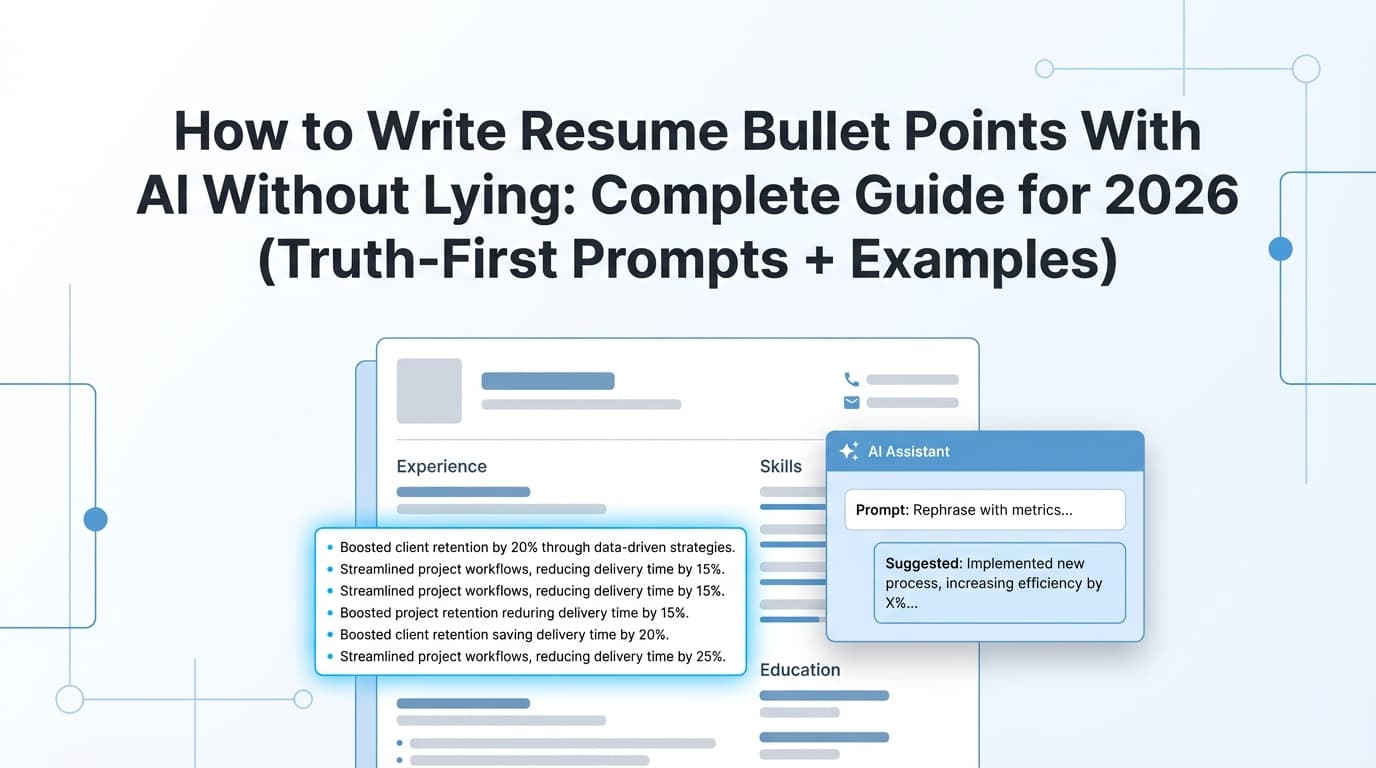
Rewrite this resume bullet to be clearer and more impact-focused without adding any new facts or numbers.
Keep it to 1 line (max ~25 words).
Start with a strong action verb.
If a metric is missing, suggest 2 metrics I could look up—but do not invent numbers.Bullet: “[PASTE BULLET]”
Context: Role = [ROLE], Tools = [TOOLS], Goal = [GOAL], Stakeholders = [WHO]
What you want back:
- 2–5 alternative rewrites
- a note like “metric to look up: time saved, adoption rate, defect rate, revenue impact…”
Step 3: Add keywords by “translation,” not stuffing
Keyword stuffing often hurts readability and can make you look like you’re gaming the system. (It’s also a common complaint in resume reviews.)
A simple explanation of why keyword stuffing is counterproductive: it makes the resume harder to read and doesn’t prove you can do the work—context matters (Martian Logic).
Prompt (copy/paste):
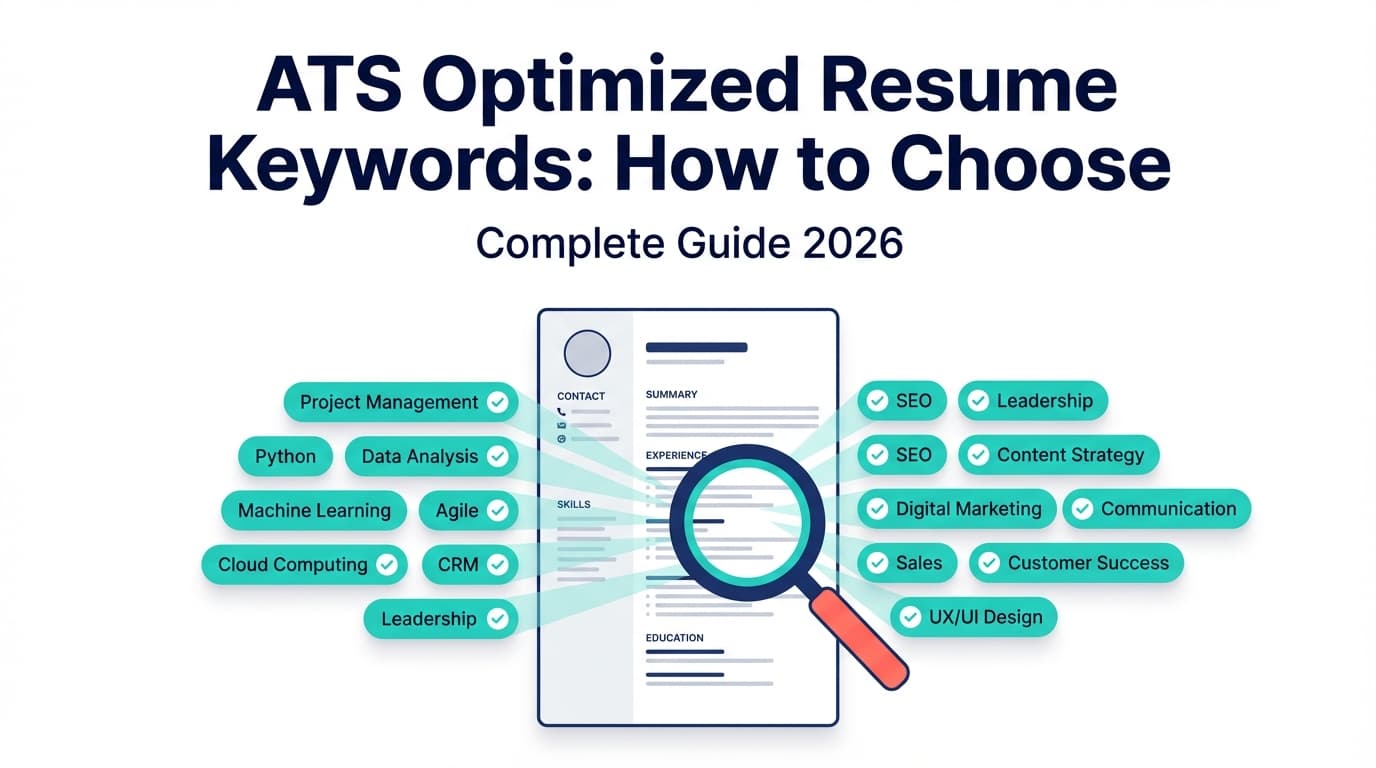
From this job description excerpt, extract the 10 most important skills/keywords.
Then rewrite my bullet to include up to 2 missing keywords naturally only if truthful.
If a keyword is not truthful, propose a close alternative that is truthful.Job description excerpt: [PASTE]
My bullet: [PASTE]
My truthful skills/tools: [PASTE LIST]
Step 4: Tailor bullets for different roles (without changing facts)
Tailoring is not lying—it’s choosing emphasis.
Prompt (copy/paste):
Create 3 versions of this bullet for these target roles, without changing any facts:
- Version A: [Role 1] (emphasize [X])
- Version B: [Role 2] (emphasize [Y])
- Version C: [Role 3] (emphasize [Z])
Keep each under 25 words.Bullet: [PASTE]
Facts I can defend: [PASTE 3–6 FACTS]
Step 5: Run a “fluff + fraud” audit (mandatory)
This step catches:
- “results-driven” filler
- invented metrics
- exaggerated scope (“spearheaded” when you assisted)
- vague outcomes (“improved efficiency” with no explanation)
Prompt (copy/paste):
Act as a skeptical recruiter. For each bullet:
- Flag vague language and buzzwords.
- Identify implied claims that require proof.
- Rewrite it to be more concrete and credible (no new facts).
Bullets:
- [B1]
- [B2]
- [B3]
Bullet frameworks to teach your AI (so outputs stop being generic)
Framework 1: X–Y–Z (impact + measure + method)
Accomplished [X] as measured by [Y] by doing [Z].
Example:
- “Reduced onboarding time (X) by 30% (Y) by rebuilding docs and adding automated environment setup (Z).”
Framework 2: CAR (Challenge–Action–Result)
Especially useful when your work was a problem-solving story.
Example:
- “Resolved recurring billing mismatches by reconciling 3 data sources and standardizing rules, improving month-end accuracy and reducing Finance escalations.”
Framework 3: STAR (Situation–Task–Action–Result) — compressed for resumes
STAR is often taught for interviews, but it can be compressed into one line for resumes.
Example:
- “Migrated a legacy reporting workflow to automated SQL pipelines, improving data freshness and enabling weekly KPI reviews without manual pulls.”
Before/after examples (AI rewrites done right)
Example 1: Software Engineer
Before: “Fixed bugs and improved APIs.”
After (truth-safe):
- “Improved API reliability by adding retries, logging, and alerts, reducing recurring production issues and accelerating incident response.”
Why it works: methods + outcome, no fake numbers.
Example 2: Data Analyst
Before: “Made dashboards.”
After:
- “Built dashboards for weekly KPI reviews, surfacing churn drivers and giving stakeholders a shared view of retention performance.”
Metric ideas to look up (don’t invent): number of users, time saved per week, adoption rate.
Example 3: Project Manager
Before: “Managed cross-functional projects.”
After:
- “Coordinated a cross-functional launch across Product, Engineering, and Support, aligning stakeholders on scope and delivering milestones on schedule.”
Example 4: Marketing / Content
Before: “Wrote blogs and did SEO.”
After:
- “Wrote SEO content and optimized on-page structure to improve organic visibility and drive qualified inbound traffic.”
Metric ideas: ranking improvements, leads, CTR, conversions.
Best practices for using AI to rewrite resume bullets
- Rewrite one bullet at a time. Better control, fewer hallucinations.
- Enforce constraints every time: “no new facts, no invented metrics.”
- Use 1–2 keywords per bullet max. Spread keywords across the section.
- Prefer outcomes over tasks. Tasks describe a job; outcomes describe performance.
- Keep bullets scannable. The 7.4-second scan statistic is your north star (TheLadders PDF).
- If it reads like a template, it will be treated like one. Add concrete detail (tool, scope, stakeholder).
Common mistakes to avoid (and how to fix them)
Mistake 1: Copy/pasting AI output without edits
Fix: Add one concrete detail per bullet (tool, scope, or measurable proxy).
Mistake 2: Keyword stuffing
Fix: Replace lists of tools with “tool + what it enabled.” Also, remember that keyword stuffing can reduce readability and credibility (Martian Logic).
Mistake 3: Inventing metrics (even “small” ones)
Fix: Use “metric placeholder” notes in your draft, then look up the real number later.
Mistake 4: Inflated verbs that don’t match scope
Fix: Use verbs that accurately reflect ownership (built, improved, delivered, coordinated, analyzed, partnered).
Mistake 5: Optimizing for ATS at the expense of humans
Fix: ATS is common (e.g., Jobscan’s Fortune 500 stat: Jobscan), but hiring decisions still involve people scanning your resume quickly. Balance both.
Tools to help with AI bullet rewriting (honest options)
JobShinobi (integrated resume workflow + AI feedback)
If you want an integrated workflow (write → rewrite → analyze → tailor), JobShinobi supports:
- LaTeX resume editing with PDF compilation/preview inside the app
- AI resume analysis with scoring and detailed feedback (including ATS/keyword-focused feedback)
- An AI resume editing agent (chat-based) that can help update your resume content
- Job description extraction (from URL or text) and resume-to-job matching analysis
Pricing (accurate): JobShinobi Pro is $20/month or $199.99/year. Marketing copy mentions a 7-day free trial, but the trial mechanics are not clearly verifiable in code—so don’t assume it applies automatically.
Authentication: Google sign-in (OAuth). No email/password login.
Internal links:
/login/subscription
Other tool categories
- General AI assistants (for prompt-driven rewriting): ChatGPT, Copilot, Gemini
- Writing polish (tone/clarity): Grammarly
- ATS-tailoring and keyword tools: Jobscan (some pages may be access-restricted)
Key takeaways
- AI is best used as a rewrite + variation engine, not a resume “author.”
- The winning workflow is: truth bank → constrained rewrite → keyword alignment → tailoring → fluff audit.
- Keep bullets concrete, scannable, and defensible in an interview.
- ATS is common (Jobscan reports 98.4% Fortune 500 ATS usage in 2024), but your real goal is still: a human says “yes” fast.
FAQ
Can AI help me rewrite my existing resume bullets?
Yes—AI is very effective at rewriting your drafts for clarity and impact. Just make sure you instruct it not to add new facts or metrics.
Can employers tell if you used AI (like ChatGPT) on your resume?
They may not “detect” it reliably, but recruiters often recognize generic, templated phrasing. The safest approach is to use AI for drafts, then edit for specificity and your natural voice.
What’s the best prompt to rewrite a resume bullet without lying?
Use a constraint-based prompt: “Rewrite this bullet without adding new facts or numbers… suggest metrics to look up but do not invent numbers.”
Should I tailor every bullet for every job?
Not necessarily. Tailor the bullets most relevant to the role, align keywords across your top experience, and ensure your summary/skills reflect the job description.
Is keyword stuffing worth it to pass ATS?
Generally, no. Keyword stuffing can hurt readability and credibility; better to include keywords naturally with context and outcomes (Martian Logic).