If you’ve tried an AI resume tool and saw it invent metrics, add skills you don’t have, or rewrite your job title into something you can’t defend, you’re not imagining it. A lot of “AI resume help” is optimized for sounding impressive—not for being interview-proof.
That’s why this guide focuses on what actually solves the problem:
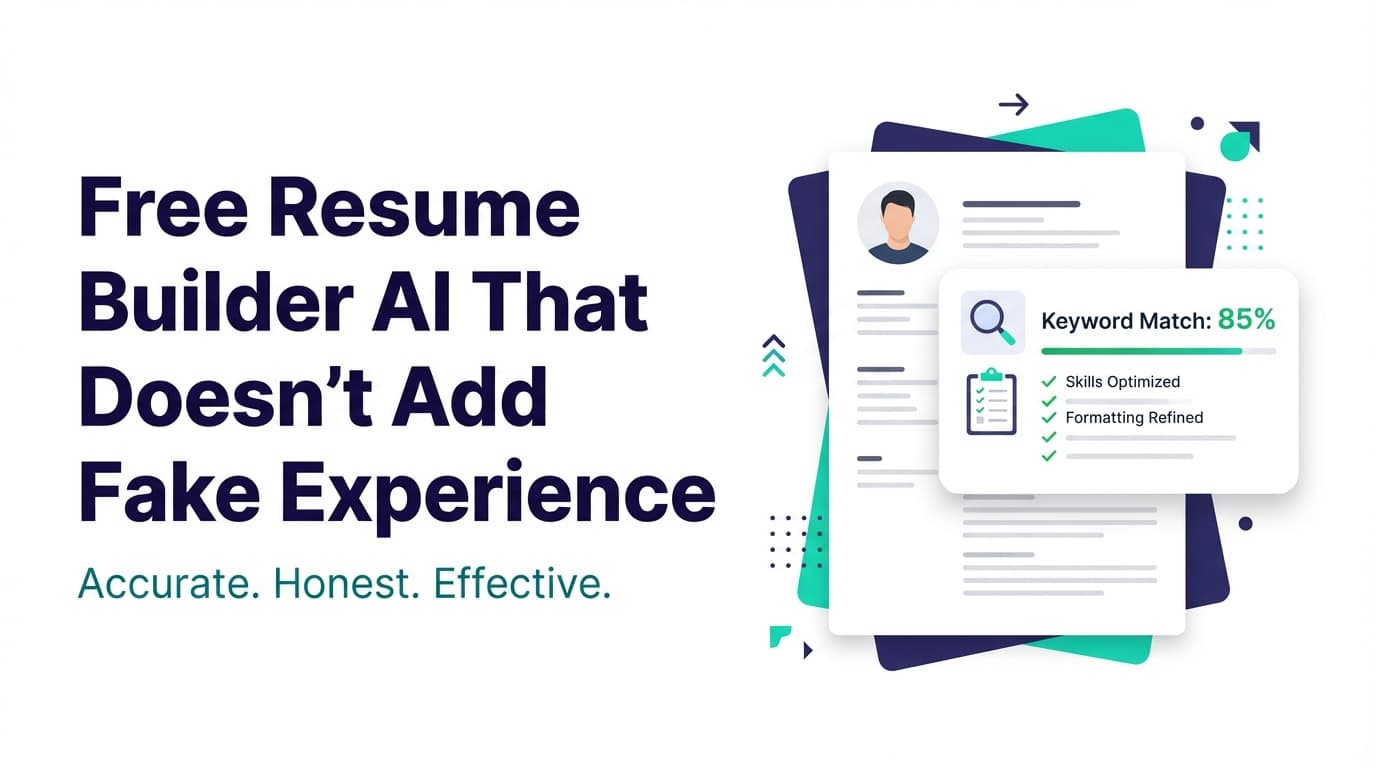
You don’t just need a “free resume builder AI.” You need a truth-first workflow that prevents hallucinations (made-up facts) and keeps your resume ATS-readable.
In this guide, you’ll learn:
- What causes AI resume “fake experience” and how to stop it
- A step-by-step truth-first workflow that works with free tools
- Copy/paste prompts that force AI to rewrite—not invent
- ATS formatting rules + a simple free parsing test
- Tool recommendations (free + paid) with honest trade-offs
- FAQ questions pulled from real searches (“People Also Ask” style)
The uncomfortable reality: “Free” AI resume builders can hallucinate
AI “fake experience” usually shows up as:
- Invented responsibilities (“owned vendor negotiations” when you didn’t)
- Invented tools/skills (adds “Kubernetes” because the job posting has it)
- Invented metrics (“increased revenue by 35%” with no source)
- Inflated titles (“Associate” becomes “Lead/Manager”)
- Fictional projects (especially for new grads/career changers)
MIT’s Career Advising & Professional Development office explicitly warns that AI can hallucinate facts and stresses setting “guide rails” and staying critical of results (High confidence; MIT CAPD: https://capd.mit.edu/resources/ai-uses-for-resume-writing/).
Why it happens
Most AI tools are trained to produce plausible language. If your prompt is vague (“make my resume stronger”), the model may “solve” the problem by generating details that sound right.
Key principle: AI can help you express your experience. It cannot ethically create your experience.
Are there any truly free AI resume builders?
Sometimes—depending on how you define “free.”
Most resume builders use one of these models:
- Free to type, pay to download/export
- Free basic builder, paid AI rewriting
- Free trial, then paywall
- Free tier with limits (e.g., one resume, limited templates)
A safer “free” path that avoids paywalls and hallucinations is often:
Free template + free AI chat + strict verification steps.
That way, your resume is still “free,” but you control the truth.
Why this matters in 2026: ATS + trust are both real
ATS is widespread (especially at large companies)
Jobscan reports 98.4% of Fortune 500 companies used a detectable ATS in 2024 (Medium confidence; Jobscan’s ATS usage reporting is widely cited, but some pages can be access-restricted: https://www.jobscan.co/blog/fortune-500-use-applicant-tracking-systems/ and https://www.jobscan.co/blog/8-things-you-need-to-know-about-applicant-tracking-systems/).
Jobscan also reports survey findings like 99.7% of recruiters use filters in their ATS or similar systems (Medium confidence; Jobscan cites its recruiter survey: https://www.jobscan.co/applicant-tracking-systems and https://www.jobscan.co/state-of-the-job-search).
Third-party ATS stats roundups also cite adoption rates like 70% of large companies using ATS (Medium confidence; SelectSoftwareReviews: https://www.selectsoftwarereviews.com/blog/applicant-tracking-system-statistics).
Resume lies are commonly caught
CareerBuilder’s survey (via PRNewswire) found:
- 58% of hiring managers have caught a lie on a resume
- 33% said they’ve seen an increase in resume lies
(High confidence; PRNewswire: https://www.prnewswire.com/news-releases/fifty-eight-percent-of-employers-have-caught-a-lie-on-a-resume-according-to-a-new-careerbuilder-survey-270277731.html)
Implication: If AI introduces even one unverifiable claim, you’re increasing risk—not “optimizing.”
What to look for in a “free resume builder AI that doesn’t add fake experience” (scorecard)
Use this quick scorecard to vet any tool (free or paid):
1) Does it force structured inputs?
Better: fields for employer, title, dates, bullets, skills.
Risky: “Paste job description, generate resume” with minimal grounding.
2) Does it encourage verification?
Look for:
- change tracking / version history
- review checkpoints
- warnings about accuracy
3) Does it keep formatting ATS-readable?
A good builder should support:
- single-column layouts
- standard headings
- clean exports (PDF, sometimes DOCX)
4) Does it pressure you into fake metrics?
AI should suggest where you might quantify—not invent numbers.
5) Is “free” actually usable?
Ask:
- Can you export without paying?
- Can you make edits without hitting a hard wall?
- Can you access your content later?
What is a “truth-first resume workflow”?
A truth-first workflow is a system that:
- Creates a source of truth (your verified work history, projects, tools)
- Uses AI only in rewrite mode
- Adds keywords ethically (only when you can defend them)
- Runs a final interview-proof check before you apply
This works with any free AI chat tool and most resume builders.
How to build a resume with AI without fake experience (step-by-step)
Step 1: Create a “Source of Truth” document (10–20 minutes)
Open a Google Doc or Notes file and create these sections:
A) Verified roles (facts only)
For each role:
- Company name
- Official title (exact)
- Dates
- Location / remote
- 1–2 lines describing what the team/product did
- Tools you used (only real ones)
B) Raw achievement dump (messy is fine)
List:
- projects shipped
- problems solved
- stakeholders you worked with
- processes improved
- constraints (time/budget/compliance)
- outcomes (only true outcomes)
C) Defensible metrics table
| Metric | Value | How you know | Where it came from |
|---|---|---|---|
| Response time | -18% | team report | weekly dashboard |
| Tickets/week | ~25 | internal tool | queue stats |
If you don’t have numbers, that’s okay. You can still write strong bullets using scope and frequency (“weekly,” “high-volume,” “cross-functional”).
Why this matters: You’re giving AI bounded data so it can’t “fill in gaps” with fiction.
Step 2: Use AI in rewrite-only mode (copy/paste prompts)
Prompt 1 — Rewrite bullets without adding facts (most important)
Rewrite the bullet points below to be clearer, ATS-friendly, and impact-focused without adding any new tools, metrics, projects, employers, job titles, or responsibilities.
Rules:
- You may only use information explicitly stated in my notes.
- If a metric is missing, do not invent one. Use “[insert metric if true]” instead.
- Keep it realistic and interview-defensible.
Source of truth notes:
[paste]
Prompt 2 — Audit for fake claims (hallucination detector)
Read the resume content below and flag anything that sounds unverifiable, inflated, or fabricated.
For each flagged item:
- explain why it’s risky, and
- propose a safer rewrite that stays truthful.
Prompt 3 — Keyword alignment without keyword stuffing
Compare my resume to this job description.
Output:
- Missing keywords I actually have experience with (ask questions if unclear)
- Suggested rewrites that incorporate those keywords without inventing experience
Resume: [paste]
Job description: [paste]
Step 3: Run the “Interview-Proof Test” (5 minutes)
For each bullet, ask:
- Can I explain this in 60 seconds?
- Can I describe how I did it (tools/process)?
- Can I tell a short story with a beginning and result?
- Would a former teammate agree with this description?
If not, rewrite it.
Step 4: Keep formatting ATS-friendly (and test parsing for free)
Many career services offices recommend ATS-safe formatting like single column, no tables, no text boxes. For example, UIC Career Services’ ATS handout explicitly recommends single column and avoiding tables/text boxes (High confidence; PDF: https://careerservices.uic.edu/wp-content/uploads/sites/26/2017/08/Ensure-Your-Resume-Is-Read-ATS.pdf).
Jobscan also discusses that ATS may not read tables and columns reliably (Medium confidence; Jobscan: https://www.jobscan.co/blog/resume-tables-columns-ats/).
Free ATS parsing test (copy/paste test)
- Export your resume to PDF.
- Copy everything (Ctrl/Cmd+A, then copy).
- Paste into a plain text editor (or Google Doc).
- Check:
- Are headings still readable?
- Are dates still attached to the right roles?
- Are bullets intact (not scrambled)?
MIT CAPD also recommends testing ATS readability by checking how your resume looks in plain text (Medium→High confidence; see MIT CAPD ATS-friendly guidance: https://capd.mit.edu/resources/make-your-resume-ats-friendly/).
Step 5: Tailor ethically (without lying)
Ethical tailoring means:
- Reordering bullets to match the job’s priorities
- Swapping in accurate synonyms (“stakeholders” vs “clients”)
- Adding keywords only when they map to real experience
Unethical tailoring means:
- Copy/pasting the job description into your resume
- Adding tools you don’t know
- Inflating titles/scope
Also: avoid “hidden text” hacks. Reporting suggests hidden prompt injections can backfire and aren’t a reliable way to beat screening (Medium confidence; Built In: https://builtin.com/articles/hidden-ai-prompts-in-resume).
Common mistakes that cause AI to add fake experience
Mistake 1: Asking for “impact metrics” without providing real data
Fix: Ask AI to identify where you could quantify and what you’d need to verify.
Mistake 2: Letting AI generate a resume from scratch
Fix: Always start from your source-of-truth notes.
Mistake 3: Copying keywords without context
Fix: Add keywords inside real project bullets, not in random skills dumps.
Mistake 4: Over-optimizing for ATS myths
The “ATS rejects 75% of resumes automatically” claim is heavily debated and often described as unsubstantiated (Medium confidence; Interview Guys covers the myth: https://blog.theinterviewguys.com/ats-resume-rejection-myth/).
Fix: Optimize for parsing and clarity—then focus on relevance and credibility.
Mistake 5: Submitting without a final audit
Fix: Run Prompt 2 (“Audit for fake claims”) and the Interview-Proof Test.
Ethical rewrite examples (stronger, not fake)
Example 1: Operations / Admin
Before: Managed schedules and communication.
After: Coordinated weekly scheduling and stakeholder updates by tracking requests, confirming priorities, and documenting changes to reduce confusion across the team.
Why safe: No invented numbers; concrete process.
Example 2: Customer Support
Before: Helped customers and solved problems.
After: Resolved account and billing issues by troubleshooting in internal systems, documenting steps, and escalating edge cases to the appropriate teams to prevent repeat issues.
Why safe: Specific, defensible, ATS-readable.
Example 3: Software / Data
Before: Worked with data and built reports.
After: Built recurring reports by consolidating data sources and clarifying metric definitions with stakeholders, improving consistency and reducing rework.
Why safe: No fabricated tools/metrics.
Tools to help (free + paid) — honest recommendations
Free / low-cost options
- FlowCV: Markets a free plan with unlimited downloads and no paywalls (Medium confidence; verify on their site: https://flowcv.com/).
- Google Docs + a simple ATS template: Maximum control, easiest to verify.
- University career center resources: Often the most ATS-safe templates and advice (High confidence example: UIC ATS PDF above; MIT CAPD resources).
Paid option (natural mention): JobShinobi
If you want a more structured workflow than “free chat + docs,” JobShinobi includes:
- A LaTeX resume editor with in-app PDF preview (compile LaTeX to PDF)
- AI resume analysis (scoring + detailed feedback)
- Job description extraction and resume-to-job matching
- An AI resume editing agent (chat-based editing)
Pricing (High confidence): JobShinobi Pro is $20/month or $199.99/year.
A “7-day free trial” is mentioned in marketing materials, but trial mechanics can depend on billing configuration—so treat it as mentioned, not guaranteed.
Explore: /pricing and the resume area: /dashboard/resume.
Research-backed stats you can cite (with confidence levels)
-
58% of hiring managers have caught a lie on a resume (High confidence; PRNewswire/CareerBuilder):
https://www.prnewswire.com/news-releases/fifty-eight-percent-of-employers-have-caught-a-lie-on-a-resume-according-to-a-new-careerbuilder-survey-270277731.html -
33% of hiring managers saw an increase in resume lies (High confidence; same source above).
-
AI resume help can improve outcomes when used as assistance: job seekers with algorithmic assistance received 7.8% more job offers (High confidence; MIT Sloan):
https://mitsloan.mit.edu/ideas-made-to-matter/job-seekers-ai-boosted-resumes-more-likely-to-be-hired -
Academic backing: the NBER working paper reports an ~8% increase in hiring probability, with a 95% confidence interval (3%, 13%) (High confidence; NBER PDF):
https://www.nber.org/system/files/working_papers/w30886/revisions/w30886.rev0.pdf -
AI-generated applications are affecting hiring and detection: Robert Half reports findings about hiring managers detecting AI use (Medium confidence; check their article context and survey framing):
https://www.roberthalf.com/us/en/insights/hiring-help/ai-generated-resumes-hiring-challenges -
Some recruiters may reject AI-generated materials: TopResume reports 19.6% of recruiters would reject an AI-generated resume/cover letter (Medium confidence; survey methodology should be reviewed):
https://topresume.com/career-advice/ai-in-hiring-survey
Key takeaways
- “Free AI resume builder that doesn’t add fake experience” is less about the tool and more about constraints + verification.
- Create a source of truth, then force AI into rewrite-only mode.
- Use ATS-safe formatting and run a free parsing test.
- Avoid prompt-injection/hidden text hacks—they can backfire.
- If you pay for a tool, pay for workflow + analysis, not for “magical” auto-generation.
FAQ
Is there a completely free AI resume builder?
Some claim to be free, but many hide paywalls behind export/download. A reliable free method is: Google Docs template + free AI chat for rewriting + verification.
Will AI add fake experience if I use it for my resume?
It can, especially if prompts are vague. Prevent it by using strict prompts (“do not add tools/metrics”) and auditing the final draft.
How do I stop AI from making up metrics?
Tell it explicitly: do not invent numbers and use placeholders like “[insert metric if true]”. Then either verify real numbers or remove them.
How can I test if my resume is ATS-friendly for free?
Do the copy/paste test: paste your PDF into plain text and check whether headings, dates, and bullets stay readable. MIT CAPD also recommends plain text testing (https://capd.mit.edu/resources/make-your-resume-ats-friendly/).
Do ATS systems struggle with tables and columns?
Often, yes. Career services resources recommend avoiding tables/text boxes and using a single-column format (UIC ATS PDF: https://careerservices.uic.edu/wp-content/uploads/sites/26/2017/08/Ensure-Your-Resume-Is-Read-ATS.pdf).
Do employers reject AI-generated resumes?
Some may—especially if content is generic or unverifiable. Surveys and reporting suggest a portion of recruiters/hiring managers can detect AI use or dislike overly AI-generated materials (Medium confidence; Robert Half and TopResume sources above). The safest approach is to keep your resume truthful, specific, and interview-proof.
Is it ethical to use AI to write a resume?
Using AI to edit, clarify, and tailor is generally ethical if everything remains truthful. Using AI to fabricate experience is not.