Over half of job seekers (53%) said they used ChatGPT or a similar generative AI tool to help with their job search in Q1 2024—and 23% used it to draft resumes. (Confidence: High — ZipRecruiter Economic Research, New Hires Survey Q1 2024: https://www.ziprecruiter-research.org/new-hires-survey-2024q1)
That means the competitive advantage isn’t “using AI.” It’s using AI responsibly—without letting it introduce inaccuracies, privacy risks, or “too-polished-to-be-true” claims that hiring teams can spot.
This guide is written for high-volume applicants who are tired of sending resumes into the void and wondering: Is my resume getting filtered out by ATS? Did AI just make me sound generic—or worse, dishonest?
In this guide, you’ll learn:
- A printable ethics + accuracy checklist you can run in 10–15 minutes before every application
- A step-by-step workflow that reduces AI hallucinations, exaggerations, and keyword stuffing
- Real-world examples of “ethical polish” vs “unethical fabrication”
- Tools (including JobShinobi) that can help you keep your resume consistent, ATS-readable, and verifiably accurate
What is an “AI resume builder” (and what can go wrong)?
An AI resume builder is any tool that uses machine learning / generative AI to help you create or edit resume content—typically by:
- rewriting bullets,
- generating summaries,
- suggesting skills and keywords from a job description,
- scoring your resume for ATS-style criteria,
- or tailoring your resume to a specific role.
The two biggest risk categories
-
Accuracy risk (truth risk):
Generative AI can produce plausible-sounding content that’s not true, not provable, or not consistent with your background (often called hallucinations/confabulations). (Confidence: High — NIST identifies “confabulation” as a key GenAI risk: https://nvlpubs.nist.gov/nistpubs/ai/NIST.AI.600-1.pdf) -
Ethics risk (trust + fairness + privacy):
Even if the resume is “technically true,” AI can introduce:- hidden bias (stereotyped language),
- privacy leakage (you paste sensitive data into a tool),
- deception-by-omission (claims you can’t defend in an interview),
- or mass-produced sameness that hurts credibility.
A useful mental model:
If you couldn’t defend it confidently in a live interview with follow-up questions, it doesn’t belong on your resume.
Why ethics and accuracy matter more in 2026
1) Employers are wary of AI-generated applications
Some surveys suggest hiring teams are actively skeptical:
- 62% of employers say AI-generated resumes without customization are more likely to be rejected. (Confidence: Medium — reported by Resume Now; verify context and methodology on page: https://www.resume-now.com/job-resources/careers/ai-applicant-report)
- 19.6% of recruiters would reject a candidate with an AI-generated resume or cover letter, according to one TopResume survey. (Confidence: Medium — TopResume survey summary: https://topresume.com/career-advice/ai-in-hiring-survey)
What this means for you:
Using AI is not automatically disqualifying—but “generic AI output” is. Your goal is human specificity: numbers, scope, tools, constraints, and outcomes that sound like lived experience.
2) “Sea of sameness” is real
Canva research has been widely reported as finding 45% of job seekers have used generative AI to build/update/improve resumes. (Confidence: Medium — commonly cited by secondary sources; see Tech.co recap and others: https://tech.co/news/half-job-seekers-using-ai)
When many candidates use similar prompts, the outputs converge:
- same verbs (“spearheaded,” “leveraged,” “optimized”),
- same claims,
- same “perfectly balanced” bullet structure.
That sameness makes recruiters pay more attention to proof signals: specificity, consistency, and defensible detail.
3) AI + hiring is becoming regulated (directly and indirectly)
Even though these laws generally govern employers, they influence how hiring systems are built and audited—affecting how your resume is processed.
- EU AI Act entered into force Aug 1, 2024. (Confidence: High — European Commission announcement: https://commission.europa.eu/news-and-media/news/ai-act-enters-force-2024-08-01_en)
- NYC Local Law 144 regulates automated employment decision tools (AEDTs), requiring notices and bias audits in certain cases. (Confidence: High — NYC DCWP page: https://www.nyc.gov/site/dca/about/automated-employment-decision-tools.page)
- The EEOC has guidance warning AI tools can contribute to employment discrimination and that existing anti-discrimination laws still apply. (Confidence: High — EEOC worker guidance PDF, Apr 2024: https://www.eeoc.gov/sites/default/files/2024-04/20240429_Employment%20Discrimination%20and%20AI%20for%20Workers.pdf)
Takeaway: Trust, transparency, and fairness expectations are rising—so you should treat your resume like a professional document with QA, not a text-generation experiment.
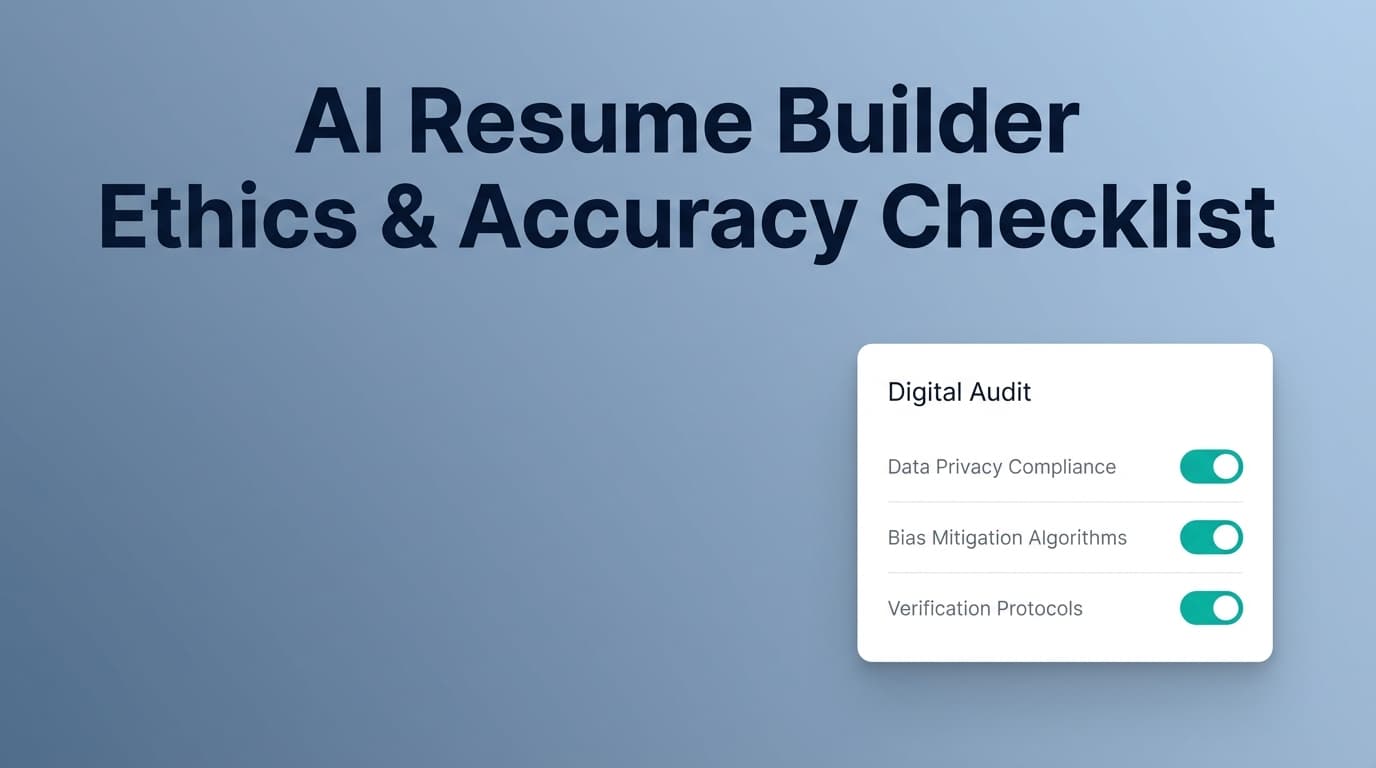
The AI Resume Builder Ethics and Accuracy Checklist (Printable)
Use this checklist as a final QA pass before you submit any AI-assisted resume.
A. Truth & Defensibility (Accuracy Checklist)
- No invented facts: Every number, tool, certification, employer, title, and date is real.
- Metrics are defensible: For every metric (%, $, time saved), you can explain how you measured it.
- Scope is clear: Your bullets include scope signals (team size, users, budget, revenue, volume, timeline).
- Tool claims are accurate: If you list a tool/skill, you can answer: “When did you use it, and what did you build with it?”
- No misrepresentation of seniority: Your resume doesn’t imply leadership/ownership you didn’t have.
- Consistency across documents: LinkedIn, portfolio, GitHub, and resume don’t contradict each other.
Red-flag phrases to re-check: “led,” “owned,” “architected,” “end-to-end,” “delivered,” “increased by X%” (unless you can prove it).
B. Transparency & Ethical Use (Ethics Checklist)
- AI used as a writing assistant, not a truth generator.
- No confidential info leaked: You didn’t paste proprietary code, customer names, internal metrics, or private company strategies into an AI tool.
- No copied proprietary bullets: You’re not reusing company-internal phrasing that violates policy or NDAs.
- No deceptive credentialing: You didn’t list credentials you don’t have or imply licenses you’re not eligible for.
- No “keyword stuffing”: Keywords are integrated naturally into real experience, not dumped into a skills block.
- Fairness check: Your content avoids biased or stereotyped descriptors (e.g., “aggressive,” “dominated,” “native English speaker” unless job-relevant and lawful).
C. ATS Readability & Parsing (Technical Checklist)
- Simple structure: One column, clear headings, standard bullets (Jobscan warns graphics/columns/tables can confuse ATS). (Confidence: Medium — Jobscan guidance: https://www.jobscan.co/blog/ats-formatting-mistakes/)
- No icons/images used as meaning: ATS may skip them.
- Dates and titles are standard: e.g.,
May 2022 – Aug 2024, not “Summer ‘22.” - Section headings are conventional:
Experience,Education,Skills,Projects. - File type matches the employer request: PDF unless portal suggests otherwise.
D. Authentic Voice & Human Credibility
- No “AI tells”: Overuse of buzzwords, overly symmetrical bullets, vague hype language.
- Specific nouns > fancy verbs: Names of systems, stakeholders, constraints, deliverables.
- Your resume matches how you speak: If a recruiter calls, you won’t sound like a different person.
E. Bias, Privacy, and Data Handling
- Minimized personal data shared: You only shared what’s necessary (especially if using free tools).
- You reviewed the tool’s privacy stance: What do they store? for how long? can you delete data?
- No sensitive identifiers in prompts: SSN, full address, ID numbers, private phone numbers.
Mozilla has cautioned that AI tools (including resume tools) can raise privacy and bias concerns depending on training data and data practices. (Confidence: Medium — Mozilla Foundation overview: https://www.mozillafoundation.org/nl/blog/ai-resume-builder-bias/)
How to use AI ethically and accurately: step-by-step workflow
This is the workflow that prevents 90% of “AI resume failures.”
Step 1: Build a “source of truth” file (before you open any AI tool)
Create a single document (Notion/Google Doc/Notes) called:
Resume Fact Sheet (Source of Truth)
Include:
- Employers, titles, dates
- 8–12 core projects
- Tools/tech used per project
- The “before/after” of your work (baseline + outcome)
- 10–20 raw metrics (even rough ranges)
Pro tip: If you can’t share exact numbers, store:
- ranges (“~$50–100K monthly spend”),
- volumes (“thousands of users”),
- or relative deltas (“cut processing time from days to hours”).
This protects you from AI inventing detail you never provided.
Step 2: Use AI for rewrite options, not resume truth
When prompting AI, constrain it:
Prompt template (safe version):
Rewrite these resume bullets to be clearer and more impact-focused.
Do not add new tools, metrics, or claims.
Keep all facts exactly the same.
Return 3 options per bullet.
If your AI tool can’t reliably follow “don’t add facts,” it’s not safe for resume writing.
Step 3: Add metrics responsibly (the “measurement integrity” rule)
AI will often suggest metrics because they improve perceived impact. That’s good—if the numbers are real.
A useful rule: No number without a measurement story.
Examples of valid measurement stories:
- “We tracked conversion in GA4 over 6 weeks.”
- “PagerDuty incidents dropped from X/week to Y/week.”
- “Finance report shows cost reduction of $Z.”
If you don’t have a measurement story, convert the metric into a defensible scope statement:
Instead of: “Increased revenue by 35%”
Use: “Improved conversion through A/B testing across landing pages; results validated in analytics reporting.”
Step 4: Run the “interview cross-exam” test
Recruiters and hiring managers often use deep follow-ups to validate claims. SHRM notes that probing interview questions can expose questionable or inflated resume content. (Confidence: Medium — SHRM coverage on AI-written resumes: https://www.shrm.org/topics-tools/news/talent-acquisition/ai-written-resumes--use-a-discerning-eye--hiring-managers-advise)
For each bullet, ask:
- What was the starting point?
- What exactly did I do?
- What trade-offs did we face?
- How do I know it worked?
- What would I do differently?
If you can’t answer in 30 seconds, simplify the bullet.
Step 5: Tailor ethically (keyword alignment without lying)
Tailoring is ethical when you:
- map job keywords to real experience you have, and
- use the employer’s language to describe what you actually did.
Tailoring becomes unethical when you:
- add tools you didn’t use,
- claim domain experience you don’t have,
- mirror the job posting word-for-word (plagiarism/credibility risk),
- or “launder” weak experience into senior-sounding ownership.
Ethical tailoring example
- Job asks: “stakeholder management”
- You did: weekly cross-functional syncs + requirements alignment
→ Add a bullet that accurately uses “stakeholder management” in that context.
Ethical vs unethical AI resume edits: real examples
Example 1: Metrics hallucination
Your original bullet:
- “Built weekly sales dashboard for leadership.”
AI-generated (risky):
- “Built a weekly sales dashboard that increased revenue by 18%.”
Why it fails: invented causality and a number.
Ethical rewrite:
- “Built a weekly sales dashboard for leadership, improving visibility into pipeline and forecast changes.”
Example 2: Tool laundering
Your original bullet:
- “Automated monthly reporting using spreadsheets and scripts.”
AI-generated (risky):
- “Automated monthly reporting using Python, SQL, and Tableau.”
Why it fails: adds tools you didn’t confirm.
Ethical rewrite (if true):
- “Automated monthly reporting using scripts, reducing manual compilation time.”
(Then add tools only if you actually used them.)
Example 3: Seniority inflation
Your original bullet:
- “Contributed to cloud migration project.”
AI-generated (risky):
- “Led end-to-end cloud migration strategy across the organization.”
Ethical rewrite:
- “Supported cloud migration by migrating X services and documenting deployment steps.”
A deeper framework: “Trustworthy AI” principles applied to your resume
NIST’s AI Risk Management Framework resources describe characteristics of trustworthy AI such as validity & reliability, safety, accountability & transparency. (Confidence: Medium — NIST AI RMF hub and resources: https://www.nist.gov/itl/ai-risk-management-framework)
Translate that into resume behavior:
- Validity & reliability: Your resume content remains accurate across versions and tools.
- Accountability: You (not the AI) take responsibility for every claim.
- Transparency: If asked, you can describe how you used AI (“I used it for wording suggestions; all experience is mine”).
- Safety: You avoid sharing sensitive data that could harm you or your employer.
Common mistakes to avoid (that hurt ethics and results)
Mistake 1: Chasing a perfect “ATS score” at the expense of truth
Resume scanners can be useful, but they’re not the same as a real employer’s ATS configuration—and they can push you toward keyword stuffing.
Fix: Use scanner feedback as signals, then rewrite bullets to include keywords only where true.
Mistake 2: Submitting “robotic sameness”
If your resume reads like a template, it reduces trust.
Fix: Add:
- specific project nouns,
- meaningful constraints (“regulated environment,” “legacy system,” “tight timeline”),
- and outcomes tied to your role.
Mistake 3: Copying the job description into your resume
That can look like plagiarism or deception.
Fix: Translate the requirement into your experience:
- Requirement: “cross-functional collaboration”
- Your truth: “partnered with design and data teams to ship X”
Mistake 4: Sharing sensitive data in prompts
Many job seekers paste entire resumes and job descriptions into tools without thinking about retention.
Fix: Redact:
- client names,
- internal system names,
- revenue,
- customer lists,
- private repos/code,
- personal identifiers beyond what’s necessary.
Mistake 5: Inflating credentials because “everyone does it”
Some survey/reporting suggests a meaningful portion of candidates are tempted to let AI introduce “tiny lies.” (Confidence: Medium — Kickresume press references this theme; validate exact study details directly from Kickresume if you cite specifics: https://www.kickresume.com/en/press/)
Fix: Use the replacement technique:
Replace false credentialing with honest proximity:
- “Worked with” instead of “led”
- “Supported” instead of “owned”
- “Exposure to” instead of “expert in” (but don’t overuse “exposure”)
Tools to help with ethical and accurate AI resume building
The best tool is the one that supports human-in-the-loop control: you decide what changes go in, and you can review diffs/version history.
JobShinobi (AI resume builder + ATS-focused analysis + job tracking)
JobShinobi can help if you want a workflow that combines:
- LaTeX resume building with PDF preview/compilation (so you can keep formatting consistent) (Confidence: High)
- AI resume analysis with scoring + detailed feedback (Confidence: High)
- Resume-to-job matching (paste a job description or URL, get match feedback) (Confidence: High)
- Resume version history so you can roll back changes and avoid losing “truthy” versions (Confidence: High)
- A job application tracker, including the option to track applications by forwarding job emails to a unique address (this email-forwarding automation requires JobShinobi Pro) (Confidence: High)
Pricing accuracy note: JobShinobi Pro is $20/month or $199.99/year. The pricing page marketing mentions a 7-day free trial, but trial mechanics are not clearly verifiable from public code—so treat trial availability as not guaranteed. (Confidence: High on pricing; Medium on trial mention)
Internal links you can use:
- If you’re deciding on access: /subscription
- If you want to start with Google sign-in: /login
Other common categories of tools (use carefully)
- ATS checkers / resume scanners: Great for formatting + keyword gap signals, but don’t blindly optimize for one score.
- Grammar/style tools: Useful for clarity, but still require fact-checking.
- Plagiarism checkers: Helpful if you worry you’re echoing job posts too closely.
A “Responsible Tailoring” mini-checklist (per job)
Run this every time you tailor:
-
Match keywords to evidence
- If you add a keyword, point to a bullet/project that proves it.
-
Keep a stable base resume
- Don’t reinvent your entire resume for every application—version drift creates inconsistencies.
-
Only tailor the top third
- Summary + top 2–4 bullets per recent role often gives the best ROI.
-
Avoid overfitting
- If you chase one job too hard, you can become less credible for adjacent roles.
Quick self-audit: “Could this get me fired later?”
This sounds dramatic, but it’s a useful ethical filter.
Ask:
- If my future employer finds out this bullet is exaggerated, would it damage trust?
- If asked for proof (portfolio, references, interview deep dive), can I back it up?
- Did AI insert anything I wouldn’t have written myself?
If the answer is uncomfortable, edit now—before you submit.
Key takeaways
- AI is common in job searching—53% of job seekers reported using GenAI tools, and 23% used them to draft resumes in ZipRecruiter’s Q1 2024 survey. (Confidence: High — ZipRecruiter)
- The winning strategy is not “more AI.” It’s better QA: truth checks, defensibility, ATS readability, privacy controls, and authentic voice.
- Use the checklist above as a repeatable process—especially if you’re applying at high volume.
- Tools can help, but you own the claims. Treat AI like an editor, not an author of record.
FAQ (People Also Ask-style)
Is it ethical to use AI to write a resume?
Yes—if AI is used as a writing assistant and every claim is true and defensible. It becomes unethical when AI introduces fabricated metrics, tools you didn’t use, inflated responsibilities, or copied content that misleads an employer.
Do employers check if resumes are AI-generated?
Some may not “detect” AI formally, but many hiring managers say they can spot generic, overly polished patterns—especially when details don’t hold up under interview questions. (Confidence: Medium — general guidance echoed in hiring content such as SHRM’s coverage: https://www.shrm.org/topics-tools/news/talent-acquisition/ai-written-resumes--use-a-discerning-eye--hiring-managers-advise)
Should you disclose that you used AI on your resume?
Usually, you don’t need to add a resume disclaimer. A better approach: be prepared to explain your process if asked:
“I used AI to help refine wording, but all experience and accomplishments are mine.”
If a company explicitly asks about AI usage, answer honestly.
How do I prevent AI hallucinations in my resume?
- Start with a Resume Fact Sheet (source of truth).
- Prompt AI with constraints: “do not add tools/metrics/claims.”
- Run the interview cross-exam test for each bullet.
- Keep version history so you can roll back risky edits.
NIST flags “confabulation” (hallucinations) as a core GenAI risk. (Confidence: High — NIST AI 600-1: https://nvlpubs.nist.gov/nistpubs/ai/NIST.AI.600-1.pdf)
Are ATS resume checkers accurate?
They’re useful for basic signals (formatting issues, keyword gaps), but they can’t perfectly simulate every employer’s ATS setup. Use them as a guide—then prioritize clarity, truth, and recruiter readability.
Can ATS read columns and tables?
Some ATS can parse complex layouts, but many guides recommend avoiding columns/tables/graphics to reduce parsing errors. (Confidence: Medium — Jobscan formatting guidance: https://www.jobscan.co/blog/ats-formatting-mistakes/)
Is it safe to paste my resume into an AI tool?
It depends on the tool’s data practices. Avoid sharing confidential employer data and sensitive personal identifiers. If privacy is a concern, redact details and review the tool’s policies before uploading or pasting content. (Confidence: Medium — Mozilla Foundation highlights privacy considerations for AI resume tools: https://www.mozillafoundation.org/nl/blog/ai-resume-builder-bias/)