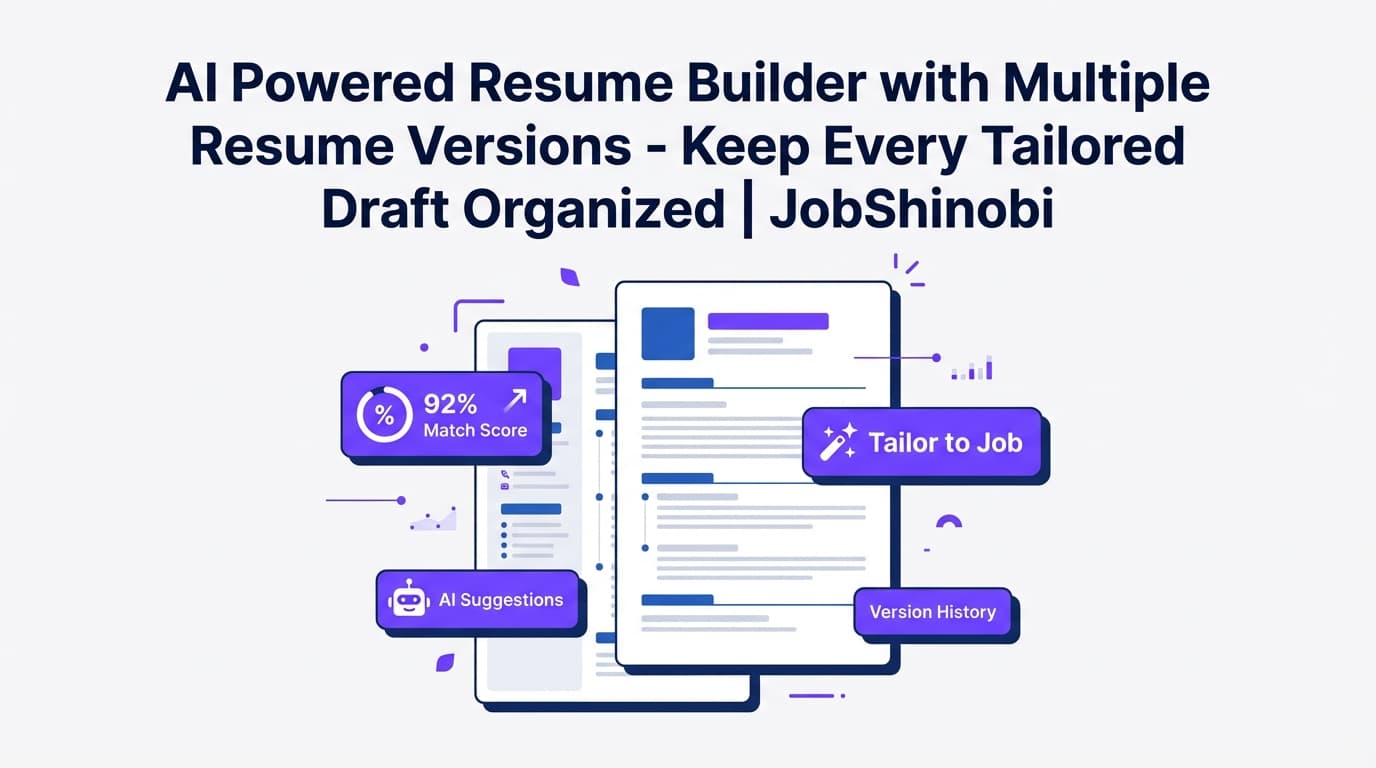
JobShinobi is a job tracking app with resume versions built for job seekers who tailor often and apply in volume. It combines:
- a Job Application Tracker dashboard (with realtime updates and Excel export), and
- a LaTeX resume builder with resume version history—so you can iterate, undo, and revert confidently as your resume evolves across applications.
If your job search currently looks like “a spreadsheet + 27 resume files + no idea which one you sent,” JobShinobi gives you a cleaner system: track the pipeline, version the resume, and keep momentum.
Get started:
- Sign in: /login
- Job tracker: /dashboard/job-tracker
- Resume + versions: /dashboard/resume
Why Choose JobShinobi for Job Tracking + Resume Versions?
Most job trackers are good at logging applications. Most resume tools are good at formatting a document. JobShinobi is designed for what actually happens in a job search: you apply, you learn, you revise, and you apply again—with new variations.
1) A job tracker you’ll actually keep updated (realtime + simple)
JobShinobi’s Job Application Tracker is a dedicated dashboard for managing job applications with:
- fast add/edit/delete workflows
- status updates (e.g., Applied → Interview → Offer → Rejected)
- realtime changes (so your table stays current as you work)
- Export to Excel (.xlsx) when you need a backup or want to do your own analysis
Why this matters: if tracking feels like busywork, you stop doing it. A lightweight tracker with realtime updates makes it easier to keep your system accurate.
2) Resume versions that don’t turn into “final_final_v9.pdf”
JobShinobi’s resume workflow stores your resume as LaTeX source, and supports version history so you can:
- tailor without fear (you can revert)
- compare iterations over time
- keep multiple resume variations organized as separate saved resumes
This is especially useful if you tailor for different role types (e.g., “Frontend,” “Backend,” “Data Analyst”) and want each resume to evolve without losing past versions.
3) AI tooling that’s built into the resume workflow (not a disconnected “scanner”)
JobShinobi includes:
- Resume Analysis (with structured scoring and cached results when the resume hasn’t changed)
- a streaming AI resume editor that can propose edits and update LaTeX while checking compilation
- job description extraction + resume-to-job matching, so you can see keyword gaps and alignment
Why this matters: “resume versions” aren’t helpful if you don’t know why a version is better. Analysis + matching makes versioning more purposeful.
4) Optional email-forwarding automation (Pro gating)
If you want less manual tracking, JobShinobi also supports an email-forwarding workflow that can parse job-related emails and create/update job applications.
Important: Email processing is restricted to Pro members.
How JobShinobi’s Job Tracking + Resume Versions Works
Step 1: Sign in and open your dashboard
Start by signing in via Google OAuth:
- /login
Once signed in, you can access the dashboard areas you’ll use most:
- Job tracker: /dashboard/job-tracker
- Resumes: /dashboard/resume
- Analytics: /dashboard/analytics
Step 2: Track job applications in the Job Application Tracker
In /dashboard/job-tracker, you can:
- add a job application (Job Title, Company, Status)
- edit any entry later
- update statuses as you progress
- delete entries you don’t want to keep
- see lightweight stats like total applications, interviews, offers, and companies
- export your applications to Excel (.xlsx)
Practical tip: Track immediately after applying—or track automatically via email forwarding if you’re Pro (details below).
Step 3: Create multiple resumes (separate “base” variants)
In /dashboard/resume, you can:
- start from a template
- create and manage saved resumes
- duplicate a resume to create a new variant quickly
This is the simplest way to handle “resume versions for different applications” without chaos:
- Create separate saved resumes for major role targets
- Use version history inside each saved resume as you tailor and refine
Recommended resume naming convention (so you always know what you sent):
SWE - Backend - InfrastructureSWE - Frontend - ReactData Analyst - SQL + PythonPM - B2B SaaS
Step 4: Edit, compile, preview, and save (versions are created as you work)
Inside the resume editor (/dashboard/resume/editor), JobShinobi supports:
- editing LaTeX
- generating a PDF preview (via LaTeX compilation)
- downloading PDF and
.tex - saving changes to the database
JobShinobi stores your work in a way that supports resume version history, including versions created during AI-assisted edits.
Step 5: Use AI to improve a version—without breaking LaTeX
JobShinobi includes a streaming AI chat editor for resume editing. The workflow is designed around a tool-style editing loop (e.g., update sections, compile-check, save versions), so you can iterate quickly while keeping the resume buildable.
Common high-impact ways to use the AI editor:
- rewrite bullets to be more quantified
- tighten summaries and skills sections
- tailor a section for a role type (e.g., frontend vs backend)
Step 6: Match your resume to a job description (and create a better version on purpose)
When you have a specific posting, you can:
- paste a job description or provide a URL for extraction
- run resume-to-job matching
- review missing/present keywords and alignment suggestions
- implement changes back in the editor to produce a new tailored version
Step 7 (Optional, Pro): Forward job emails to auto-create/update applications
If you’re Pro, JobShinobi can process forwarded emails via an inbound email parsing pipeline.
How it works in practice:
- After subscription activation, JobShinobi provisions a unique forwarding email address (e.g.,
[email protected]). - Forward job-related emails (confirmation, interview invite, rejection, etc.) to that address.
- JobShinobi attempts to extract structured fields like company, job title, status, and optional details (location, salary, job URL, additional info).
- It uses fuzzy matching to update an existing application when possible (instead of duplicating entries).
You can also see a “Processing Email” indicator in the tracker while emails are being processed.
Key Features for a Job Tracking App with Resume Versions
| Feature | What It Does | Why It Matters |
|---|---|---|
| Job Application Tracker dashboard | Track applications (add/edit/delete) with statuses | Keep your pipeline accurate and actionable |
| Realtime tracker updates | Updates job tracker changes instantly | Less friction; your view stays current |
| Export to Excel (.xlsx) | Exports job applications to an Excel file | Backup, reporting, sharing, or your own analysis |
| LaTeX resume builder | Create and manage resumes as LaTeX source | Precise formatting control and consistency |
| Resume templates library | Start from templates stored in the app | Faster setup and standardized structure |
| Resume version history | Stores versions so you can revert and iterate | Tailor confidently without losing a “good” version |
| Streaming AI resume editor | Chat-based editing that updates LaTeX with compile checks | Faster iteration without breaking the document |
| Resume analysis (Comprehensive + Enhanced) | Generates structured feedback and scores; can return cached results if unchanged | Improve systematically and avoid re-running the same analysis |
| Job description extraction + resume match | Extracts job details and computes match insights (keywords present/missing) | Tailor with clarity instead of guesswork |
| Job search analytics dashboard | Computes response rates, interview conversion, and trends | See what’s working and adjust your strategy |
| Email forwarding ingestion (Pro) | Parses forwarded job emails to create/update applications | Reduces manual tracking work |
How JobShinobi’s Resume Version History Helps (Real Use Cases)
Use case A: You want 3 “base resumes,” not 30 messy files
A practical approach:
- Create 3–6 saved resumes (base variants)
- Tailor using version history inside each base
- Revert quickly when a “tailor” makes your resume worse
This prevents over-fragmentation while still supporting role-specific targeting.
Use case B: You made a big edit and want to undo without losing progress
Version history is useful when you:
- try a new summary angle
- restructure a skills section
- experiment with different bullet styles
You can keep momentum by reverting, instead of rebuilding from scratch.
Use case C: You want consistent formatting while iterating content
Because JobShinobi is LaTeX-based with PDF preview, you can change content frequently while keeping a consistent structure.
Job Tracking App with Resume Versions vs. Common Alternatives
Alternative 1: Spreadsheet + folders of resumes
Works when: you apply to a few roles and rarely tailor.
Breaks when: you tailor in volume and can’t remember what you sent.
Where JobShinobi is stronger:
- resume version history (instead of file chaos)
- job tracking UI with realtime updates
- Excel export when you want the spreadsheet anyway
Alternative 2: A job tracker that stores documents per application
Some tools emphasize attaching documents to each application.
JobShinobi’s approach is different:
- it focuses on resume version history and iteration in the resume workflow
- it supports multiple saved resumes (variants) you can manage intentionally
- it supports AI analysis + job matching to make each new version more strategic
Important: JobShinobi does not claim a dedicated feature to “assign a specific resume version to each job application record.” If you need that organization, a practical workaround is consistent resume naming (examples above) and/or storing your “sent resume” filename in your own notes system.
Alternative 3: Resume-only tools (no job tracking)
Resume tools can help you generate a document, but they won’t manage:
- pipeline status
- interview progression
- job search metrics
- application history export
JobShinobi gives you the tracking layer plus the resume iteration layer.
Suggested “Simple System” for Tracking Applications + Resume Versions (Without Extra Complexity)
If you want a reliable system that matches what JobShinobi supports today:
- Keep 3–6 saved resumes max (base variants)
- Use version history inside each base resume for tailoring
- Name resumes clearly (role + focus + optional location/industry)
- Track applications immediately in /dashboard/job-tracker
- Export to Excel monthly if you want a portable archive
- If you’re Pro, forward job emails to reduce manual entry
This keeps your job search organized without requiring a complicated CRM workflow.
Pricing
JobShinobi offers paid subscriptions via Stripe:
- Monthly: $20.00
- Yearly: $199.99
Manage subscription access here:
- /subscription
Note: JobShinobi’s subscription handling uses Stripe webhooks for membership activation. (Some UI pages may include placeholder checkout links, so the most reliable source of plan pricing is the plan definitions used by the app.)
Frequently Asked Questions
What makes JobShinobi a “job tracking app with resume versions”?
JobShinobi includes:
- a Job Application Tracker dashboard for managing applications, and
- a resume workflow with resume version history, so you can iterate and revert as you tailor your resume over time.
Can I keep multiple resume versions for different roles?
Yes. You can create multiple saved resumes (separate variants), and each resume can maintain version history as you edit and save.
Can I attach a resume version to a specific job application in the tracker?
JobShinobi supports job tracking and resume version history, but it does not claim a built-in “attach this resume version to this application” feature. A practical approach is:
- create role-based resume variants (saved resumes),
- use consistent naming so it’s obvious what you sent.
Does JobShinobi export my job tracker data?
Yes—JobShinobi can export your tracked applications to Excel (.xlsx).
Does JobShinobi update the job tracker in realtime?
Yes. The job tracker supports realtime updates, so changes to your job application records can appear immediately.
How does the AI resume editor work?
JobShinobi includes a streaming AI resume editor that can propose edits and update your LaTeX resume while checking compilation. This helps you iterate quickly without breaking formatting.
Does JobShinobi analyze my resume and give scores?
Yes. JobShinobi has resume analysis (including comprehensive and enhanced modes), and can return cached results when the resume hasn’t changed.
Can JobShinobi match my resume to a job description?
Yes. You can paste a job description or provide a job URL for extraction, then run resume-to-job matching to identify keyword gaps and alignment suggestions.
Can JobShinobi auto-track applications from email?
JobShinobi supports an email-forwarding ingestion workflow that parses inbound job-related emails and creates/updates applications. Email processing requires Pro membership.
Get Started with JobShinobi Today
If you’re applying a lot and tailoring your resume often, JobShinobi helps you stay organized without spreadsheets and without losing track of resume iterations.
- Sign in: /login
- Track applications: /dashboard/job-tracker
- Create resumes + manage versions: /dashboard/resume
- See job search analytics: /dashboard/analytics
- Subscription: /subscription