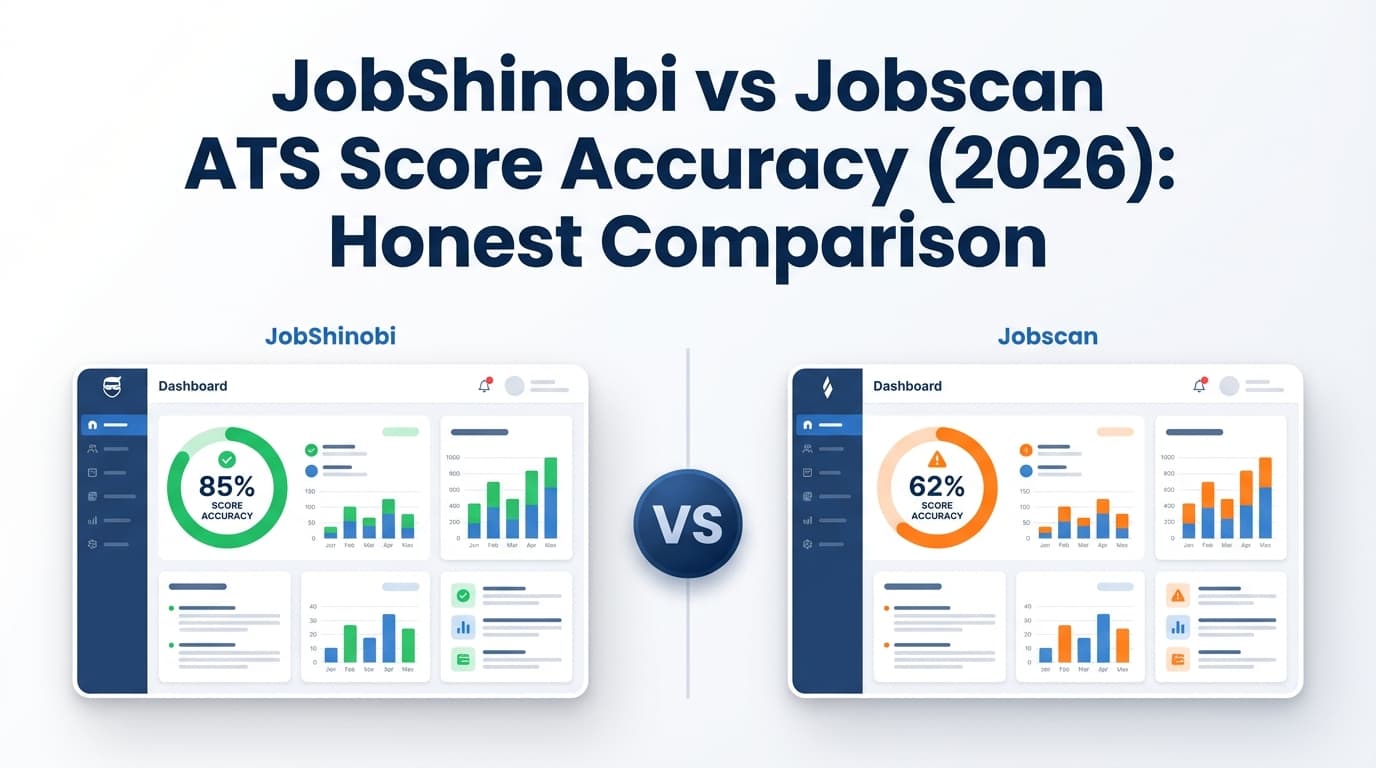
If you’re searching “JobShinobi vs Jobscan ATS score accuracy”, you’re probably not looking for hype—you’re looking for signal:
- Is Jobscan’s “ATS score” (match rate) accurate enough to matter?
- Does JobShinobi’s scoring/matching lead to better applications—or just different numbers?
- Which tool helps you get interviews without wasting time “chasing 100%”?
This comparison is intentionally fair. Jobscan is a well-known player with a big content library and a clear match-rate framework. JobShinobi is built around a different workflow: LaTeX-first resumes + AI scoring/matching + automation for job tracking via email forwarding.
Quick Verdict:
- Choose Jobscan if you want a highly recognized match rate approach, clear “what score should I aim for?” guidance (e.g., 75–80% targets), and an established set of adjacent job-seeker tools (LinkedIn optimization, cover letter generator, job tracker, etc.).
- Choose JobShinobi if you want a resume-building + tailoring workflow with strong structure control (LaTeX) plus resume scoring + job match analysis, and you also want to automate job application tracking (forward emails → tracker updates) instead of manually maintaining a spreadsheet.
TL;DR Comparison
| Feature | JobShinobi | Jobscan |
|---|---|---|
| “ATS score accuracy” model | Resume scoring + ATS/keyword feedback + resume-to-job matching (aimed at actionable improvements) | Match-rate style scoring comparing resume vs job description; publishes score targets (e.g., 75–80%) |
| Best use case | End-to-end workflow: build → score → tailor → track | “Scan and improve” workflow with strong ATS education and widely used match rate concept |
| Resume creation | LaTeX resume builder + live PDF compilation | Primarily resume scanning/optimization; also markets AI resume tools (varies by plan) |
| Version history | Full resume version history + revert/undo workflows | Not commonly positioned as a differentiator (varies) |
| Job tracking | Email forwarding → auto-log and update applications + analytics + Excel export | Job Tracker + Chrome extension to save jobs (publicly listed) |
| Starting price | $20/mo or $199.99/yr | Free plan + paid plans commonly shown as $49.95/mo or $89.95/3 months (~$29.98/mo) |
| Free plan | Limited (core automation gated to Pro) | Free plan includes 5 scans/month (plan page snippet) |
What “ATS Score Accuracy” Actually Means (Important)
Before picking a tool, it helps to define “accuracy.” Most resume scanners do not literally run your resume through the exact ATS your target company uses, with that company’s configuration, parsing rules, and recruiter workflows.
In practice, “ATS score accuracy” typically means the tool is good at:
- Parsing risk detection (formatting/layout issues that can break readability)
- Keyword alignment measurement (does your resume reflect the job’s requirements?)
- Prioritization (which missing requirements matter most?)
- Actionability (can you make changes without wrecking your resume?)
If you treat the score as directional feedback (not truth), you’ll get more value from either product.
JobShinobi Overview
JobShinobi combines three things job seekers often use separately:
- an AI resume builder (LaTeX-first),
- an ATS resume analyzer + job matching, and
- a job application tracker that can be automated by email forwarding.
The workflow is designed for people who want to avoid the two biggest time drains in a job search:
- spending hours rewriting resumes without a clean system for iteration, and
- maintaining a manual spreadsheet of applications and statuses.
Key Strengths
- Email-forwarding job tracking (Pro feature): Forward application emails and JobShinobi extracts job details and updates application status automatically (applied/interview/offer/rejected, etc.).
- LaTeX-first resume workflow: Templates + editor + cloud compilation for reliable PDF output and consistent structure.
- AI resume scoring + job match: Score breakdowns, keyword analysis, and match scoring against a pasted job description or URL.
- Version history (“unlimited undo” style workflow): Makes iterative tailoring less risky because you can revert.
Limitations (honest)
- LaTeX isn’t everyone’s preference: If you want Word/Google Docs editing, there’s a learning curve.
- Automation is gated: Key “magic” features (like inbound email parsing for tracking) are Pro-only, so the free tier is more limited for the full workflow.
Jobscan Overview (ATS Match Rate / Score)
Jobscan is one of the most recognized resume scanning brands. Its core offering is a resume vs job description scan that produces a match rate style score and optimization guidance.
Key Strengths (verified via public sources)
- Clear match-rate targets and education: Jobscan publishes guidance on what match rate to aim for. For example, Jobscan content commonly mentions targets like 75% and in some guidance 80% (e.g., “generally recommend 80%,” while noting many succeed at 75%).
- Example URL surfaced in search: https://www.jobscan.co/blog/what-jobscan-match-rate-should-i-aim-for/
- Free plan with ongoing scans: Jobscan’s plan page snippet shows a free tier that includes 5 scans on signup and 5 scans monthly.
- Plan page (JS-rendered / thin to automated analyzers, but indexed snippet shows details): https://app.jobscan.co/plan
- Broader suite of job-seeker tools: Jobscan has publicly indexed pages for features like:
- One-Click Optimize (AI-assisted tailoring): https://www.jobscan.co/one-click-optimize
- LinkedIn optimization (guide/tools): e.g., https://www.jobscan.co/linkedin-optimization-guide
- AI cover letter generator: https://www.jobscan.co/cover-letter-generator
- Resume bullet point generator: https://www.jobscan.co/resume-bullet-point-generator
- Job tracker + Chrome extension: https://www.jobscan.co/job-tracker and Chrome Web Store listing
Limitations (from reviews + common user concerns)
- Score-chasing is a real risk: The clearer the number, the more people optimize for the number instead of clarity/truth. That’s not unique to Jobscan, but match-rate tools make it tempting.
- Billing/cancellation complaints appear in review ecosystems:
- Trustpilot shows Jobscan with an “Excellent” rating and hundreds of reviews visible at verification time: https://www.trustpilot.com/review/jobscan.co
- Sitejabber shows more mixed ratings and includes complaints about charges after trials in user review snippets: https://www.sitejabber.com/reviews/jobscan.co
Accessibility note: Several Jobscan pages returned HTTP 403 to automated page analysis during verification. Where that happened, this comparison relies on search-indexed snippets, accessible third-party review pages, and accessible public listings (e.g., Chrome Web Store).
Feature-by-Feature Comparison (with ATS Score Accuracy in Mind)
1) Scoring Method: Match Rate vs Multi-Factor Scoring
Jobscan:
- Strong at resume-to-job keyword alignment presented as a match rate.
- Helpful if you like a clear target (e.g., “aim for ~75–80%”).
JobShinobi:
- Provides resume scoring + ATS/keyword feedback and also supports job matching workflows.
- Better suited if you want the “score” to be one signal inside a broader build-and-iterate system (especially with version history).
Winner: Depends
- If your priority is a recognized match rate benchmark, Jobscan wins.
- If your priority is controlled iteration + structure + matching, JobShinobi wins.
2) Formatting & Parse Reliability (where “accuracy” often breaks)
Jobscan:
- Good at flagging ATS-style formatting and keyword gaps—especially for people working from existing resumes.
JobShinobi:
- By being LaTeX-first, JobShinobi nudges you toward consistent structure (which can reduce parsing surprises).
- You can compile and preview output quickly, and keep structure stable while iterating content.
Winner: JobShinobi for “build it clean”; Jobscan for “audit what I already have”
- If you’re rebuilding anyway, JobShinobi can be a cleaner foundation.
- If you want to scan and patch an existing resume fast, Jobscan is convenient.
3) Speed to Tailored Resume
Jobscan:
- Built for scan → adjust → rescan cycles.
- Publicly indexed plan snippets mention “Unlimited One-Click AI Optimizations” on paid tiers (plan page snippet: https://app.jobscan.co/plan).
JobShinobi:
- Combines job extraction + match analysis + an AI resume agent that can modify LaTeX while you keep version history.
Winner: Tie
- Jobscan is fast for repeated scans.
- JobShinobi is strong for safe iteration and managing multiple tailored versions.
4) Job Tracking & Staying Organized
Jobscan:
- Offers Job Tracker and a Chrome extension to save jobs from sites like LinkedIn/Indeed/Glassdoor (per Chrome Web Store listing and Jobscan job tracker page).
JobShinobi:
- Differentiator: email-forwarding automation (confirmation emails, interview scheduling, etc. → auto updates in tracker).
- Includes analytics (response rate, interview conversion) and Excel export.
Winner: JobShinobi
Jobscan tracks jobs, but JobShinobi reduces manual upkeep more aggressively.
Pricing Comparison (Current/Indexed at Verification Time)
| Plan | JobShinobi | Jobscan |
|---|---|---|
| Free | Limited; automation features (email parsing/tracking) are Pro-gated | Free plan shown with 5 scans on signup + 5 scans/month (plan snippet) |
| Monthly | $20/mo | $49.95/mo (plan snippet) |
| Quarterly / Annual | $199.99/year | $89.95 every 3 months (~$29.98/mo) (plan snippet) |
| Trial | Marketed as 7-day free trial (may be configured via billing) | Indexed pages/snippets commonly reference a 2-week free trial (e.g., plan/promos pages in search results) |
Value Analysis:
- If you only need occasional scans, Jobscan’s free 5 scans/month can be enough.
- If you want an integrated workflow (build + score + tailor + track automatically), JobShinobi’s $20/mo can be strong value—especially if tracking time is a bottleneck.
Who Should Choose JobShinobi?
You’ll prefer JobShinobi if you:
- Want to automate job application tracking via email forwarding (instead of updating a spreadsheet).
- Want LaTeX-first structure control and a consistent resume format while iterating.
- Tailor frequently and want version history so you can safely test improvements.
- Prefer an all-in-one system: resume builder + scoring + job matching + tracking + analytics.
Who Should Choose Jobscan?
You’ll prefer Jobscan if you:
- Want a widely recognized match rate framework and clear targets (75–80% guidance).
- Already have a resume and want a scan-and-fix workflow.
- Want extra job-seeker tools (LinkedIn optimization content, cover letter generator, job tracker + extension).
- Want a free plan with recurring scans (5/month) and upgrade only when applying heavily.
Switching from Jobscan to JobShinobi (Practical Considerations)
- Data migration: No one-click import for Jobscan scans. You’ll typically copy the best improvements manually.
- Resume migration: If your resume lives in Word/Docs, plan to rebuild into a JobShinobi template (then iterate).
- Learning curve: Moderate if you’ve never used LaTeX—but version history + AI assistance can reduce friction.
- Best strategy: Use Jobscan to understand job-specific keywords, then use JobShinobi to manage structured tailoring and track outcomes.
FAQ
Is JobShinobi really “more accurate” than Jobscan for ATS scores?
Not in a literal sense—because “ATS score accuracy” isn’t a single measurable truth across all employers.
A better framing:
- Jobscan is excellent for directional keyword alignment and provides clear match-rate targets.
- JobShinobi is excellent for structured iteration and workflow accuracy (you can tailor, keep versions, and track outcomes without losing control).
What match rate should I aim for on Jobscan?
Jobscan’s own published guidance commonly references aiming around 75% and in some content 80% as a recommended target (with the caveat that many users succeed below that). Don’t add keywords you can’t defend.
Are ATS resume scanners reliable?
They’re reliable for certain tasks (keyword gap checks, formatting risk detection) and less reliable for predicting interview outcomes. Use them as diagnostics, not judges.
Which tool is cheaper?
At the time of verification:
- JobShinobi: $20/month (or $199.99/year).
- Jobscan: Free plan available; paid plans commonly shown as $49.95/month or $89.95/quarter (indexed plan snippets).
If I hate score-chasing, what should I do?
Use any score as a checklist starter, then prioritize:
- clean formatting,
- truthful, role-aligned keywords,
- quantified impact,
- and consistent tracking/iteration.
If organization is your weak point, JobShinobi’s automated tracking can improve your job search more than squeezing a score from 78% to 92%.